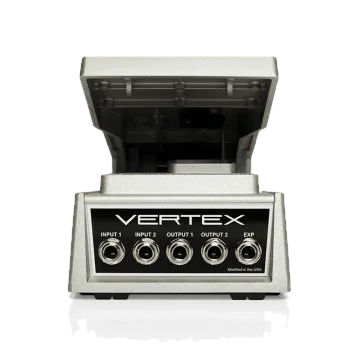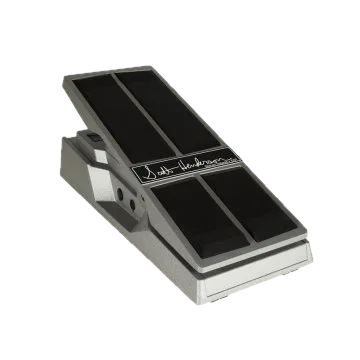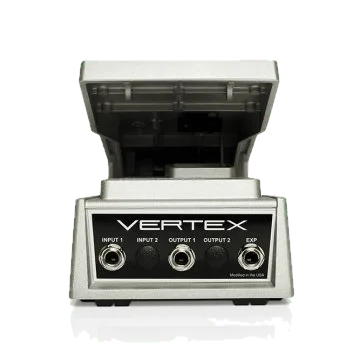
The Vertex Mono Volume Pedal is a passive, hand-wired mono volume pedal: a rocker pedal that sits in your signal chain and sets your volume with your foot, with no power supply, no battery and no active circuitry in the path. Vertex describes it as "the most transparent passive volume pedal available," saying the design lets "the organic tone and dynamics of your instrument" flow through1.
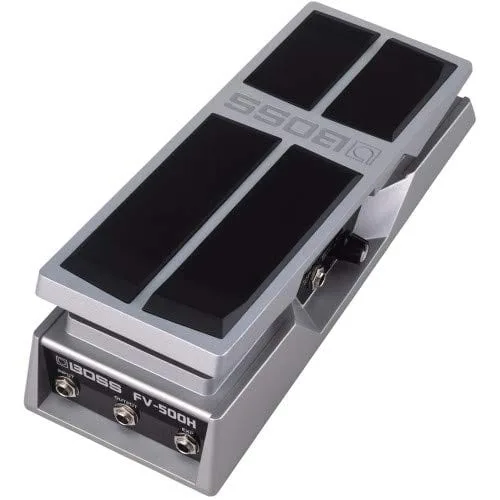
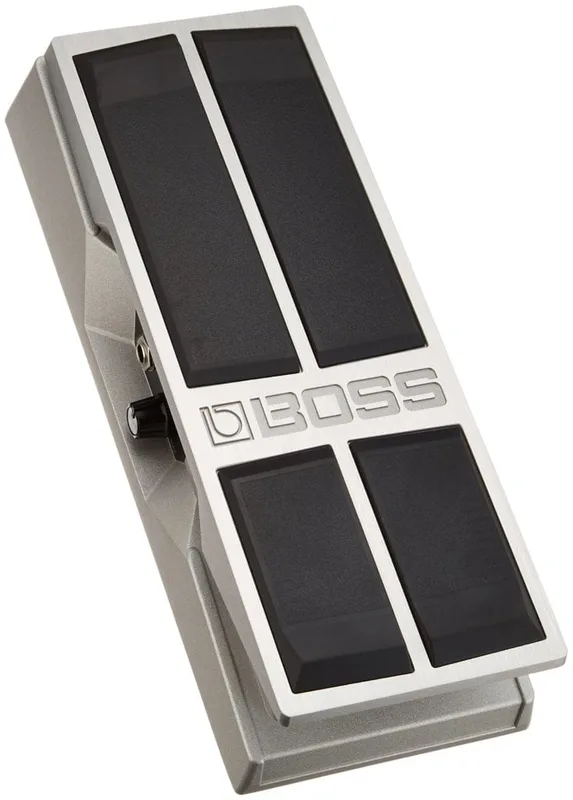
Two details set it apart from most volume pedals. First, Vertex states the unit is "100% Handwired, Point-to-Point" and "Modified in California," so it is not a stock imported build1. Second, the circuit is deliberately simple: Vertex says it "simplifies the Boss FV-500 volume pedal circuit to its fewest components," taking the circuit of the well-known Boss FV-500H and Boss FV-500L family and stripping it back1.
What it does and how it works
A passive volume pedal works like the volume knob on your guitar, only under your foot. Because the pedal is 100% passive, it needs no power: no battery, no adapter, no current draw, and nothing to plug into a daisy chain1. That also means it behaves differently from active or sensor-based designs, which do require power to run. A passive pedal like the Vertex removes one cable and one point of failure from a board.
The trade-off with passive designs is that the pedal's potentiometer value has to suit the instruments and pedals around it. Where the Vertex differs is in its construction: the hand-wired, point-to-point build and the simplified FV-500-based circuit are the maker's answer to keeping the path short1.
Mono operation and where it fits
The pedal is listed as Mono Operation, so it carries one signal1. For a standard guitar-to-amp setup that is all you need. If you run two amps or a stereo rig, Vertex also makes a Vertex Stereo Volume Pedal for that job1.
Like most volume pedals in its class, it can do more than set level. JHS Pedals' buying guide notes that "You can also use a basic pedal like the passive Mono Ernie Ball Volume Pedal as an expression pedal," by connecting it to a pedal's expression jack with splitter cables2. The same trick applies to passive volume pedals generally, which makes one pedal useful for both volume and effect control.
How it compares
Volume pedals divide into passive and powered designs. The Vertex Mono Volume Pedal is passive and needs no power; powered designs such as sensor-based pedals require an external supply to run.
- Passive, no power: the Vertex Mono Volume Pedal runs without power1.
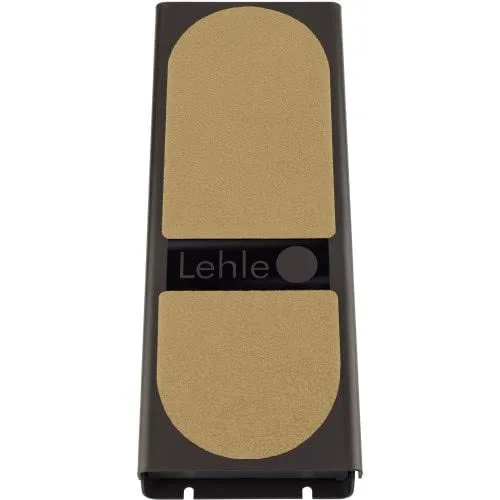
- Powered, sensor-based: in a roundtable on volume pedals, Grant Klassen of Goodwood Audio, Brian Omilion of Omilion Audio, Mason Marangella of Vertex Effects and Joki Schaller of Lehle described sensor-based designs as having "no gear, no string, no mechanical friction," with volume changed "without any gear part whatsoever"3.
- Same family: Vertex's own Stereo Volume Pedal covers stereo rigs with the same approach1.
Support and buying terms
Vertex backs the pedal with a lifetime warranty and a 30-day money back guarantee return policy, both stated on the maker's product page1. A product manual is available as a PDF download from Vertex1.
Questions
Is the Vertex Mono Volume Pedal passive?
Yes. Vertex describes it as 100% passive, meaning it needs no power to work: your guitar's signal passes through the pedal's circuit and the rocker pedal sets the level. Because there is no active circuitry, there is no battery or power supply to wire up, and the pedal simply sits in your signal chain where you want hands-free volume control.
What is the Vertex Mono Volume Pedal based on?
Vertex says the design simplifies the Boss FV-500 volume pedal circuit to its fewest components. The idea is to strip the circuit back so that as little as possible stands between your instrument and the output, which the maker says lets the organic tone and dynamics of the instrument flow through.
Does the Vertex Mono Volume Pedal need a battery or power supply?
No. The pedal is 100% passive according to Vertex, so it runs without a battery or an external power supply. That is in contrast to some other volume pedals: the manual for the Lehle Mono Volume 90, for example, states that an external power supply is required for that pedal.
Is the Vertex Mono Volume Pedal mono or stereo?
It is a mono pedal. Vertex lists it as Mono Operation, so it carries a single audio signal and suits a standard one-cable guitar or bass setup. Players running two amps or a stereo rig would need a stereo volume pedal instead, such as the Vertex Stereo Volume Pedal.
What warranty does the Vertex Mono Volume Pedal have?
Vertex offers a lifetime warranty on the Mono Volume Pedal, along with a 30-day money back guarantee return policy. Both are stated on the maker's own product page, so the pedal is covered for as long as you own it under the maker's warranty terms.
Sources (3)
- Mono Volume Pedal, www.vertexeffects.com
- HOW TO USE A VOLUME PEDAL, JHS Pedals
- Why EVERY Guitar Player Needs LEHLE On Their Pedalboard, vertexeffects.com, 2024-10-15