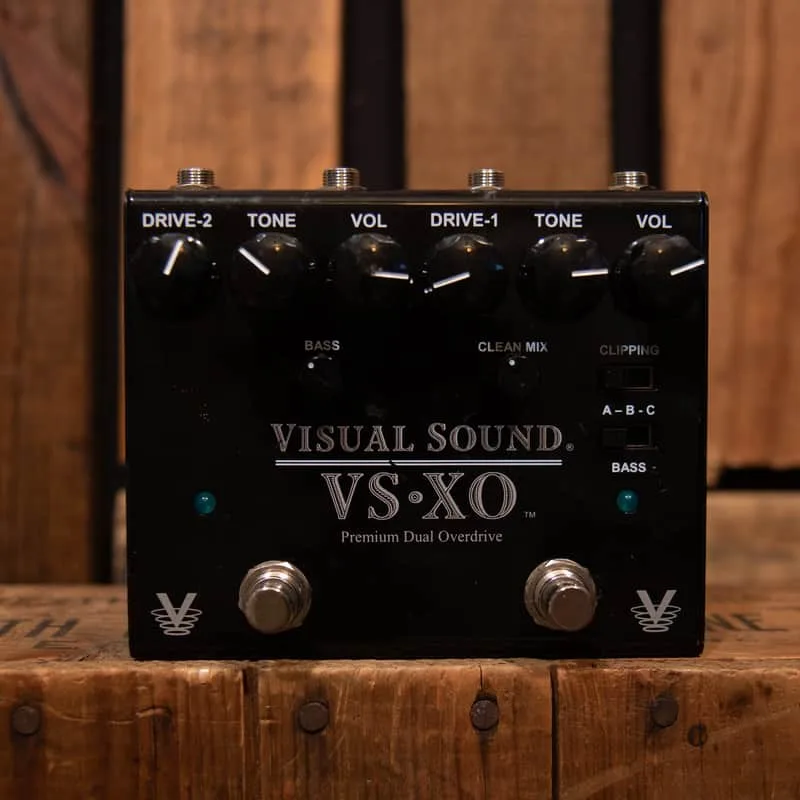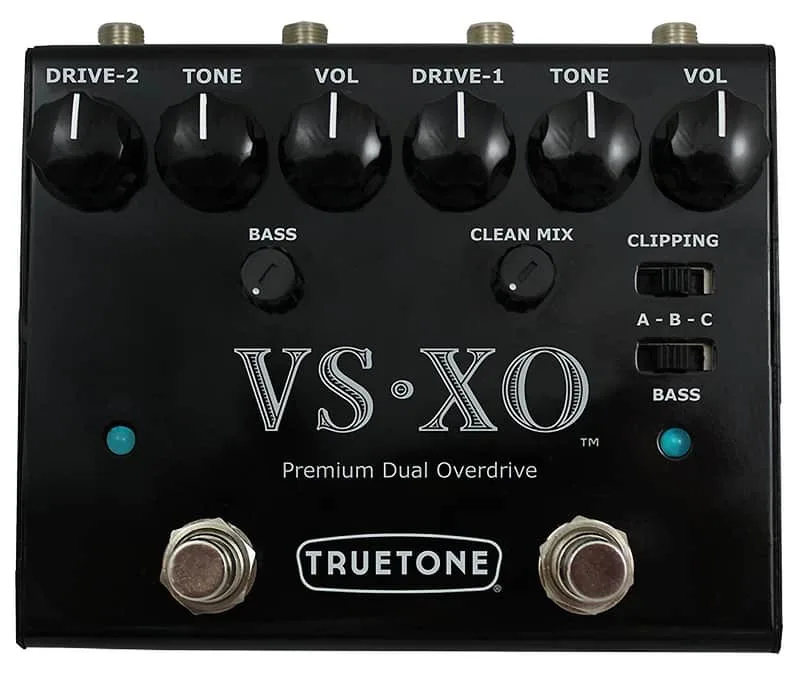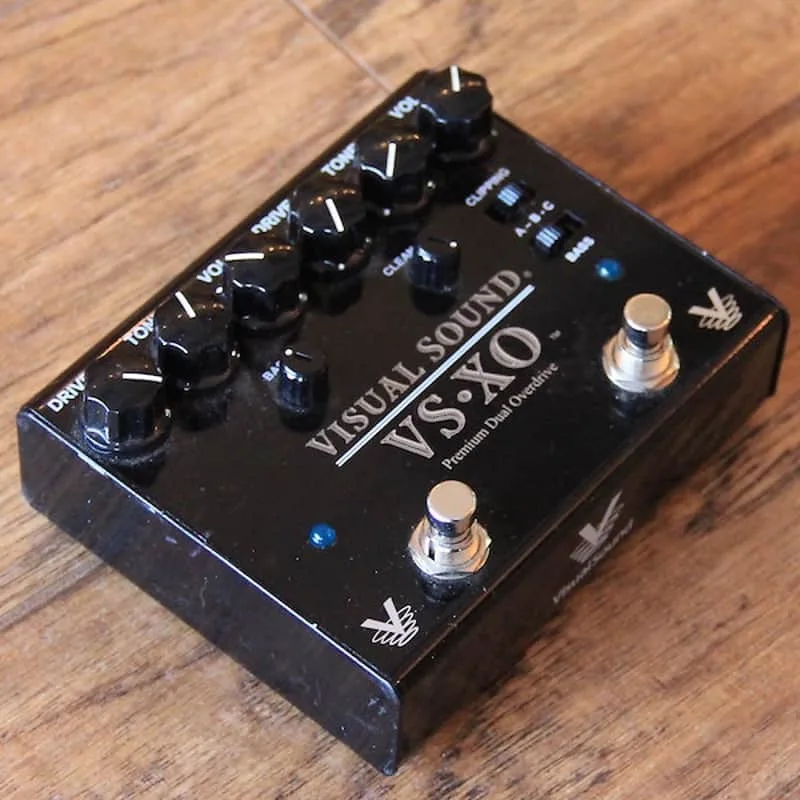


The Visual Sound VS-XO is a dual-channel overdrive pedal: two independent overdrive circuits in one enclosure, each with its own footswitch, controls and jacks, usable separately or stacked together1. Visual Sound announced it in September 2013 as the VS-XO Premium Dual Overdrive, and it shipped around mid-November that year2.
The two channels are voiced differently on purpose. According to the maker, one channel is open and amp-like with a sweeping bass control, while the other is tighter, with enhanced mid-range presence so it cuts through a dense mix3. Premier Guitar's announcement described the right channel as having pronounced mids without being honky, and the left channel as having flat mids, making it sound very amp-like2. Guitar World's reviewer found the range runs from clean boost and subtle crunch through amp-like grind to fat, compressed distortion1.
Visual Sound changed its company name to Truetone in 2015, and the VS-XO now sits in the Truetone V3 Series archive, so it is no longer a current product3. See the Truetone VS-XO page for the later version.
A dual overdrive with two different voices
The VS-XO's core idea is giving a player two overdrives that complement rather than duplicate each other. Guitar World's review described it as two individual overdrive circuits that players can use separately or together, with the right section having an EQ curve with boosted midrange and the left section a flat midrange EQ1.
That split maps to how many players actually use two overdrives: a flatter, more open channel as the foundation, and a mid-boosted channel to push the front end or cut through a band. The maker's own description of the current Truetone archive page frames it the same way: one channel open and amp-like with a sweeping bass control, the other tighter with enhanced mid-range presence for cut in a denser mix3.
Each section has its own set of inputs and outputs, which allows each section to be used and engaged separately, reordered in the signal chain, or run with a single cable like a normal dual pedal1. Premier Guitar noted the separate ins and outs also suit use with a switching system2.
The switching itself was a design point. Bob Weil, Visual Sound's founder, invented new footswitches that look traditional but interact with gold-plated relays, and RG Keen invented a circuit to keep them quiet2. The VS-XO was the first Visual Sound pedal to incorporate true bypass2.
The controls on each channel
The two channels are laid out with different control sets, matching their different jobs132.
| Channel | Controls | Voicing |
|---|---|---|
| Overdrive 1 (right) | Drive, Tone, Volume, Clean Mix, 3-way Clipping (diodes) switch, 3-way Bass switch | EQ curve with boosted midrange2 |
| Overdrive 2 (left) | Drive, Tone, Volume, rotary Bass control | Flat midrange EQ1 |
The right channel's Clean Mix knob blends your clean signal with the overdriven one, and its 3-way clipping switch selects between diode configurations, which changes the character and compression of the drive21. The 3-way bass switch shapes the low end in three steps, while the left channel handles bass with a single rotary knob2.
Guitar World's reviewer found the tone shaping versatile overall, covering clean boost, subtle crunch, amp-like grind and fat, compressed distortion, with shades in between1.
Bypass and the Pure Tone buffer
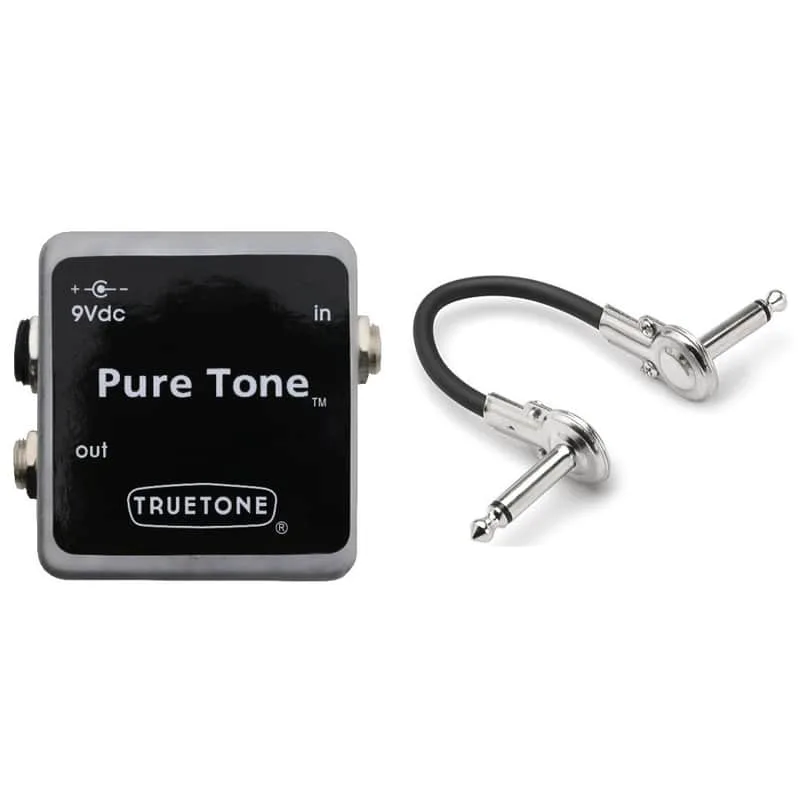
Each channel's bypass mode is independently selectable: true bypass, or buffered through the Pure Tone circuit3. The Pure Tone buffer can also be internally switched on or off for each channel2.
This per-channel choice is the practical point. A player who wants the second channel to drive a long cable run or a later pedal can leave that channel buffered while keeping the first true bypass, or run both either way. The same internal Pure Tone buffer on/off arrangement appeared on the later Truetone V3 Jekyll & Hyde, Guitar World's Paul Riario noted4.
Where it came from
Visual Sound announced the VS-XO as a premium overdrive, with Bob Weil designing new foot-switches that look traditional but interact with gold-plated relays, and RG Keen inventing a circuit to keep them quiet5. The pedal was slated for release around mid-November 20132.
The VS-XO was announced in September 20132 and was expected to ship by mid-November 20132. Guitar World reviewed it in April 20141. After Visual Sound renamed itself Truetone in 2015, the pedal was carried in the V3 Series archive3. The V3 generation of the company's dual pedals continued with models like the V3 Route 66 American Overdrive, which added a two-position voice switch varying the overdrive tone between bright and open, or more saturated67.
Videos
Sweetwater
Truetone
Shawn Tubbs
Questions
Is the Visual Sound VS-XO true bypass?
Yes. The VS-XO was the first Visual Sound pedal to incorporate true bypass, using gold-plated relays rather than a conventional bypass switch. Each channel can also run buffered through the Pure Tone circuit instead, and the choice is made independently per channel.
Can the VS-XO channels be used separately?
Yes. Each of the two overdrive circuits has its own set of inputs and outputs, so the channels can be used completely separately, run in either order, or integrated into a switching system. A single cable also works for normal dual-pedal use with both channels in series.
Is the VS-XO the same as a Truetone pedal?
Visual Sound changed its company name to Truetone in 2015, and the VS-XO later appeared in the Truetone V3 Series archive. It is the same pedal line under the maker's later name, no longer a current product.
Can the Pure Tone buffer be turned off on the VS-XO?
Yes. The Pure Tone buffer is internally switchable on or off for each channel independently. That means one channel can run true bypass while the other stays buffered, depending on where each sits in your signal chain.
Does the VS-XO have a warranty?
Yes. The VS-XO is covered by the Visual Sound Lifetime Warranty, which applied across the company's V2 and V3 series pedals. After the 2015 rename, the same coverage continued under the Truetone name.
Sources (7)
- Review: Visual Sound VS-XO Premium Dual Overdrive Pedal, Guitar World, 2014-04-28
- Visual Sound Announces VS-XO Dual Overdrive, Premier Guitar, 2013-11-15
- V3 VS-XO Premium Overdrive, Truetone, 2026
- Review: Truetone V3 Jekyll & Hyde Overdrive Distortion Pedal, Guitar World, 2015-08-13
- Visual Sound Introduces VS-XO Premium Dual Overdrive Pedal, Guitar World, 2013-09-19
- Visual Sound Launches V3 Route 66 American Overdrive, Vintage Guitar magazine, 2014-11-27
- Visual Sound Launches V3 Route 66 American Overdrive, Premier Guitar, 2014-11-21