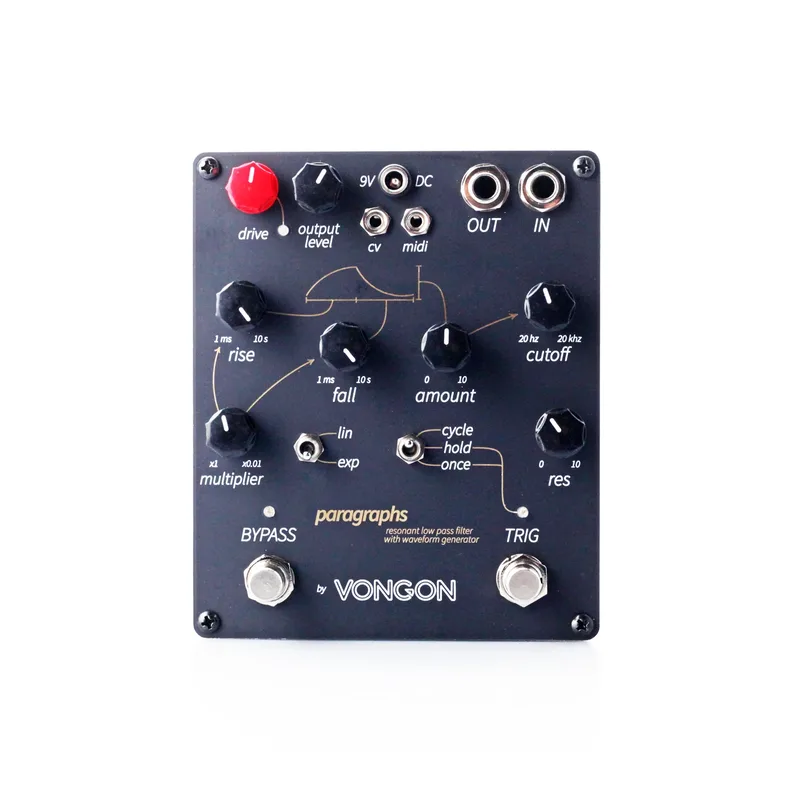


The Vongon Paragraphs is an analog four-pole resonant low pass filter pedal with its own attack, decay (AD) envelope generator, built for shaping harmonics rather than adding overdrive of its own. Vongon describes it as the company's "original resonant filter" with an "onboard envelope generator with vintage character"1. The filter sweeps your signal's high end from open and clear down to dark and muffled, and the resonance control can push it into self-oscillation, so it behaves more like a synthesizer's filter section than a typical guitar stompbox.
The heart of the filter circuit is the AS3320 analog chip, a modern replica of the component used in the Sequential Prophet 5, the Pro-One mono-synth, the Elka Synthex, and the LinnDrum2. That lineage puts the Paragraphs in the same filter family as classic analog synths rather than the state-variable designs common in envelope filter pedals.
The original Paragraphs is discontinued, with a final batch available and in stock, ready to ship from the USA1. It has been replaced by the Paragraphs II, covered below.
What it does to your sound
A low pass filter lets everything below its cutoff frequency through and rolls off everything above it. With the cutoff wide open the Paragraphs is essentially transparent; sweep it down and your tone darkens, thins, and finally disappears into a murmur. Add resonance and the filter emphasizes the frequencies right at the cutoff, from a gentle vocal quack to a whistling, synth-like peak.
Because the resonance starts to self-oscillate at about seventy percent of its range, the filter can sing on its own, producing a pitched tone independent of what you feed it3. That is the behavior players seek out in vintage synthesizer filters, and it is what separates a resonant filter like this from a simple tone control or EQ.
The envelope generator is the other half of the pedal. Instead of only moving the cutoff by hand, the Paragraphs can sweep it automatically each time you play a note, in the style of an auto-wah but with the full four-pole character of the filter underneath123.
The controls
The control set is built around the filter and its envelope:
| Control | What it does |
|---|---|
| Cutoff | Spans the full audio spectrum, from fully open to fully closed23 |
| Resonance | Emphasizes the cutoff frequency; self-oscillates at about seventy percent3 |
| Gain | Boosts lower-level signals, or drives any instrument to a clipping fuzz3 |
| Input (drive) / Output level | Dedicated controls for moving between a clean tone and a driven one3 |
| Envelope generator (attack, decay) | Sets how the filter sweeps when triggered21 |
The gain stage is worth noting for players who pair filters with dirt. A gain knob that can both boost quiet signals and drive an instrument into clipping fuzz means the Paragraphs can feed itself harmonically rich material, and Vongon's own description of the filter family says this kind of low-pass filter "excels at adding character to harmonically complex, fuzzed, and distorted signals"4. Running it after a fuzz or distortion pedal is the classic arrangement for that reason.
The envelope generator itself covers an unusually wide range of frequencies. Pedal of the Day describes modulations "starting as low as 0.05 hz for slowly evolving 20 second long cycles, and reaching up to (and past) the audio threshold at 300 hz for a wave shaping effect similar to sounds found on west coast style synthesizers"2. At the slow end that means gradual, evolving sweeps over tens of seconds; at the fast end the filter's motion enters the audible range itself and becomes a form of wave shaping.
The pedal also carries an extra "Trig" footswitch, which starts an LFO cycle in different ways depending on the mode selected3.
Power, CV and MIDI connections
The Paragraphs runs on 9 to 9.6 VDC, center negative, through a 2.1mm DC connector, with a maximum current draw of 100mA3. There is no battery option implied by that spec, and 100mA is more than a small analog pedal typically draws, so plan a dedicated output on your power supply rather than sharing a daisy chain.
For control, the pedal offers inputs for control voltage (CV) and MIDI, which can remotely trigger the envelope generator3. That means an external source, whether a synth, a sequencer, or a MIDI controller, can fire the filter's sweep on cue rather than relying on your picking dynamics alone. The jacks accept both instrument and line level signals, so the pedal sits happily in a guitar rig or a studio setup with synths and line-level gear3.
Paragraphs II: what changed
In 2024 Vongon released the Paragraphs II, the updated version of the company's very first product3. It is a substantial redesign rather than a reissue:
| Paragraphs | Paragraphs II | |
|---|---|---|
| Price | $249.00 USD1 | $449.00 USD5 |
| Signal | Mono, instrument or line level3 | Stereo inputs and outputs5 |
| Bypass | True bypass3 | Buffered bypass5 |
| Presets | None stated | 9 onboard presets4 |
| MIDI | Triggering the envelope3 | Control of every parameter4 |
| Enclosure | 5.7" x 4.7" x 1.5"3 | Walnut block, CNC routed, hand sanded and polished4 |
The II keeps the four-pole resonant low-pass design but builds it around what Vongon calls "the same rich ladder-style filter found in our replay synthesizer"4, replacing the original's AS3320 chip. It adds modulation functions that respond to playing dynamics and add stereo depth, with a follower mode for dynamic auto-wah and ducking effects, a trigger mode that fires the envelope from transients passing a threshold, and a cycle mode that turns the envelope into an LFO for rhythmic, synth-like effects43. It runs on 9 VDC center negative at 200mA, with a 3.5mm MIDI input (Type B) and a 3.5mm control voltage input accepting 0 to 3.3 volts5.
Delicious Audio's Paolo De Gregorio summed up the II on its release:
"The Paragraphs II looks like a fun new entry for the creative-oriented guitarist and synthesist."3
Videos
Vongon
Vongon
Vongon
Questions
Is the Vongon Paragraphs discontinued?
Yes. Vongon lists the original Paragraphs as discontinued, with a final batch available and in stock, ready to ship from the USA. It has been succeeded by the Paragraphs II, an updated stereo version released in 2024 at $449.00 USD.
Does the Paragraphs filter self-oscillate?
Yes. According to Delicious Audio, the resonance control starts to self-oscillate at about seventy percent of its range, meaning the filter can produce its own pitched tone without an input signal, like a synthesizer filter pushed hard.
Can you trigger the Vongon Paragraphs with MIDI or CV?
Yes. The Paragraphs has inputs for control voltage and MIDI that can remotely trigger the onboard envelope generator, so an external source can fire the filter sweep in time with your playing or a sequencer.
What power does the Vongon Paragraphs need?
It runs on 9 to 9.6 VDC, center negative, through a 2.1mm DC connector, drawing up to 100mA. That current draw is high for a compact analog pedal, so a dedicated spot on a power supply is safer than a shared daisy chain.
Is the Vongon Paragraphs true bypass?
Yes, the original Paragraphs is true bypass. The Paragraphs II differs here: it uses buffered bypass instead, which keeps the signal path consistent when the effect is off.
What is the difference between Paragraphs and Paragraphs II?
The Paragraphs II is the 2024 update of Vongon's first product. It adds stereo inputs and outputs, playing-dynamics-responsive modulation, nine onboard presets, MIDI control of every parameter, a walnut enclosure, and buffered bypass instead of true bypass, at $449.00 versus $249.00.
Sources (5)
- VONGON PARAGRAPHS, Vongon (www.vongon.com)
- Vongon Paragraphs Resonant Low Pass Filter, Pedal of the Day, 2024-06-08
- Updated Pedal: Vongon Paragraphs II Resonant Filter, Delicious Audio, 2024-10-22
- VONGON PARAGRAPHS-II, Vongon
- VONGON PARAGRAPHS II, VONGON