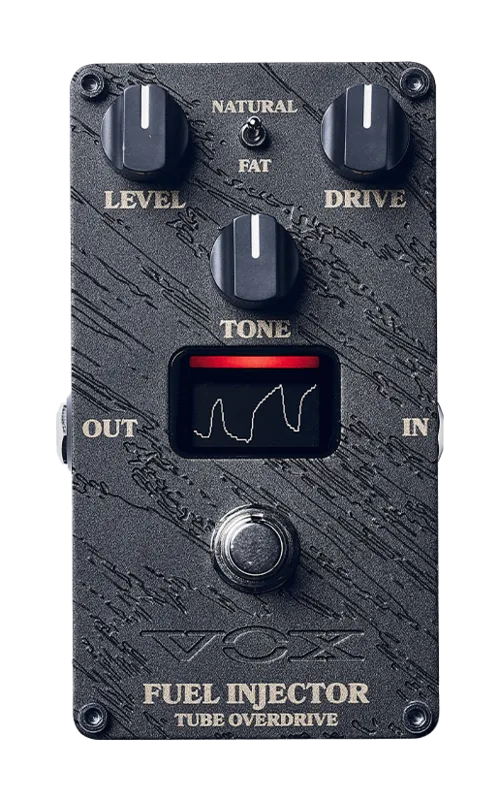


Vox describes the Fuel Injector as offering "a distinctive overdrive with clean characteristics, rich harmonics, and a natural sense of compression and bite," and says the pedal "stands out for its amp-like distortion"1. In other words, it is not a smooth, transparent boost so much as an overdrive with its own voice, one that reviewers found leans aggressive rather than silky.
What it does: a Nutube overdrive with bite
The Fuel Injector's sound comes from the Nutube at its heart. To get the most out of that tube, Vox designed a dedicated, newly developed buffer circuit at the pedal's initial stage, which the company describes as essential for harnessing the Nutube's full potential1. When you switch the effect off, the Nutube keeps working: it functions as a buffered bypass, which Vox says provides a natural response and a light feel1.
What that means in practice was spelled out by the press. Guitar Player's reviewer, Dave Hunter, called it "an original overdrive with a distinctively aggressive character when pushed," crediting it with good note-to-note clarity, a raspy bark and aggression at the core, and "a little fizz at the edge of the note hinting toward old-school '70s distortions"3. His one caution was that it "might be a little hard-edged for players seeking smoother TS-style overdrive"3.
"An original overdrive with a distinctively aggressive character when pushed."
Guitar World's review of the 2nd Series took a similar view of the pedal's voice controls, noting that while the Tone knob is limited, engaging the Fat toggle lets users dial in an attractive midrange bump4.
The controls: Natural and Fat modes
The control layout is a familiar three-knob setup plus one voice switch. Guitar World described it as "a typical three-knob (Level, Drive, Tone) configuration plus a Natural/Fat toggle"4, and Guitar Pedal X's launch coverage listed the controls as Level, Voice (Natural/Fat), Drive and Tone5.
| Control | What it does |
|---|---|
| LEVEL | Controls the output volume1 |
| DRIVE | Sets the amount of overdrive5 |
| TONE | Adjusts the high-frequency content1 |
| Switch (Natural/Fat) | Chooses between the two voice modes1 |
The two modes give the pedal two distinct characters, and Vox is specific about who each one is for15:
- NATURAL: Vox calls this "the fundamental mode"1
- FAT: "Delivers a thicker tone, ideal when combined with single-coil pickups"1
That Fat mode is the practical answer for anyone finding the Natural voice too lean with a Strat or Tele: it thickens things up and, as Guitar World found, adds an attractive midrange bump4. The Tone control's range is the one limitation reviewers pointed out, with Guitar World calling the knob limited4.
Power and connections
The Fuel Injector connects simply: one monaural phone jack in, one monaural phone jack out, and a DC 9V power terminal1. Power comes from either a 9V alkaline battery (6LF22/6LR62) or a DC 9V AC adapter, with both sold separately; Vox's own adapter is the KA181 (9V)1.
Vox recommends using an AC adapter rather than a battery, because the unit's power consumption is relatively high1. If you run it on a battery, expect to go through 9V alkalines.
Physically, the pedal measures 72mm x 120mm x 55mm with the plug retracted and weighs 300 g excluding batteries1. The top panel of the new Valvenergy chassis carries an etched design inspired by the unique sound of each effect pedal in the series1.
Where it came from
Videos
VOX Amps
VOX Amps
Questions
Does the Vox Fuel Injector run on a battery?
Yes. It runs on 9V alkaline batteries (6LF22/6LR62) or a DC 9V AC adapter, both sold separately. Vox recommends the adapter because the unit's power consumption is relatively high, so a battery is a backup rather than the best way to power it.
Is the Vox Fuel Injector true bypass?
No. When the effect is deactivated, the Nutube itself functions as a buffered bypass, which Vox says provides a natural response and a light feel. Vox also designed a dedicated buffer circuit at the pedal's initial stage to harness the full potential of the Nutube.
Does the Vox Fuel Injector use a real tube?
It uses a Nutube, the vacuum tube component developed by Korg and Noritake that Vox builds its Valvenergy pedals around. The Fuel Injector is part of the Valvenergy 2nd Series announced at NAMM 2024, and the Nutube handles the tube-like response and harmonics.
How much does the Vox Fuel Injector cost?
Guitar Player listed it at $199.99 street in its review. At the time of the pedal's announcement in January 2024, UK pricing was still to be confirmed.
Where is the Vox Fuel Injector made?
Guitar Player's review lists the Fuel Injector as assembled in Vietnam. It is developed by Vox, the amp manufacturer, as part of the Valvenergy 2nd Series.
Does the Vox Fuel Injector sound like a Tube Screamer?
Not really. Guitar Player's reviewer found it an original overdrive with a distinctively aggressive character when pushed, and noted it might be a little hard-edged for players seeking a smoother Tube Screamer-style overdrive. Its character leans toward raspy bark and aggression rather than a smooth midrange.
Sources (5)
- FUEL INJECTOR, Vox Amps (voxamps.com), 2024-05-24
- Vox issues Valvenergy Power Burst, Tone Sculptor, Fuel Injector & Smooth Impact pedals, Guitar World, 2024-01-19
- Vox Valvenergy pedals reviewed, GuitarPlayer (www.guitarplayer.com), 2024-11-11
- Vox Valvenergy 2nd Series pedals review, Guitar World, 2025-01-02
- Guitar Pedal X, Guitar Pedal X, 2024-01-25