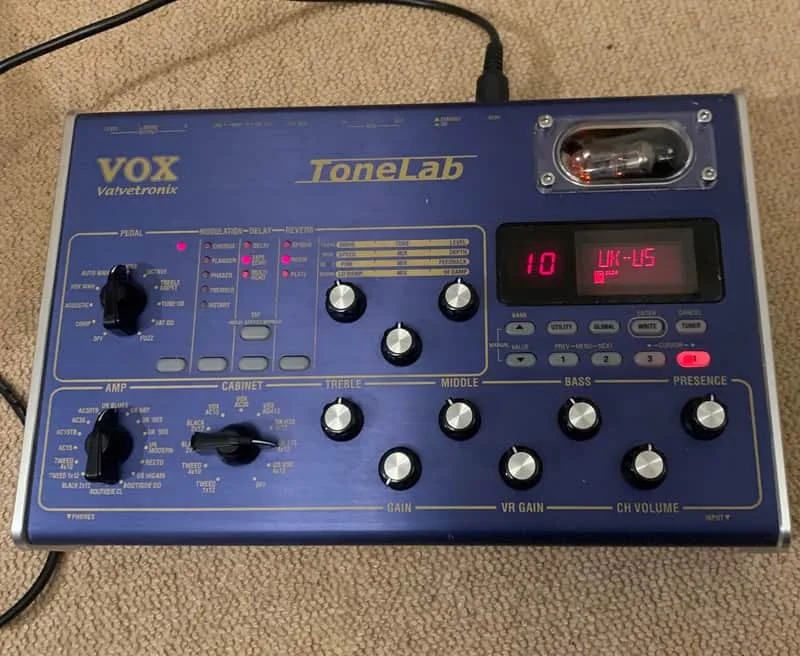


The Vox Valvetronix Tone Lab is a Modeling Valve Guitar Preamp from Vox, a spin-off from the company's AD60VT and AD120VT modeling amplifiers. It packs the amp modeling of those amps into a floor unit built around a miniature power-amp stage using a 12AX7/ECC83 dual-triode tube, which Vox calls the Valve Reactor. The idea is that the tube stage shapes the modeled sound the way a real power amp does, rather than leaving everything to the digital modeling1.
The controls and display
The Tone Lab is presented in a businesslike metal case with Vox-style chicken-head knobs and a small perspex bulge protecting the tube. A plasma display shows patch names of up to eight characters and numbers, and monitors parameter editing1.
There are seven rotary amp controls:
| Control | What it does |
|---|---|
| Treble | High-frequency amp voicing |
| Middle | Midrange amp voicing |
| Bass | Low-frequency amp voicing |
| Presence | Upper treble shaping |
| Gain | Preamp gain of the model |
| VR Gain | Gain from the preamp stage into the power stage |
| Channel Volume | Output level of the patch |
Beneath the display are ten buttons: four preset selectors for the four patches in the current bank, bank up and down keys, keys for Utility and Global setup modes, a patch write key, and a tuner key1.
Amp models and effects
The unit offers 16 amp models. Names like Tweed, Black, UK68P, UK '80s, UK '90s, UK Modern, Recto, US High Gain and Boutique leave little doubt about what each model is aiming at1.
The effects section sits after the amp modeling and is edited with three knobs1:
- Modulation: five types, including chorus, flanging, tremolo, phaser and rotary. The tremolo has a width control for stereo panning.
- Delay: three types, offering pristine digital delay, simulated tape echo, or multi-head echo with a choice of five "head" combinations.
- Reverb: three types, including spring, plate and room, with controls for high and low damping and the wet/dry mix1.
Several of the effect models are based on specific circuits. The Wah is modeled on the original Vox V847 wah pedal, and Treble Boost is modeled on the AC30 top boost circuit. U-Vibe is based on the Univibe phase/vibrato pedal favored by Jimi Hendrix, and the Flanger has the same features as the original Electro Harmonix Electric Mistress, including the manual or "parked" flange option. There is also an Auto Wah setting that responds to picking intensity, and an Octave setting, an octave divider that only works with single notes and can dial in one or two octaves below the original signal. An Acoustic Emulation model adjusts the bass, body resonance and treble of the modeled sound1.
Connections and setup
The Tone Lab has the usual stereo analog outs on balanced jacks, and mono operation is possible by connecting only the left output. A rear-panel slide switch selects between Amp and Line output voicing, so the unit can be matched to a guitar amp or to a desk. MIDI In and Out jacks allow patch dumping or parameter editing from an external device1.
The built-in tuner's reference A can be recalibrated between 438Hz and 445Hz1.
History: from the AD60VT and AD120VT amps
The Tone Lab is a spin-off from Vox's AD60VT and AD120VT modeling amplifiers, carrying their modeling and Valve Reactor tube stage into a standalone preamp format. The digital signal at both the input and output converters runs at 20-bit resolution with a sampling rate of 44.1kHz1.
What the reviewer said
Paul White reviewed the Tone Lab for Sound On Sound in December 2003, checking out the presets using both a Strat and a Les Paul. His verdict on the pros was that it is "Very easy to use," with excellent clean and lightly distorted sounds with lots of life and jangle, and a great effects section1.
"Very easy to use."
Videos
The Gearland
Pete Lamont
Pete Lamont
Questions
How many presets does the Vox Tone Lab hold?
It has 96 program memories arranged as 24 banks of four. Of those, 48 are factory presets and the remaining 48 are user patches for your own sounds.
Can the Vox Tone Lab run in mono?
Yes. The unit has stereo analogue outputs on balanced jacks, and you can run it in mono simply by connecting only the left output.
What does the Amp/Line switch do on the Tone Lab?
It is a rear-panel slide switch that selects between two output voicings, Amp and Line, so you can match the unit to a guitar amp or to a mixing desk or recorder.
Can you recalibrate the Tone Lab tuner?
Yes. The built-in tuner's reference A can be recalibrated between 438Hz and 445Hz.
Does the Vox Tone Lab have MIDI?
Yes. It has MIDI In and Out jacks, which can be used for patch dumping or parameter editing from an external device.
Sources (1)
- Vox Valvetronix Tone Lab, Sound On Sound, 2003-12