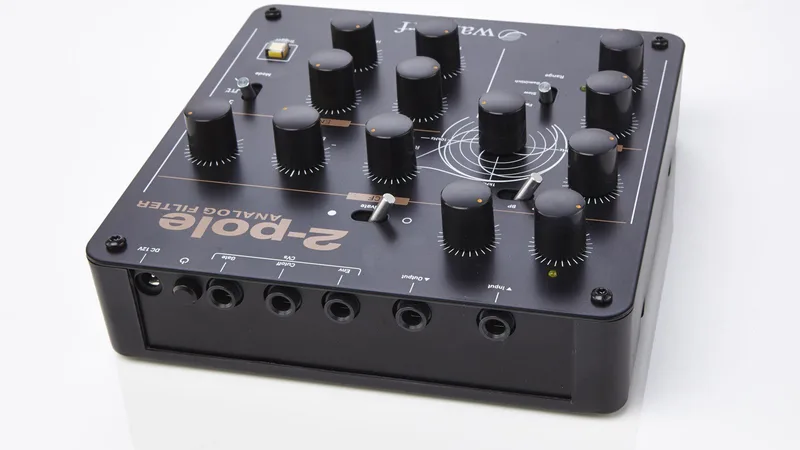


The Waldorf 2-Pole Analog Filter is a standalone hardware filter unit from the German synth manufacturer Waldorf, and it arrived 11 years after Waldorf's previous standalone hardware filter release1. It is a mono filter with low-pass, high-pass and band-pass modes, cutoff and resonance controls, and an LFO whose rate can be pushed into the audible frequency range1.
What it does to a signal
At its core the 2-Pole is a two-pole analog filter with a mode selector and the two controls players expect: cutoff and resonance1. MusicRadar's reviewer described the character across the resonance range in detail:
"With the resonance down, the filter itself is smooth and warm, and capable of lovely wide sweeps in all three modes1."
At maximum resonance the filter self-oscillates, and at mid-range settings it produces Acid-style squelches1. That range, from smooth sweeps to self-oscillation, is the main reason a guitarist or synth player would reach for a unit like this rather than a fixed wah or a simple EQ pedal: the resonance control changes the behavior of the filter, not just the sharpness of the sweep.
The LFO
Alongside the manual controls there is an LFO with three speed settings and a rate control1. The rate can be pushed into the audible frequency range, where the modulation stops sounding like a wobble and starts creating distortion-style effects1. That puts the 2-Pole in territory closer to ring-modulation and distortion effects than to a conventional slow filter sweep.
Design and build
The 2-Pole is housed in a plastic chassis with a metal top, and it is the same size and shape as Waldorf's recent desktop synth the Rocket, as well as the then-forthcoming Streichfett1. MusicRadar's reviewer described the layout as highly tweakable and knob-per-function, with flexible modulation tools1.
What reviewers said
MusicRadar's review is positive on the unit's character and value. The reviewer summed it up1:
"Gritty, flexible and a lot of fun, the 2-Pole is a great way to instantly add character to your sounds1."
The same review recommends it as a means of injecting instant analog grit at an affordable price, and praises its characterful sound with a real vintage flavor1.
Videos
WaldorfMusicChannel
WaldorfMusicChannel
Ask.Audio
Questions
Is the Waldorf 2-Pole Analog Filter fully analog?
Yes. MusicRadar's review describes the 2-Pole as having an entirely analog signal path with no digital technology, which the reviewer notes sets it apart from Waldorf's earlier offerings such as the MIDI-equipped X-Pole. For a player, that means the filtering and resonance character come from the analog circuit itself rather than a digital model of one.
What filter modes does the Waldorf 2-Pole have?
The 2-Pole is a mono filter with three modes: low-pass, high-pass and band-pass. MusicRadar's reviewer found that with the resonance turned down, the filter is smooth and warm and capable of wide sweeps in all three modes, so the mode switch changes the character of the sweep as well as the band of frequencies that passes through.
Can the Waldorf 2-Pole self-oscillate?
Yes. According to MusicRadar's review, the filter is capable of self-oscillation at maximum resonance, and produces Acid-style squelches at mid-range resonance settings. With the resonance down, the same filter is described as smooth and warm, so the resonance control covers a wide range of characters.
Is the Waldorf 2-Pole a mono or stereo filter?
It is a mono filter. MusicRadar's review describes it as a mono filter with low-, high- and band-pass modes, so it processes a single audio channel rather than a stereo pair.
Can the LFO on the 2-Pole reach audio rates?
Yes. The 2-Pole has an LFO with three speed settings and a rate control, and MusicRadar notes that the rate can be pushed into the audible frequency range, where the modulation itself creates distortion-style effects rather than a simple wobble in the tone.
Sources (1)
- Waldorf 2-Pole Analog Filter review, MusicRadar, 2014-07-14