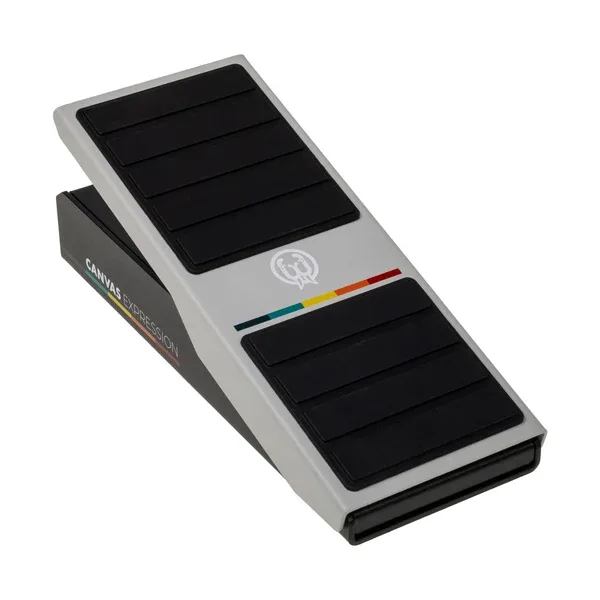



The Walrus Audio Canvas Expression is an expression pedal released in August 2026 that treats expression control as a configurable system rather than a single sweep. Each of its two independent TRS outputs can be set to work as a standard expression output, a programmable switch output, or a control voltage (CV) source, and the pedal also carries MIDI over both an eighth-inch TRS jack and USB1.
Instead of a potentiometer linked to the treadle, the pedal uses a contactless magnetic position sensor, which Gearnews pointed out means it will not wear out in the way a string or potentiometer based mechanism can2. It sells for $299.991, and Gearnews reported it as available from Thomann and Sweetwater at €3292.
What it does: two outputs for expression, switch or CV
The core idea is that Output A and Output B are variable-operation TRS jacks, and each can be assigned independently to one of three jobs1.
- Expression output: In TRS mode it works as a voltage divider using a 50 kΩ potentiometer, behaving like a conventional expression pedal. In TS mode it acts as a variable resistor with selectable total resistances of 10 kΩ, 25 kΩ or 50 kΩ, so it can match pedals that expect different expression pot values1.
- Switch output: It can ground tip to sleeve, ring to sleeve, or tip and ring to sleeve. Switch behavior is programmable: momentary or latching operation, an activation point at heel, middle or toe, multiple switching configurations, and forward or reverse triggering1.
- Control voltage output: Selectable CV voltage ranges of 0 to 3.3 V and 0 to 5 V, aimed at synths and other CV gear1.
Because the two outputs are independent, one treadle can drive two different things at once, for example an expression input on a delay pedal on one output and a tap-tempo or bypass switch input on the other, or two different MIDI destinations134.
The controls and editable parameters
Editing happens on the pedal itself. Located under the treadle, the lower interface has two directional arrow buttons and four parameter LEDs that show which of the four editable parameters is currently selected for editing: TYPE, WIRE, DIR, or X2. TYPE sets what the output does, WIRE relates to the wiring mode, and the remaining parameters handle direction and other behavior.
Wiring is handled automatically. Walrus Audio describes the process as: "Simply connect your pedal, and with a few button presses, Canvas Expression determines the proper wiring automatically."1 It supports TRS, RTS and TS resistance modes, which covers the common variations in how effect makers wire their expression jacks1.
The treadle itself is adjustable. A simple drag adjustment lets you increase or decrease pedal resistance for a lighter or firmer sweep depending on your playing style1.
MIDI and USB
For players running MIDI pedals, the Canvas Expression offers independent TRS MIDI and USB MIDI outputs, with the USB side running at high-resolution 14-bit1. The hardware MIDI connection is a 1/8" TRS Type A MIDI In and MIDI Out1.
- Up to 16 assignable MIDI messages1
- Message types: Control Change (CC) and Program Change (PC)1
- MIDI input for remotely enabling or disabling outputs1
- USB-C port for firmware updates via walrusaudio.io1
There is also a web editor at canvasexp.walrusaudio.io for MIDI assignments, switch behavior, TS resistance values, global settings, and firmware updates1. The pedal carries Walrus Audio's Limited Lifetime Warranty1.
The power requirement is an isolated 9 VDC, center-negative supply delivering 300 mA minimum1. That current draw is well above what a typical analog pedal needs, and the isolation requirement means a simple daisy chain will not do. Gearnotes notes it powers from standard 9 V negative-tip 300 mA supplies, so most isolated pedalboard supplies should handle it2.
What reviewers said
Gearnews reviewed the pedal at release in August 2026. Reviewer Jef highlighted the sensing system, writing that the contactless magnetic position sensor "means it won't wear out, unlike the string-based systems found on many expression pedals"2. He also noted the rugged enclosure made from steel and aluminum, sharing a similar form factor with the rest of the Canvas line2.
On who the pedal suits, his verdict was measured:
"If you have more complex expression pedal requirements, the Canvas Expression could well be exactly what you need."2
He framed it as a great solution for touring musicians with complex rigs, but overkill if you only want to control one parameter of a single effect pedal2. That is the practical dividing line for this product: its value comes from the two configurable outputs, the automatic wiring detection and the MIDI layer, and a player whose only need is a simple sweep into one pedal has simpler options.
Videos
walrusaudioeffects
The Studio Rats
Nobes Music
Questions
Can the Canvas Expression send MIDI over USB?
Yes. It has independent TRS MIDI and USB MIDI outputs, and the USB MIDI runs at high-resolution 14-bit. There is also a MIDI input for remotely enabling or disabling outputs, and up to 16 assignable MIDI messages covering Control Change and Program Change.
Does the Canvas Expression detect TRS or TS wiring automatically?
Yes. Walrus Audio describes automatic wiring detection: you connect your pedal, and with a few button presses the Canvas Expression determines the proper wiring automatically. It supports TRS, RTS and TS resistance modes, so it can adapt to pedals with different expression jack wiring.
Can I adjust the treadle tension on the Canvas Expression?
Yes. A simple drag adjustment lets you increase or decrease pedal resistance for a lighter or firmer sweep depending on your playing style. The treadle position is read by a contactless magnetic position sensor, which Gearnews noted will not wear out like a string or potentiometer based mechanism.
Does the Canvas Expression need an isolated power supply?
Yes. Walrus Audio specifies an isolated 9 VDC, center-negative supply delivering 300 mA minimum. Gearnews notes it powers from standard 9 V negative-tip 300 mA supplies, so it should integrate into most setups, but the isolation requirement rules out simple daisy chains.
Is there a web editor for the Canvas Expression?
Yes. The Canvas Expression web editor at canvasexp.walrusaudio.io handles MIDI assignments, switch behavior, TS resistance values, global settings and firmware updates. The USB-C port on the pedal is used for firmware updates through walrusaudio.io.
Sources (4)
- Canvas Expression Pedal, Walrus Audio
- Walrus Audio Canvas Expression Pedal: The Most Control ever?, gearnews.com, 2026-08-18
- Canvas Line Isolator / D.I., Walrus Audio
- Canvas Stereo Dual Line Isolator / D.I., Walrus Audio