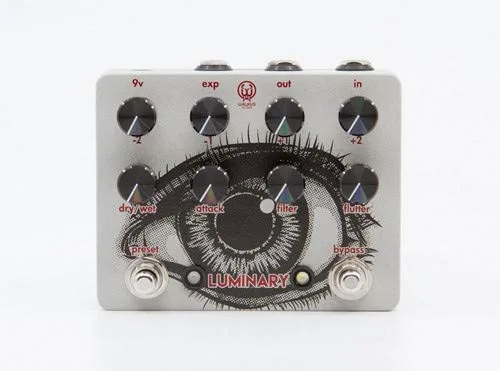


The Walrus Audio Luminary V2 is a polyphonic quad octave generator pedal: it takes your guitar signal and generates four octave voices, two below the note you play (-2 and -1) and two above (+1 and +2), each with its own volume knob so you can blend any combination1. Because it is polyphonic, it tracks chords, not just single notes, and Walrus Audio describes the result as "crystal clear and immediate octave tracking" for creating "inspiring symphonic gusts of sound"12. It is a digital pedal, built on the Analog Devices Sharc DSP platform with high resolution A/D and D/A conversion13.
The V2 arrived on April 24, 2018 at a retail price of $319, refining the original Walrus Audio Luminary released in spring 201634. Walrus Audio has since discontinued it: the maker's own product page lists it as discontinued and no longer available1.
What it does: four blendable octave voices
The core of the pedal is the four octave voices. Each of the four knobs across the top of the pedal controls the level of one octave: -2, -1, +1 and +21. You can blend and mix them any way you wish, then shape the result with the Filter, Flutter and Attack knobs6. In practice that covers a wide range: in Sweetwater's demo of the V2, Don Carr highlighted "organ tones, stuttering synth pads, subtle 12-string-style sounds, and much more"7.
The Dry/Wet control sets the balance between your clean signal and the generated octaves. Below 12 o'clock the octave signal stays lower than your dry signal for subtler blends; above 12 o'clock the dry signal sits lower than unity1. For players chasing organ-style or synth-style textures, that blend control is where most of the musical settings live.
The controls
| Control | What it does |
|---|---|
| Octave volume knobs (-2, -1, +1, +2) | Set the level of each octave voice; any combination can be dialed in1 |
| Dry/Wet | Blends dry and octave signal; below 12 o'clock the octaves sit under the dry signal, above 12 o'clock the dry signal sits below unity1 |
| Attack | Sets how fast the octaves bloom after the initial attack; higher settings swell gradually, low or off gives immediate octave response1 |
| Filter | Controls the cutoff of a low-pass filter on the octave signals and increases an envelope-type effect at higher settings1 |
| Flutter | Enables a tremolo effect on the octaves; at zero it is off, turning it up engages the tremolo and sets its rate1 |
The Attack control is worth a moment for players new to octave pedals: because it dictates how fast the octaves bloom after the initial attack, higher settings give a swell rather than an instant octave hit, which suits pad-like parts1. The Filter knob works only on the octave signals, not your dry tone, and doubles as an envelope effect at high settings1.
On the V2, the Flutter knob produces a tremolo effect on the octaves16. On the original Luminary the same knob enabled a chorus effect on the octaves, with the knob controlling the rate8. That chorus-to-tremolo swap is one of the concrete differences between the two versions.
Presets and live mode
The Luminary V2 has three onboard presets for saving go-to sounds, plus a live mode, so up to four custom sounds are available at any moment1. In live mode, the settings on the face of the pedal are active, which is where the fourth sound comes from7. Gearnews described live mode as being "for when you want to lose yourself in tweaking your sound"4. On the original Luminary, presets were saved by holding down the preset switch for three seconds9.
The V2 also added Smart Momentary Bypassing, which lets players switch between latching and momentary operation depending on how long they hold their foot on the switch10. In Sweetwater's demo, Don Carr explained the momentary behavior: starting with the bypass switch off, holding it down makes it momentary, meaning the effect is on only while the switch is held7.
An expression pedal can be connected to the Luminary V2, and the expression control can be assigned to manipulate any combination of -1 and +1 octave volume, +1 octave volume, Attack, Flutter, and Dry/Wet14. That makes it possible to sweep octave levels or the wet/dry balance with your foot mid-phrase.
Power
Power requirements are 9V DC at 300mA minimum1. The original Luminary drew less, at 250mA minimum11, so the V2 is hungrier than its predecessor. Two things a player needs to know:
The power supply is not included with the Luminary, and Walrus Audio notes that Strymon power supplies will not work with it1. At 300mA minimum it also needs more current than a typical 100mA daisy-chain outlet provides.
Versions and editions
The Luminary line has two versions. The original Luminary Quad Octave Generator was announced in April 2016 at $319, running on the same Analog Devices Sharc platform with the same four octave voices, three presets and live mode8211. The V2, announced in April 2018, kept the price at $319 and shipped from April 24, 20183.
Walrus Audio's own summary of the V2 refinements:
- Refined octave volume knobs1
- Lengthened attack time1
- Revised envelope low-pass filter1
- Tremolo effect on the Flutter knob1
- Added Smart Momentary Bypassing1
The enclosure also changed shape between versions: the original measured 4.67" x 3.68" x 1.547", while the V2 is a smaller 4.77" x 2.6" x 1.39" die-cast box83. Both carry the dystopian dictator's watchful eye artwork in black and red ink on a sand pebble textured enclosure18. The V2 artwork is by illustrator Adam Forster, described by Walrus Audio as "an updated version of a dystopian dictator's watchful eye"36.
What reviewers said
Reviews of the original Luminary circuit, which the V2 shares, were positive about tracking. Pedal of the Day's reviewer wrote:
Pedal of the Day's reviewer called the Luminary's octave tracking "some of the best octave tracking on the market bar none," and found that its tracking was impeccable with a bass guitar playing chords9.
That matters for bass players in particular: polyphonic octave tracking on chords is where many octave pedals fall apart, and the reviewer found the Luminary held up9. The same reviewer noted that while octave pedals come in many configurations, units that operate in a useful octave range and track well enough to be musical are hard to find9.
Sweetwater's Don Carr demoed the V2 at launch, covering the octaves, the control set, the preset system and the momentary bypass:
In the demo, Carr walks through the four octave voices, the preset and live mode behavior, and the momentary switching, and generates the organ, synth-pad and 12-string-style sounds the pedal is known for7.
For players comparing octave options today, the Luminary V2 sits among polyphonic octave generators rather than monophonic octave fuzzes: its strength is clean, blendable octave voices with modulation and envelope shaping on top, rather than aggressive synth-bass sounds. Since it is discontinued, the original Luminary and secondhand V2 units are the closest matches in the octave and pitch category.
Videos
walrusaudioeffects
walrusaudioeffects
Questions
Is the Walrus Audio Luminary V2 discontinued?
Yes. Walrus Audio's own product page states that the Luminary V2 is discontinued and no longer available. It launched on April 24, 2018 at a retail price of $319, updating the original Luminary that appeared in spring 2016. Secondhand units are the practical route for players who want one now.
What does the flutter knob do on the Luminary V2?
On the V2, the Flutter knob enables a tremolo effect applied to the octave voices. At zero the tremolo is off; turning it up engages the modulation and controls the rate. On the original Luminary the same knob produced a chorus effect on the octaves, so this is one of the clearest changes in the V2.
Can you use an expression pedal with the Luminary V2?
Yes. The expression input can be set up to manipulate any combination of -1 and +1 octave volume, +1 octave volume, Attack, Flutter, and Dry/Wet. That lets a player sweep octave levels or the wet/dry balance with their foot while playing, rather than bending down to turn knobs.
Is the Luminary V2 analog or digital?
It is digital. The Luminary V2 runs on the Analog Devices Sharc DSP platform with high resolution A/D and D/A conversion, which is what allows polyphonic octave tracking across four voices. The original Luminary used the same platform.
Who did the artwork on the Luminary V2?
Illustrator Adam Forster. The V2 artwork is an updated version of the original's dystopian dictator's watchful eye, printed in black and red ink on a sand pebble textured enclosure. The original Luminary carried the same watchful eye theme.
Sources (11)
- Luminary Quad Octave Generator, Walrus Audio
- Walrus Audio promises "symphonic gusts of sound" from Luminary Quad Octave Generator guitar effects pedal, MusicRadar, 2016-04-13
- Walrus Audio Launches Luminary Octave V2 Generator, Premier Guitar, 2018-04-17
- Walrus Audio Luminary V2 launches next week for some polyphonic madness, gearnews.com, 2018-04-19
- Luminary Quad Octave Generator v2 by Walrus Audio, RockBoard (PedalPedia), 2026
- Walrus Audio updates the Luminary Octave Generator, Guitar.com, 2018-04-18
- Walrus Audio Luminary V2 Quad Octave Generator Pedal, Sweetwater, 2018-04-17
- Walrus Audio Launches Luminary Quad Octave Pedal, Premier Guitar, 2016-04-12
- Guest Reviewer Fridays: Walrus Audio Luminary Quad Octave Generator, Pedal of the Day, 2016-09-23
- Walrus Audio upgrades Luminary Octave Generator pedal to V2 specs, MusicRadar, 2018-04-18
- Walrus Audio Unveils the Luminary Quad Octave Generator, Guitar Interactive Magazine, 2016-04-13