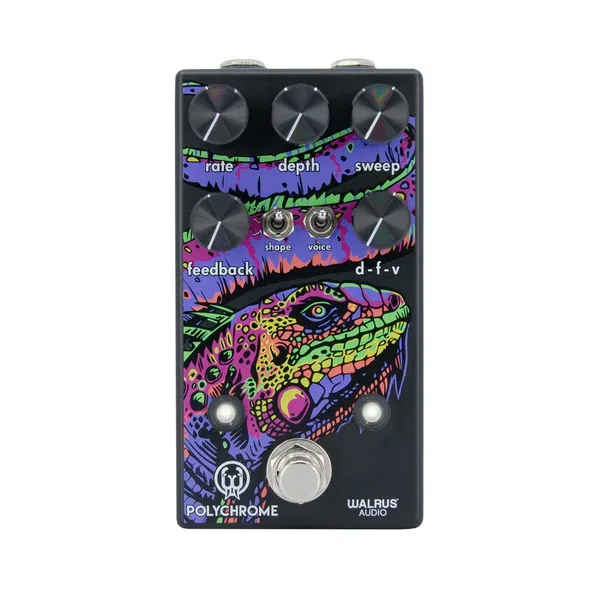


The Walrus Audio Polychrome is a true bypass, all-analog flanger pedal, launched by Walrus Audio in May 202112. Walrus Audio describes it as "a uniquely colorful tool for adding modulated textures to songs"34. What sets it apart from a standard flanger box is its D-F-V (Dry, Flange, Vibrato) blend knob, which sweeps continuously from a completely dry, unaffected signal at minimum, through a traditional flange at noon, to full pitch vibrato at maximum4.
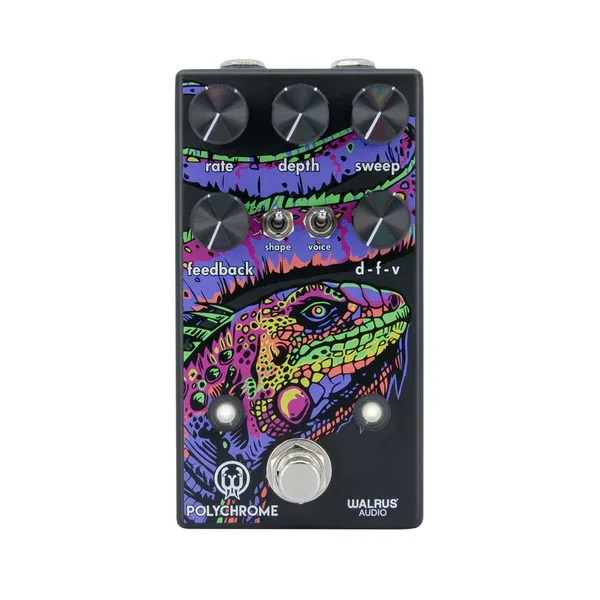
The pedal carries multi-colored iguana artwork against a matte black background, with original artwork by David Hüttner56. It is built in the USA7.
What it does to your sound
A flanger works by mixing a short, modulated delay with the dry signal, producing the sweeping, jet-like character the effect is known for. On the Polychrome, the D-F-V knob is the central control: at minimum you hear no effect at all, at noon you get a traditional flange, and at maximum the dry signal is gone and the pedal produces pitch vibrato48. Delicious Audio described the knob as giving "access to three flanger flavors: Dry, Flange, and Vibrato"8.
Two mini toggle switches shape the character further:
| Control | What it does |
|---|---|
| D-F-V knob | Blends dry and delayed signal: full dry (no effect) at minimum, traditional flange at noon, full pitch vibrato at maximum4 |
| Voice switch | Down: traditional, full-frequency flange. Up: more complex, notched flange with less low end108 |
| Shape switch | Selects sine, triangle, or random LFO waveform to modulate the delay line128 |
| Feedback knob | Sets regeneration; at minimum, with D-F-V maxed and voice up, the pedal produces pitch vibrato14 |
| Bypass footswitch | Standard latching action, plus momentary activation of the effect with a press and hold10 |
The Shape switch is where the Polychrome reaches beyond a basic analog flanger. Guitar.com's reviewer Michael Watts noted that "shape gives you a choice of sine, triangle or random LFO waveforms"12, and the random setting in particular offers a modulation character most single-function flangers do not.
Getting vibrato from it
The vibrato setting is a specific recipe rather than a separate mode switch. Walrus Audio's instructions: "Set the D-F-V knob to maximum, feedback to a minimum, and the voice switch up for some unique pitch vibrato"14. With the dry signal blended out and the feedback regeneration turned down, what remains is the pitch-modulated delayed signal on its own, which reads as vibrato rather than flange. Rolling the D-F-V knob back toward noon reintroduces the dry signal and returns the pedal to flanger territory, so the transition between the two effects is continuous rather than switched4.
Power and connections
The Polychrome runs on 9V DC, center negative, with a current draw of 50mA minimum14. The power supply is not included1, and Walrus Audio recommends using an isolated power supply5. There is no expression pedal input; MusicRadar's review lists that absence among the pedal's drawbacks7. Input, output, and power jacks are all top-mounted, which Walrus Audio says helps the pedal fit on a crowded board384.
The 9V DC center-negative requirement and the maker's recommendation of an isolated supply mean the Polychrome is not designed around a battery, and a daisy-chain supply is not what Walrus Audio recommends15.
Where it came from: the Julia and Lillian layout
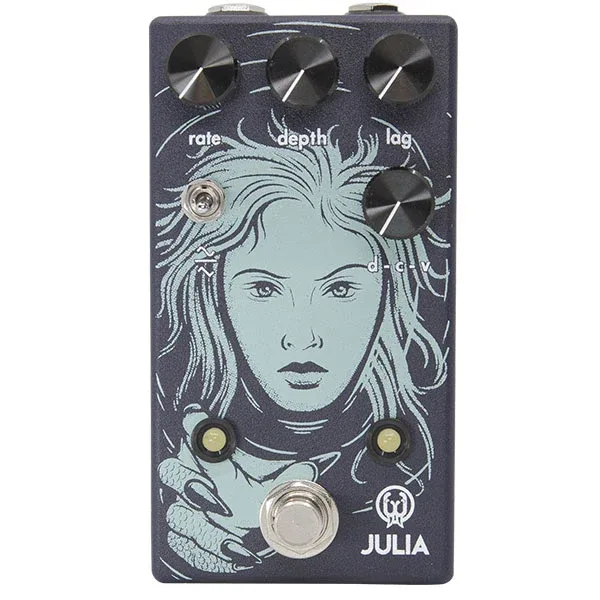
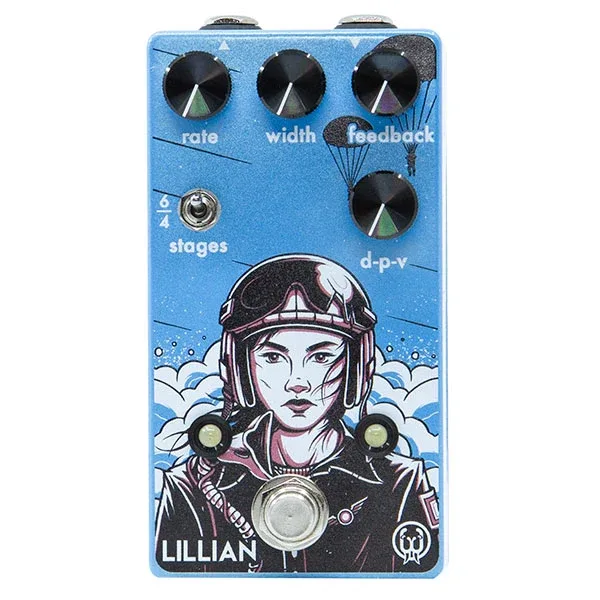
The Polychrome sits in a known place in Walrus Audio's modulation line. Walrus Audio describes it as "a true bypass, analog Flanger pulling in familiar layout controls from the Julia and Lillian"1, meaning the control layout will feel immediately familiar to anyone who has used the Julia chorus or the Lillian phaser. Guitar World's launch coverage put it the same way: the design "takes the Julia and Lillian control array and brings it to a versatile new all-analog flanger"2. Guitar.com's review called the pedal "positively bristling with features inherited from the acclaimed Julia chorus and Lillian phaser"12.
The pedal was announced in May 2021 and was available at launch for $1992. Gearnews' first look noted the Thomann customer-facing price at the time as $199.00 / £179.00 / 213.00€5; Guitar World's later review lists the price as $199 / £179511. A blemished-unit listing on Walrus Audio's own site is marked sold out1.
What reviewers said
Guitar.com reviewed the Polychrome in June 2021 and rated it 9/10, praising its core sounds and tonal options121. MusicRadar's overall verdict:
"A flanger with plenty of range and hidden depths, the Polychrome is another classy addition to Walrus Audio's modulation"7
MusicRadar's review also flagged the lack of an expression pedal input as a con7. Gearnews' first look took a favorable view of the pedal's value, writing that "for €209, the Walrus Audio Polychrome may be hard to beat"5.
Videos
Pete Thorn
Premier Guitar
walrusaudioeffects
Questions
Does the Walrus Audio Polychrome have an expression input?
No. MusicRadar's review lists the lack of an expression pedal input among the pedal's cons. Control changes on the Polychrome are made by hand with its knobs and mini toggle switches, and there is no jack for an external controller.
Is the Polychrome true bypass?
Yes. Walrus Audio describes the Polychrome as a true bypass, analog flanger, and the switching uses a soft-touch footswitch with relay bypassing. The bypass footswitch also offers momentary activation of the effect when you press and hold it.
How do you get vibrato from the Polychrome?
Set the D-F-V knob to maximum, the feedback knob to a minimum, and flip the voice switch up. Walrus Audio describes this setting as producing a unique pitch vibrato. The D-F-V knob blends dry and delayed signal, so full clockwise removes the dry signal and leaves only pitch-modulated vibrato.
What does the Voice switch on the Polychrome do?
It selects between two flanger characters. In the down position the flange is more traditional and full frequency; in the up position it becomes more complex and notched, with less low end. Guitar.com's reviewer described it as toggling between a full-frequency flange and a notched flange with less bottom.
Is the Walrus Polychrome analog?
Yes. Walrus Audio describes the Polychrome as a true bypass, all-analog flanger. It is a mono pedal with an analog delay line modulated by a selectable sine, triangle, or random LFO waveform.
Sources (12)
- Voyager Preamp/Overdrive, Walrus Audio
- Walrus Audio bolsters its modulation lineup with the Polychrome analog flanger, Guitar World, 2021-05-11
- Polychrome Analog Flanger, Walrus Audio
- Polychrome by Walrus Audio, RockBoard PedalPedia, 2026
- Walrus Audio Polychrome Review: quality analog flanger tones?, Gearnews, 2021-05-15
- Walrus Audio offers a spectrum of colourful modulation options with the Polychrome analogue flanger, MusicRadar, 2021-05-11
- Walrus Audio Polychrome review, MusicRadar, 2021-11-24
- Walrus Audio Polychrome Analog Flanger, Delicious Audio, 2022-02-09
- Walrus Audio launches new-and-improved Iron Horse V3 distortion pedal, Guitar World, 2021-10-26
- Walrus Audio Polychrome Analog Flanger review, Guitar World, 2021-10-12
- Best Effect Pedals 2021: Did your favourite make our Top 10?, Gearnews (www.gearnews.com), 2021-12-26
- Walrus Audio Polychrome review: An analogue flanger with a rich range of tones, Guitar.com, 2021-06-04