

The Wampler Latitude Tremolo Deluxe is a tremolo pedal aimed squarely at the player who wants to shape the effect rather than just switch it on. Premier Guitar called it "a trem aimed at the tinkerer," an exceptionally tweakable effect that can mimic vintage amp tremolo or push into modern, syncopated chop1. Wampler released it worldwide on May 29, 20142, and Wampler positioned it as covering everything "from true vintage mojo to modern syncopated helicopter chops"2.
Under the hood it is a hybrid design: digital technology controls a completely analog guitar signal path23. In practice that means your dry tone stays analog while the pedal's clock handles tap tempo and subdivisions digitally. It also runs with true bypass2.
What it does: vintage amp tremolo to modern helicopter chop
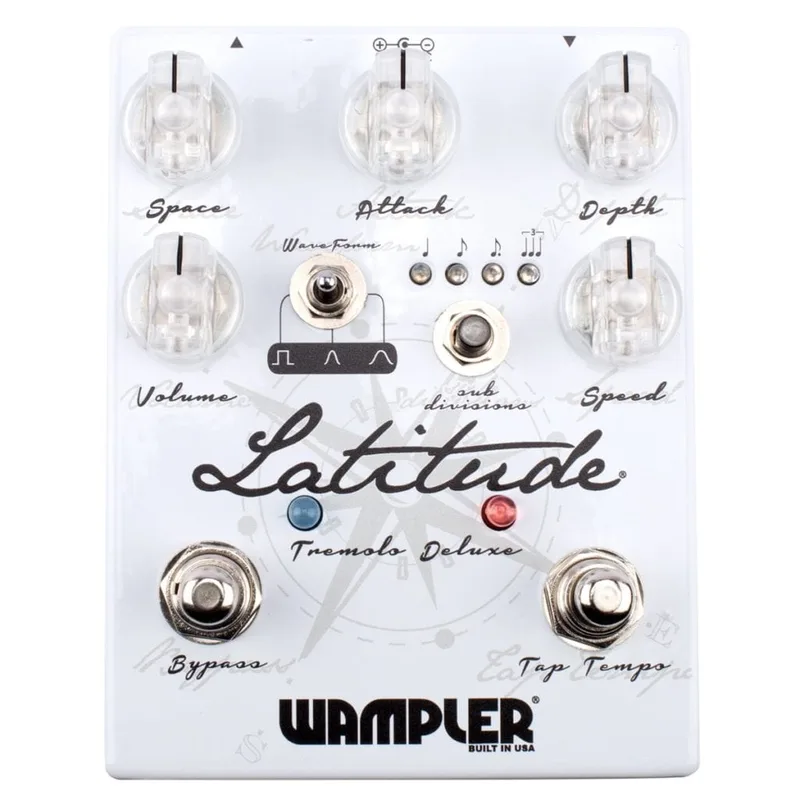
Tremolo raises and lowers your volume in a repeating cycle, and the shape of that cycle is where the Latitude Deluxe earns its keep. A three-position waveform toggle selects between square, peak, or bell-shaped waves1, and each one lands in a different territory:
- Bell-shaped wave: delivers the classic vibrations of '50s and '60s amp tremolo, the smooth wobble built into old Fender and Gibson amplifiers1.
- Square wave: Premier Guitar's reviewer found it "a powerful, choppy, and stuttering tremolo that's ideal for spare, intense tremolo passages," noting it can sound almost synthy and intensely electronic when you max the depth and tweak the space and speed controls1.
- Peak wave: sits between the two, with the attack knob further reshaping how quickly each pulse rises1.
MusicRadar summed up the pedal's range as "one foot in sweet vintage tremolo tones and one foot in more modern helicopter chops, offering the best of both worlds"3. If you want one pedal that covers both a slow, amp-like shimmer and hard rhythmic stutter, that is the pitch.
The controls
The Latitude Deluxe carries a total of seven controls for shaping your signal1. Speed and depth work the way anyone who has used an onboard amp tremolo expects: speed sets how fast the volume pulses, depth sets how far it dips1. The rest go further than a typical trem.
| Control | What it does |
|---|---|
| Speed | Sets the tremolo rate, as on onboard amp tremolos1 |
| Depth | Sets how deep the volume dip goes; unity gain sits around noon with single coils1 |
| Level | Can bump the pedal's output significantly1 |
| Attack | Reshapes the waveform: higher settings give a quick rise in volume followed by a soft taper, lower settings produce a slower rise to the wave peak, almost like a volume swell1 |
| Waveform toggle | Selects square, peak, or bell-shaped waves1 |
| Subdivision switch | Scales the tapped tempo to quarter notes, eighth notes, dotted-eighth notes, or triplets1 |
| Tap tempo footswitch | Adjusts the rate on the fly1 |
The level control is worth a moment before you gig with it. Premier Guitar's reviewer, testing with a Fender American Standard Telecaster with single coils, found unity gain right around noon on the depth control, so it pays to set level against your clean tone first1.
Tap tempo and subdivisions
Tap tempo is the feature that separates the Deluxe from simpler trems. The tap tempo control adjusts the rate on the fly, so you can lock the pulse to a drummer or a delay rather than hunting for a knob position1. Hitting the switch three times resets the unit1.
On top of the tapped rate, the subdivision selector scales that tempo with quarter notes, eighth notes, dotted-eighth notes, or triplets with a simple push of a button1. Dotted-eighth notes are the setting players reach for to get that lurching, off-kilter pulse familiar from ambient and post-rock parts, while triplets push the effect into busier, more percussive territory.
Build, price, and the Latitude Standard
The Latitude Deluxe is U.S.-built and handwired in a very sturdy enclosure1. At launch in 2014 it retailed at $429 USD in the US and £255 in the UK3; by Premier Guitar's 2023 review the street price was $2401.
There is no battery option1, so the pedal needs a place on a power supply from day one.
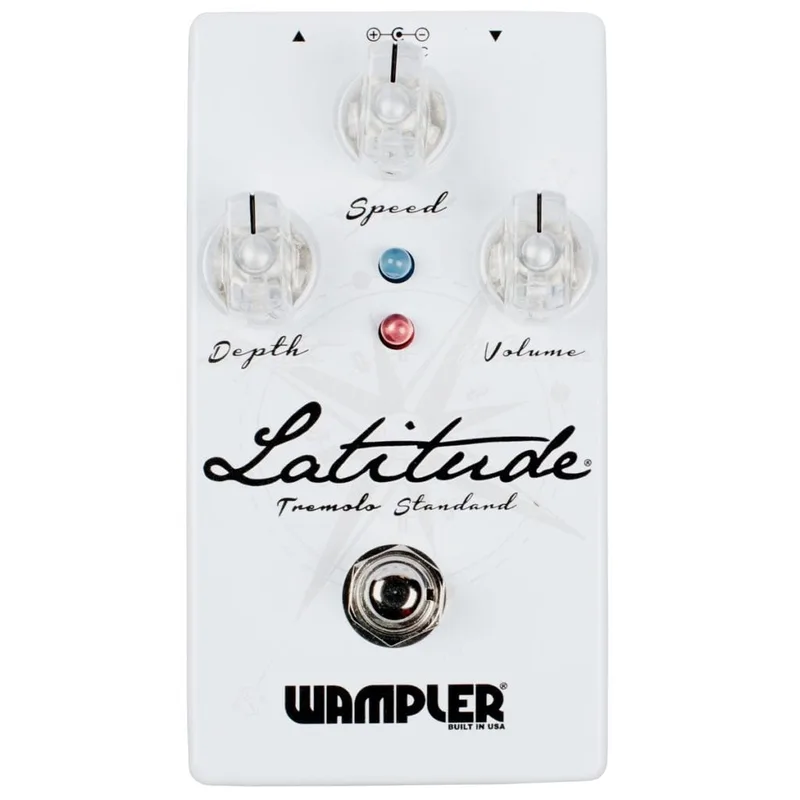
In 2015 Wampler followed it with the Latitude Standard, a smaller, stripped-down version of the same tremolo. Players who want the full set of waveforms, subdivisions, and shaping controls stay with the Deluxe; the Standard trims the feature set for a tighter board footprint.
Premier Guitar's verdict on the tone was blunt: "Excellent tone."1
Videos
ProGuitarShopDemos
Sweetwater
Premier Guitar
Questions
Does the Wampler Latitude Tremolo Deluxe take a battery?
No. Premier Guitar's review notes there is no battery option, so the pedal runs from a power supply only. Plan on a spot on your pedalboard power supply rather than a battery clip.
Is the Wampler Latitude Tremolo Deluxe analog or digital?
It is a hybrid. Digital technology controls the timing and waveform shapes, but the guitar signal path itself is completely analog, so your core tone stays analog while the tremolo's clock and subdivisions are handled digitally.
What is the difference between the Latitude Deluxe and the Latitude Standard?
The Standard, introduced in 2015, is a smaller, stripped-down version of the Deluxe. The Deluxe carries the full set of seven controls, three waveforms, and four subdivisions, while the Standard pares the feature set down for a tighter footprint.
Where is the Wampler Latitude Tremolo Deluxe made?
It is built in the United States. Premier Guitar describes it as U.S.-built and handwired inside a very sturdy enclosure.
How do you reset the tap tempo on the Latitude Deluxe?
Hitting the tap switch three times resets the unit. The tap tempo control otherwise adjusts the rate on the fly, and the subdivision switch scales the tapped tempo to quarter notes, eighth notes, dotted-eighth notes, or triplets.
Sources (3)
- Wampler Latitude Tremolo Deluxe Review, Premier Guitar, 2014-09-03
- Wampler Unveil the Latitude Deluxe Tremolo Pedal, Guitar Interactive Magazine, 2014-05-29
- Wampler Latitude Tremolo Deluxe pedal, MusicRadar, 2014-08-01