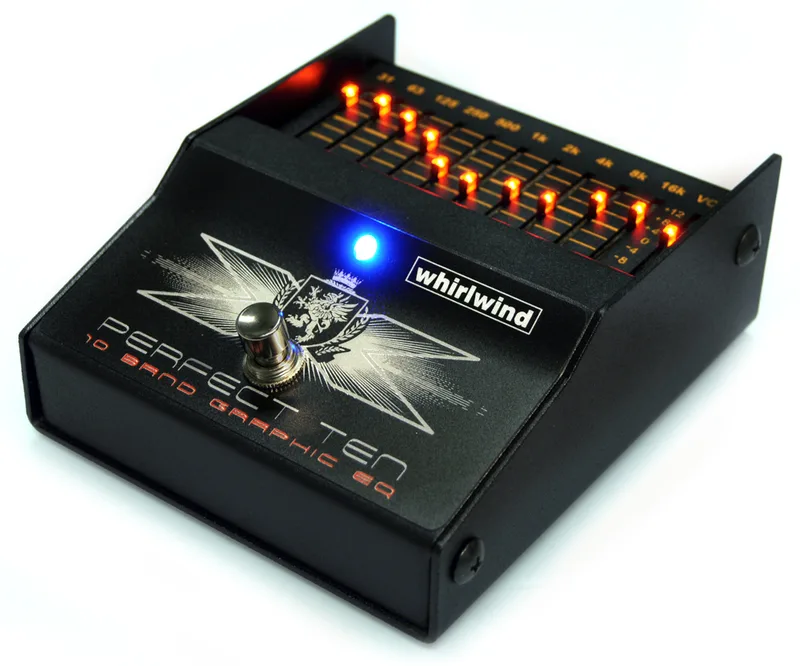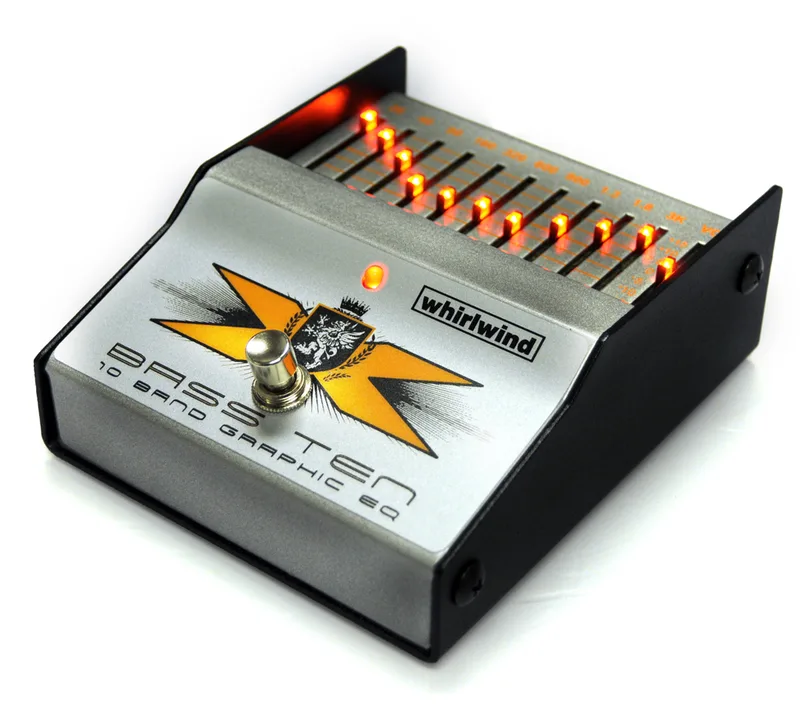


The Whirlwind Bass Ten is a 10-band equalizer pedal designed exclusively for the bass guitar. Whirlwind describes it as an "unbelievably clean" EQ that makes it possible for bass players to tailor their tone with a high level of precision and clarity1. It sits alongside a guitar-oriented sibling, the Perfect Ten, and both were announced by Whirlwind's FX Lab as a pair of ten-band equalizer pedals21.
What it does for a bass player
A graphic equalizer gives you a row of sliders, one per frequency band, so you can boost or cut specific parts of your sound: tighten the low end, bring out midrange definition, or add attack up top. The Bass Ten gives bass players ten of those bands in one pedal. Whirlwind positions it as a clean tone-shaping tool rather than a coloration effect, which puts it in a different role on a board from overdrive or compressor pedals: it reshapes what is already there rather than adding character of its own1.
Constant Q design
The Bass Ten's constant Q design means that each band's frequency width remains the same for small boosts as well as large boosts. Whirlwind explains it this way13:
Whirlwind describes the Bass Ten as a constant Q design, meaning each band's frequency width stays consistent whether the slider is pushed for a large boost or pulled for a small cut. For a player, that translates to sliders that behave predictably across their travel: the shape you dial in at moderate settings holds its character when you push a band harder, rather than narrowing or widening the way some graphic EQs do as the boost amount changes.1
In practice, that means a band behaves the same whether you nudge its slider up a little or push it a long way. Whirlwind says this makes adjustment easy and intuitive, and the same design carries over from the Perfect Ten, where the company describes the pedals as offering excellent noise and distortion characteristics while maintaining a clean signal132.
Origins and design
The Bass Ten and Perfect Ten were designed by Tony Gambacurta, whom Whirlwind's page refers to affectionately as the Guru of modern effects design12. Whirlwind announced the release of the two pedals on 19 January 2011 through its FX Lab line12. The company describes the Bass Ten as tour proven and sonically superior1.
Bass Ten and Perfect Ten
| Bass Ten | Perfect Ten | |
|---|---|---|
| Bands | 101 | 102 |
| Aimed at | Bass guitar1 | Guitar2 |
| Constant Q | Yes1 | Yes2 |
| Power | 18V supply included1 | 18V supply included2 |
| Made in | USA1 | USA2 |
Both pedals share the same designer and the same constant Q approach; the Bass Ten is the version voiced and marketed for bass12.
Videos
Guitar World
Bass Whisperer TV
Bass Stuff
Questions
What is constant Q on an equalizer?
Constant Q means that each band's frequency width remains the same whether you apply a small boost or a large one. Whirlwind says this makes adjustment easy and intuitive, because a band behaves predictably no matter how far you push its slider. On a non-constant Q design, bands can widen or narrow as the amount of boost or cut changes, which makes the pedal feel less consistent under the fingers.
Does the Whirlwind Bass Ten come with a power supply?
Yes. Whirlwind includes an 18V power supply with the Bass Ten. That is a higher voltage than many pedals run at, so it is worth keeping in mind when planning a pedalboard power setup rather than assuming a standard 9V supply will do the job.
Where is the Whirlwind Bass Ten made?
The Bass Ten is built in the USA. Whirlwind describes it as a tour-proven pedal, and the company's product page lists its footprint dimensions as 5.9 by 4.85 by 2.25 inches tall.
How many bands does the Whirlwind Bass Ten have?
The Bass Ten has ten bands, as its name suggests. It is a graphic equalizer pedal designed exclusively for bass guitar, giving players ten separate frequency bands to boost or cut when shaping their tone.
Sources (3)
- Bass Ten 10 Band EQ FX Pedal, Whirlwind Music Distributors, 2026
- Perfect Ten 10 Band EQ Pedal, Whirlwind, 2026
- Whirlwind's FX Lab releases two new pedal EQs, Whirlwind, 2011-01-19