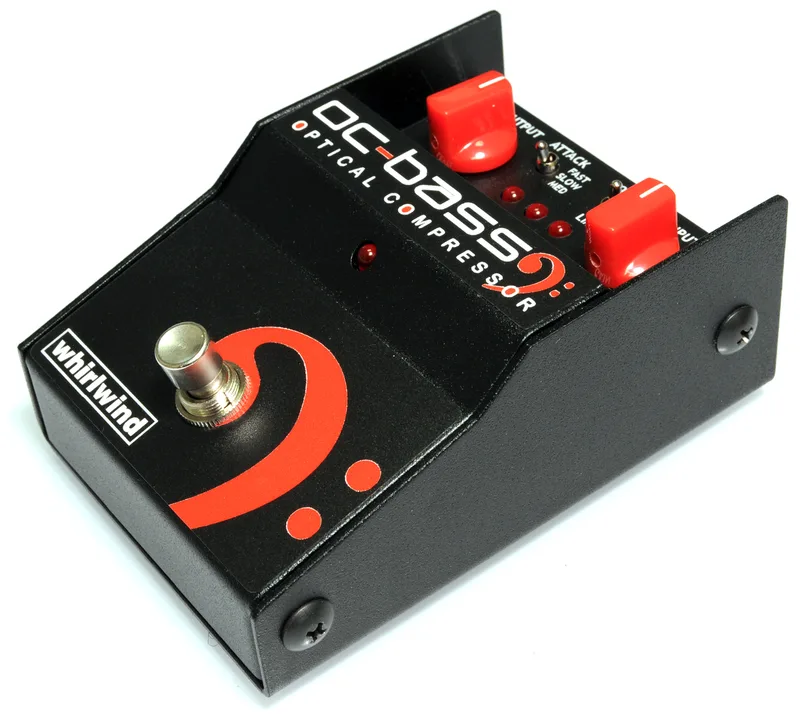

The Whirlwind OC BASS is an optical compressor and limiter pedal voiced specifically for bass. Whirlwind describes it as both a compressor and a limiter, depending on how it is switched, with adjustable input and output levels so you can tailor the amount of punch and sustain in your signal1. It debuted at NAMM in early 2012 and was announced on Whirlwind's own site on April 24, 20122.
Optical compression uses a light-dependent element to control gain reduction, the same principle behind classic studio compressors. For a bass player, the practical appeal is smooth level control that evens out the difference between a soft fingerstyle note and a hard-plucked one, without the audible working of some cheaper compressor circuits. The OC Bass is an analog pedal3.
Controls and how they work
The pedal keeps its control set small: two knobs and two switches.
| Control | What it does |
|---|---|
| Input knob | Dictates how much compressor or limiter is applied to the bass signal4 |
| Output knob | Sets the output level4 |
| Compressor/Limiter switch | Selects compressor or limiter operation1 |
| Speed switch | Three pre-programmed attack speeds: Fast, Medium, Slow5 |
The input and output knobs are the main working controls. Whirlwind says the adjustable input and output let you "easily tailor the exact amount of punch and sustain"1. Premier Guitar's reviewer found a workable starting point by dialing both knobs to 12 o'clock4.
The attack switch sets the mode of the compression rather than a continuously variable control. Whirlwind describes the range as going "from a super fast, thumping grab, to a long and lush compressed sustain, with plenty of adjustment in between"1. In practice, fast clamps the note immediately for a tight thump, while slow lets the note through before engaging longer sustain.
Compressor versus limiter mode
A compressor and a limiter do the same basic job at different intensities: a compressor reduces gain over a range of levels above a threshold, while a limiter clamps the signal harder at the top. The OC Bass gives you both in one box through its mini toggle4.
Whirlwind's own suggestion for limiter mode is aimed at funk players:
"Set the attack switch to med in the limiter mode, and turn your thumb into a registered weapon of funk"32
That is the maker's marketing voice, but it points at the real use case: medium attack in limiter mode holds down the spikes from aggressive thumb playing while keeping the note audible23.
Power and the Bass Ten pairing
The OC Bass runs on an 18V wall adapter, which is included with the pedal1. That voltage is worth noting before you build a board around it: it needs its own supply rather than sharing the power arrangement the rest of a board uses.
The OC Bass requires 18V from its included wall adapter1. Plan power separately if the rest of your board runs on a different supply.
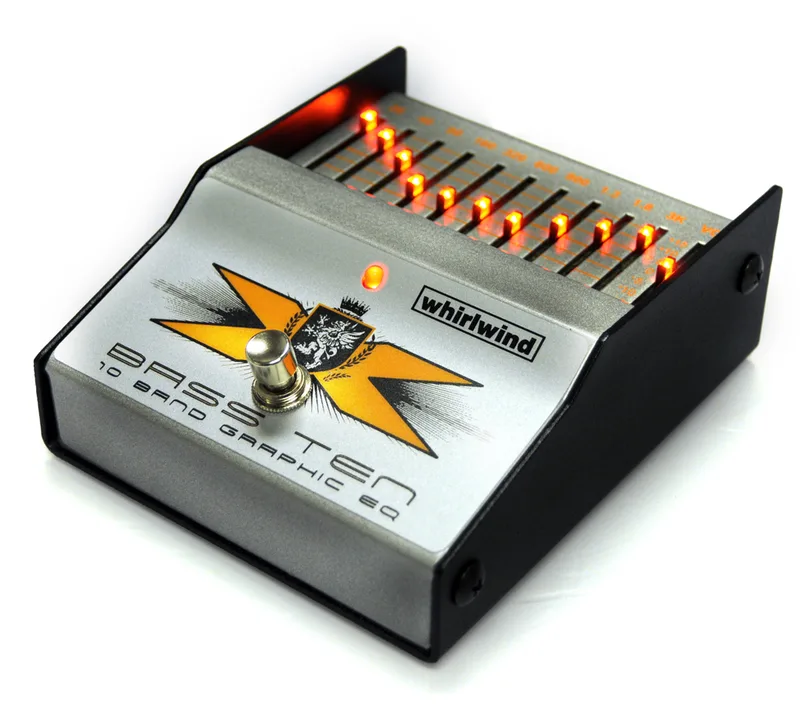
Whirlwind also positions the OC Bass as half of a pairing with its own ten-band bass EQ, suggesting players combine the two: "Combine this with our BASS TEN - 10 band EQ and hear your bass rig come to life... It's a beautiful thing!"1. The Whirlwind Bass Ten is a separate pedal, so the pairing is a suggestion rather than a built-in feature. For more on the effect type generally, see compressor pedals.
Build and layout
Premier Guitar's review describes the pedal as "housed in a solidly built steel chassis"4. One layout detail matters for pedalboard planning: the input jack sits on the rear panel of the pedal rather than on the side, which affects how close you can place neighboring pedals4.
What reviewers said
Premier Guitar reviewed the OC Bass in September 2026 and summarized it as4:
"Easy to dial in. Great tones at a great price."4
The review also noted the $199 street price4, down from the around $229 launch price No Treble reported in March 20125.
Videos
Premier Guitar
Questions
Is the Whirlwind OC Bass analog?
Yes. The OC Bass is an analog optical compressor and limiter pedal. Its compression is generated by an optical circuit rather than a VCA or digital modeling, which is the same basic approach used in classic studio optical compressors.
What power supply does the Whirlwind OC Bass use?
It runs on an 18V wall adapter, which is included with the pedal. Because it needs 18 volts, it needs its own supply rather than sharing the power arrangement the rest of a pedalboard uses.
What is the difference between compressor and limiter mode on the OC Bass?
A mini toggle switches the pedal between compressor and limiter operation. Compressor mode evens out your playing dynamics across a range, while limiter mode clamps the signal harder, which Whirlwind suggests for a tight, punchy thumb attack in funk playing.
What do the attack settings do on the Whirlwind OC Bass?
The attack switch offers three pre-programmed speeds: fast, medium and slow. Fast gives an immediate grab on the note, slow engages longer, sustained compression, and medium sits in between. Whirlwind recommends the medium setting in limiter mode for funk thumb playing.
How much does the Whirlwind OC Bass cost?
At its 2012 launch it was priced around $229. Premier Guitar's 2026 review lists its street price at $199, which is the more recent figure.
Where is the input jack on the Whirlwind OC Bass?
The input jack is on the rear panel of the pedal rather than the side, as Premier Guitar's review notes. Players used to side-mounted jacks should plan their pedalboard layout around this.
Sources (5)
- OC BASS, Whirlwind Music Distributors, 2026
- OC BASS, Whirlwind Music Distributors, 2022-01-17
- OC BASS by Whirlwind, RockBoard PedalPedia, 2026
- Whirlwind OC Bass Pedal Review, Premier Guitar, 2012-09-18
- Whirlwind Introduces OC Bass Optical Compressor Pedal, No Treble, 2012-03-10