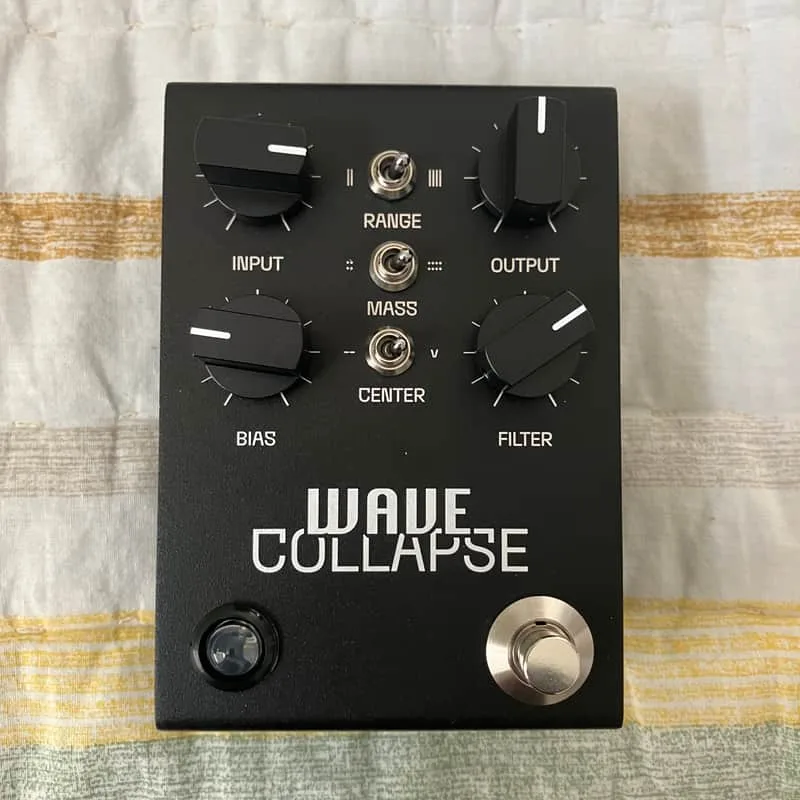


The Wave Collapse is a fuzz pedal from Whitman Audio, a builder based in Seattle, Washington. Whitman Audio calls it a fuzz, but its range runs well past that label: Premier Guitar's reviewer found it responsive and sensitive enough to input and touch dynamics to move from light overdrive to low-gain distortion and beyond, which places it in the same territory as overdrive pedals and distortion pedals at the low end of its sweep1. Designer Whitman Dewey-Smith's brief, in his own words, was "a wide palette ranging from dirty boost to almost square-wave fuzz and textures that could be smooth or sputtery"1.
From dirty boost to degenerate fuzz
Pedal of the Day, reviewing the Wave Collapse in February 2025 as Whitman Audio's next release, describes a pedal built for extremes as much as for tradition: "Highly interactive controls with extra range unleash gated glitches, sputtering chaos, and lo-fi warmth," running from vintage warmth to experimental chaos2. At the quiet end it can serve as a dirty boost, a use covered on the site's Boost Pedals page.
The reviewer's verdict pulled both ends together:
"Not only does the Wave Collapse Fuzz scratch that itch for classic, vintage fuzz sounds, it also opens up new, modern fuzz-laden possibilities."
Premier Guitar's reviewer, writing in May 2025, found the pedal "responsive and sensitive enough to input and touch dynamics" and noted that it "has personality at low gain levels and super crunchy ones"1.
How the circuit works
The Wave Collapse is not a straight copy of a vintage circuit, though it borrows from one. Premier Guitar's review lays out the design1:
- The first gain stage takes inspiration from early, simple fuzz topologies like the Tone Bender and Fuzz Face, as a two-transistor gain stage1
- A BC108 transistor drives one of the pedal's two core gain stages1
- A modified Jack Orman pickup simulator-style section sits in the front end1
- Twin red LED clipping diodes form what Dewey-Smith describes as a "fairly" symmetric hard-clipping scheme1
The pickup simulator section in front of the gain stages is the kind of input conditioning covered on the site's Buffer Pedals page, and it is part of how the pedal keeps its response consistent from one guitar to the next1.
Controls
| Control | What it does |
|---|---|
| Bias | Shapes the distortion color and response more specifically after dialing in input gain1 |
| Tilt tone | Flexible tilt control with a center catch, sweep tuned to allow a wide range of sounds2 |
The bias control is the one that takes the pedal from conventional fuzz into its stranger territory: set the gain first, then shape the distortion color and response with the bias, as Premier Guitar describes the workflow1.
Power and build
The Wave Collapse runs on 9VDC through a 2.1mm center negative barrel connector2. Pedal of the Day also notes extensive power filtering to reduce line noise, which matters for a fuzz circuit, and a bespoke heavy duty aluminum enclosure2.
Videos
Whitman Audio
Pedal of the Day
Pedalboard of the Day
Questions
Who designs the Whitman Audio Wave Collapse?
The Wave Collapse is designed by Whitman Dewey-Smith of Whitman Audio. Premier Guitar describes his design brief, in his own words, as a wide palette ranging from dirty boost to almost square-wave fuzz and textures that could be smooth or sputtery. Dewey-Smith also explained the pedal's clipping approach to the magazine, describing it as a fairly symmetric hard-clipping scheme built around twin red LED clipping diodes.
Where is the Wave Collapse made?
The Wave Collapse is built in Seattle, Washington. Premier Guitar's review refers to it as the Seattle, Washington-built Wave Collapse, and notes that the pedal has personality at low gain levels and super crunchy ones. Pedal of the Day lists it as available from the Whitman Audio website.
What does the bias knob do on the Wave Collapse?
The bias knob shapes the distortion color and response after you have dialed in the input gain. Premier Guitar's reviewer describes the workflow as setting the gain first, then using the bias control to shape the distortion color and response more specifically. It is one of the pedal's highly interactive controls.
What kind of clipping does the Wave Collapse use?
The Wave Collapse uses twin red LED clipping diodes. Designer Whitman Dewey-Smith told Premier Guitar that you can think of the whole as a fairly symmetric hard-clipping scheme. The first gain stage also takes inspiration from early two-transistor fuzz circuits like the Tone Bender and Fuzz Face.
What voltage does the Wave Collapse run on?
The Wave Collapse runs on 9VDC with a 2.1mm center negative barrel connector, according to Pedal of the Day's review. The pedal also includes extensive power filtering to reduce line noise, which matters for a fuzz circuit that can be sensitive to a dirty power supply.
How much does the Wave Collapse cost?
Premier Guitar's review puts the Wave Collapse at a sub-$200 cost as of its May 2025 review. The magazine factors that price together with the pedal's thoughtful design, high-quality execution, and malleability in its assessment.
Sources (2)
- Whitman Audio Wave Collapse Fuzz Pedal Review, Premier Guitar, 2025-04-30
- Whitman Audio Wave Collapse Fuzz, Pedal of the Day, 2025-02-08