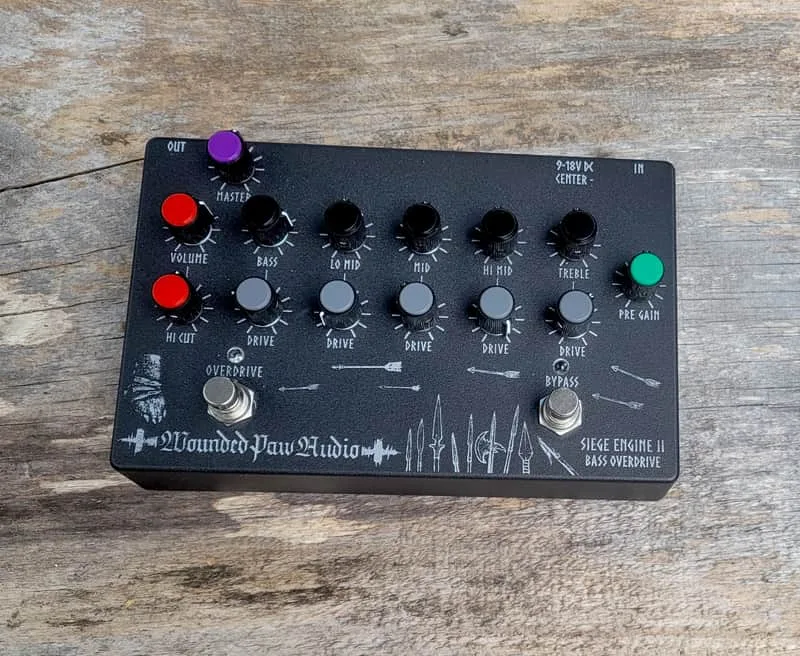


The Wounded Paw Audio Siege Engine II Bass Overdrive is a bass overdrive pedal built around a 5-band EQ and an overdrive section, so you can set the amount of gain and the tone separately at different frequencies across the bass spectrum1. Pedal of the Day's reviewer called it a pedal that "gives you more control over your low end dirt than I've ever seen"1.
How the circuit works
The signal path starts with a high impedance jfet input amp that feeds directly into a Pre Gain control. From there, the overdrive section splits the signal into five frequency bands: Bass, Lo Mid, Mid, Hi Mid and Treble. Each band gets its own overdrive, and the bands are then summed back together into one signal1.
"All the bands are summed back together to form a harmonically rich tone that still maintains the integrity of all the notes you’re playing."
Controls
| Control | What it does |
|---|---|
| Pre Gain | Pushes the overdrive section harder or lighter as desired; when pushed hard it can introduce some harmonics on its own1 |
| Bass, Lo Mid, Mid, Hi Mid, Treble Level | Sets the output level of each frequency band1 |
| Bass, Lo Mid, Mid, Hi Mid, Treble Drive | Sets how much overdrive is applied to that frequency range1 |
| Hi Cut | Works on the summed overdrive signal to tame the higher harmonics generated by mixing the overdrives together1 |
| Volume | Sets the output level of the overdrive section after the bands are summed back together1 |
The per-band Drive controls are what set this apart from a standard overdrive pedal: instead of one gain stage for the whole signal, you decide how much dirt each part of the spectrum gets, from the fundamentals up through the mids and treble1.
Footswitches and bypass
There are two footswitches. One puts the pedal in True Bypass, and the other switches the Overdrive section on or off1. In practice that means you can take the overdrive out of the circuit without removing the pedal from your signal path, and bring it back in with one stomp.
What reviewers said
Pedal of the Day reviewed the Siege Engine II on 7 September 2026. The reviewer ran it with an Ampeg Micro-VR and found it brought out tones and nuances he had not heard from that rig before: "The Siege Engine II Bass Overdrive really pushed my little Ampeg Micro-VR, in the best of ways, bringing out tones and nuances I hadn't heard before"1.
Videos
Pedal of the Day
Bass Gear Demos by Dawghouse
Questions
Is the Siege Engine II true bypass?
Yes. The pedal has two footswitches: one puts it in True Bypass, and the other switches the Overdrive section on or off. That means you can take the overdrive out of the circuit while keeping the pedal in your signal path, rather than bypassing the whole unit.
What does the Hi Cut knob do?
The Hi Cut control works on the summed overdrive signal, after the five bands have been mixed back together. Its job is to tame the higher harmonics that can build up when several overdriven frequency bands are combined, which can otherwise add up to a large amount of high-end grit.
Can you switch the overdrive off and keep the pedal in the signal path?
Yes. One footswitch handles True Bypass and a second footswitch switches the Overdrive section on or off, so the overdrive can be turned off independently of the pedal's place in your signal chain.
What does the Drive control on each band do?
Each of the five frequency bands, Bass, Lo Mid, Mid, Hi Mid and Treble, has an individual Drive control that sets how much overdrive is applied to that frequency range, alongside a Level control that sets the band's output. The overdriven bands are then summed back together.
Is the Siege Engine II made for bass only?
It is sold as a bass overdrive pedal, and its five-band approach is aimed at controlling low end dirt. The Pedal of the Day reviewer described it as giving more control over low end dirt than he had seen, and found it brought out new tones on his Ampeg Micro-VR bass rig.
Sources (1)
- Wounded Paw Audio Siege Engine II Bass Overdrive, Pedal of the Day, 2026-09-07