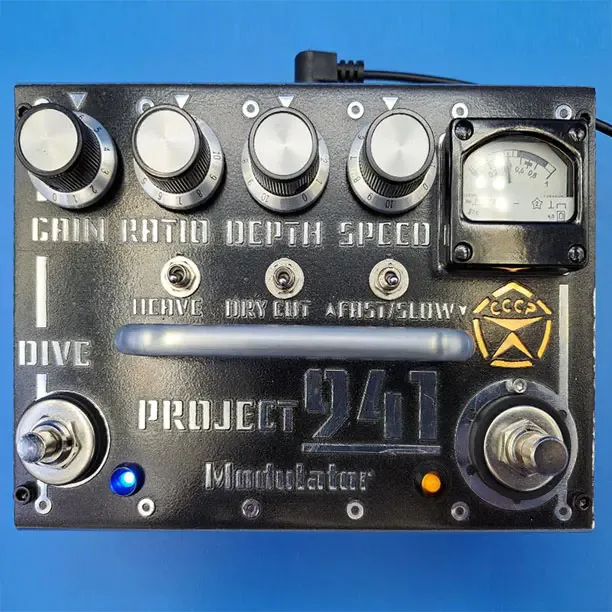

The Wrought Iron Effects Project 941 Modulator is an incandescent bulb-driven 4-stage phase shifting vibrato with a parallel dry signal, in other words a Uni-Vibe type circuit, built with 11 NOS Soviet silicon transistors1. It is the third release in the company's Cold War Series, and it features a Soviet panel meter to indicate rate1. If you are new to this family of effects, the Uni-Vibe is a classic modulation effect pedal, and the Project 941 sits among the many clones and variants of it covered on our Vibrato Pedals page1.
Delicious Audio's reviewer found the design deliberate in its aim: "Designer and company owner Ed Chaw made a particular effort to get this pedal to deliver a proper vibrato effect"1.
Where the circuit comes from
The 941 is not a straight copy of any single box. Delicious Audio describes it as an incandescent bulb-driven Vibe with roots in an old tube driven Hammond organ vibrato circuit and the original Uni-Vibe1. The original Univibe itself is a classic modulation effect pedal, and DIY builders can still work from the same blueprint: General Guitar Gadgets sells a Univibe replica project in its Modulation/Echo category, with a Ready to Solder Circuit Board offered for the project2. The Project 941 takes that same bulb-and-photocell approach and adds its own controls and switching on top.
Delicious Audio added the Project 941 to its article about the best Uni-Vibe clones and variants, its guide to this corner of the modulation world1.
The controls
The 941's control set mixes the familiar Rate and Depth knobs of a vibe with switches that reshape the effect's character1.
| Control | What it does |
|---|---|
| Rate knob | How fast the LFO cycles1 |
| Depth knob | Controls how bright the bulb flashes, which dictates how much phasing/pulsing/vibrato there is1 |
| Gain knob | Controls the gain of the final transistor stage. All the way counterclockwise is unity gain; crank it up to add some chewy overdrive1 |
| Fast/Slow toggle | Selects from 2 different speed ranges for the Rate Control1 |
| Heave toggle | Adds in a low frequency feedback path to make the effect deeper and gives a little more "throb"1 |
| Dry Cut toggle | Move this switch up if you want just the wet signal, analogous to the "vibrato" mode of a traditional Uni-Vibe1 |
| Dive footswitch | Adds in another feedback path, this one more focused in the mid range1 |
The Gain knob is worth a note, since most vibes offer no drive at all: because it controls the gain of the final transistor stage, it lets the 941 push into overdrive territory that a traditional Uni-Vibe cannot reach1.
Always-on subtlety or over-the-top pulsing
The two feedback switches and the Dive footswitch are what set the 941 apart from a stock vibe circuit. Heave deepens the effect with a low frequency feedback path, Dive adds a midrange-focused feedback path, and used together they produce what Delicious Audio calls really over-the-top pulsating sounds1.
The Project 941 was built to be an "always-on" kind of pedal, therefore a subtler-than-usual modulation effect, according to Delicious Audio1. The Dive footswitch is the escape hatch from that subtlety: with the stomp of a switch you can move between the gentle always-on sound and the extreme pulsing mode1.
Delicious Audio sums up the range this way: "Whether you want an always-on, subtle chorus/vibrato/vibe sound, or an over the top pulsating modulation, or to switch between both with the stomp of a switch, the 941 can do it"1.
Why it is called the Project 941
The name fits the Cold War Series theme. The 941 is named after the largest class of submarine ever built: the Soviet Project 941, or Akula (Shark) Class, ballistic missile submarine built in the 70s and 80s1. The Soviet parts on the pedal, the 11 NOS Soviet transistors and the Soviet panel meter that indicates rate, carry the theme through to the hardware1.
Videos
Demos In The Dark
Ed Pettersen
Questions
What does the Heave toggle do on the Project 941 Modulator?
Heave adds in a low frequency feedback path to make the effect deeper and gives a little more throb, according to Delicious Audio's write-up. Used together with the Dive footswitch, which adds a second feedback path focused in the mid range, it can push the pedal into really over-the-top pulsating sounds.
What does the Dry Cut switch do?
The Dry Cut toggle removes the parallel dry signal so you hear just the wet, phase-shifted signal. Delicious Audio describes this as analogous to the vibrato mode of a traditional Uni-Vibe, as opposed to the chorus-like mode that keeps the dry signal blended in.
Is the Wrought Iron Project 941 a Uni-Vibe clone?
Delicious Audio describes it as an incandescent bulb-driven 4-stage phase shifting vibrato with parallel dry signal, in other words a Uni-Vibe, with roots in an old tube driven Hammond organ vibrato circuit and the original Uni-Vibe. The publication added it to its article about the best Uni-Vibe clones and variants.
What does the Dive footswitch do?
Dive is a second footswitch that adds in another feedback path, this one more focused in the mid range. Used together with the Heave control, it produces really over-the-top pulsating sounds, letting you switch between subtle and extreme modulation with the stomp of a switch.
Why is it called the Project 941?
The pedal is named after the largest class of submarine ever built: the Soviet Project 941, or Akula (Shark) Class, ballistic missile submarine built in the 70s and 80s. It was the third release in Wrought Iron Effects' Cold War Series, and its Soviet parts fit the theme.
Sources (2)
- Wrought Iron Effects Project 941 Modulator, Delicious Audio, 2023-05-22
- Uni-Vibe™ Clone: DIY Univox™ Uni-Vibe™ Kit, PCB & Schematic, General Guitar Gadgets, 2014-05-18