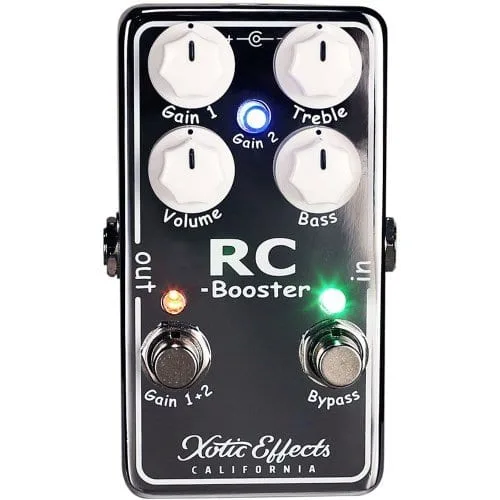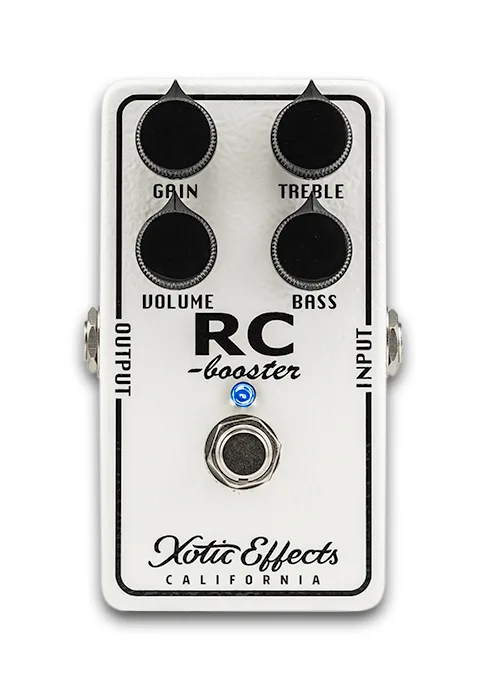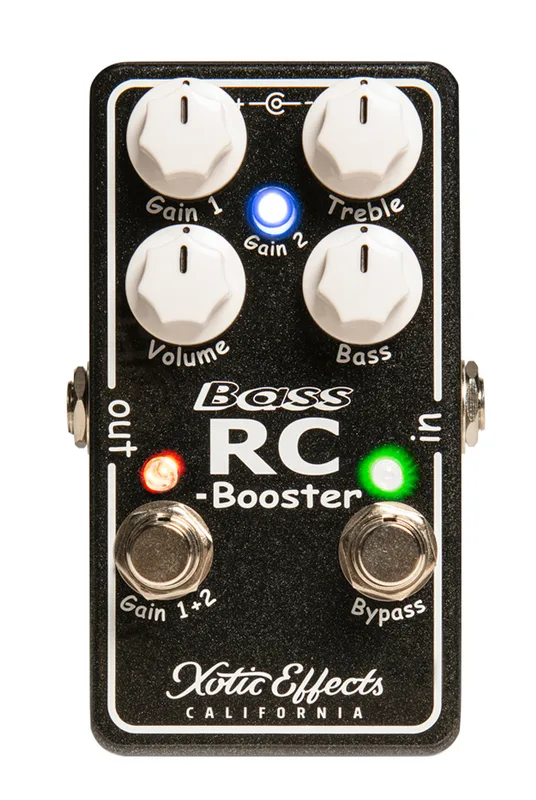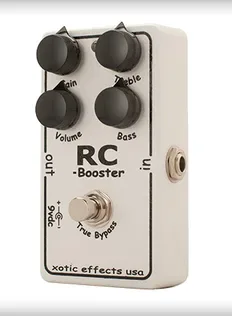


The Xotic RC Booster is a compact clean boost pedal from Xotic Effects that offers what the maker calls a "super transparent 20db+ clean boost" together with an adjustable ±15dB two-band active EQ12. Unlike a pure volume pedal in front of an amp, it gives you four knobs to shape the pushed signal: active Treble and Bass controls alongside Gain and Volume1. Xotic's manual says it can enhance other pedals, such as overdrive and distortion pedals, or you can crank the gain for a crunch sound2.
The original RC Booster went on sale in December 2002 and ran through several versions before being replaced by the RC Booster V2 in 20163. The current lineup includes the V2, the RC Booster Classic, and a Bass RC Booster V2. The original version 1 pedal is discontinued4.
What it does to your sound
The RC Booster sits in the boost and EQ family rather than the overdrive family. Its job is to raise the level of your signal cleanly, up to 20dB or more, so you can push an amp into overdrive yourself or make a solo cut through, while the active Treble and Bass controls let you correct or reshape the boosted tone12. The EQ range is ±15dB, with the manual listing control points at 90Hz, 500Hz, 1.5kHz and 10kHz2.
Because the EQ is active rather than passive, both bands can boost or cut, and the pedal stays quiet doing it. In an independent review at muzique.com, the reviewer found the pedal "top quality and dead quiet," noted that the treble and bass knobs have a center detent for boost or cut, and that the gain knob adds a slight "tube rectifier sag" that sounds amplike5.
"This pedal is top quality and dead quiet... it is my winner... The treble and bass knobs have a center detent for boost"
That review also found the pedal's EQ very flat, adding subtle girth and support, and observed that it "can't sound muddy," while calling it a little pricey5.
The controls
The original RC Booster has four knobs and a footswitch12:
| Control | What it does |
|---|---|
| Volume | Sets the overall output level |
| Gain | Sets the amount of boost; adds a slight amplike sag at higher settings5 |
| Treble | Active treble boost or cut, ±15dB, with a center detent25 |
| Bass | Active bass boost or cut, ±15dB, with a center detent25 |
| On/Off switch | True bypass footswitch2 |
The RC Booster V2 changes the layout by adding a second gain stage. Guitar Pedal X lists its controls as Gain 1, Gain 2 (a mini knob), Treble, Volume and Bass, plus a Gain 1+2 footswitch and a bypass footswitch, describing it as a "+20dB Dual Clean Boost"6. Xotic says the V2 faithfully re-created the original but "added a twist," in the form of that added gain channel4.
Power and battery
The original RC Booster runs on a 9VDC (006P) battery or an optional AC adapter taking 9VDC to 18VDC with a negative tip, regulated recommended1. The manual specifies a 2.1mm x 5.5mm DC jack, 9VDC negative center, and lists the Boss PSA, Ibanez AC109, Dunlop Brick, Voodoo Labs and 1-Spot among suitable adapters2. Current draw is 5mA at 9V1.
When an external power supply is used, the battery is disconnected from the circuit, and Xotic recommends unplugging the output jack when the pedal is not in use for longer battery life2.
Battery life is approximately 40 hours of continuous use with an alkaline battery2. The V2 and Classic draw slightly more: 6mA at 9V or 18V47.
History and versions
Xotic's own history of the pedal traces a long line of versions3:
- Engraved serial version: the earliest, with a Comic Sans font on the label, a 16mm pot and a gray epoxy substrate potted with J-B Weld. Compared with later models it has weaker highs and gain, and reads more like a pure clean booster3.
- Initial version and limited color variations: the white case was chosen by designer Kiyoshi Sasaki for a cleaner sound image than the yellow AC-Booster, which had an overdrive image3.
- Later models: the LED indicator moved to the top surface for better visibility, mostly in blue3.
- 2008 Japan limited edition: a blue model, the last limited version of the old specification3.
- RC-Booster SH (2015): a Scott Henderson signature model with Channel 1 Gain, Channel 2 Gain, Treble, Bass and Volume8.
- RC Booster V2 (2016): the previous RC-Booster was discontinued and replaced with the V2, inspired by the Scott Henderson RCB-SH model34. Version 1 production ended by the end of 20174.
- RC Booster Classic (2022): a 20th-anniversary reissue of the original design, with the same four controls and true bypass7910.
At the V2's launch, Premier Guitar reported a street price of $16811. The 20th-anniversary Classic carried a $172.00 street price in limited edition packaging, with the first 1000 pedals including picks from Xotic players including Andy Timmons, Scott Henderson, Oz Noy and Kirk Fletcher9. John Fogerty was one of the first to use the pedal, receiving it from studio personnel, and according to Xotic's history he still uses one of the earliest models3.
The bass version
Xotic also makes the Bass RC Booster V2, a transparent boost built for bass with the same 20dB+ clean boost and a two-band active EQ12. Its bass EQ cutoff is selectable between 500Hz and 800Hz, and Xotic describes it as "designed to enhance your bass guitar tone without masking it"12. Like the guitar versions it uses true bypass switching and runs on a 9V battery or a 9VDC to 18VDC negative-tip adapter, drawing 6mA12.
What reviewers said
Early coverage in Vintage Guitar magazine noted the compact baked-enamel steel chassis shared with the AC Booster13. When the V2 arrived, MusicRadar called the original "a bona fide clean boost classic" and noted that Xotic had doubled up the format with the two-channel update14. Gearnews found the V2 "looks quite fully featured" and recommended trying one, saying the choice comes down to personal taste15.
Videos
Prymaxe
shnobel
Ryan Kiesshauer
Questions
Is the Xotic RC Booster true bypass?
Yes. Every version of the RC Booster uses true bypass switching, so the pedal is out of the signal path entirely when switched off. Xotic describes this as eliminating any signal interference when the pedal is disengaged.
What does RC stand for in RC Booster?
RC stands for Rig Conductor. Xotic's own history of the pedal explains that the name comes from that term, reflecting the pedal's original purpose as a tool for driving and shaping the whole rig rather than just adding volume.
How long does a battery last in the RC Booster?
Xotic's manual rates the original RC Booster at approximately 40 hours of continuous use with an alkaline 9V battery. Unplugging the output jack when the pedal is not in use extends battery life, and connecting an external power supply disconnects the battery from the circuit.
Is there a bass version of the RC Booster?
Yes. Xotic makes the Bass RC Booster V2, a transparent boost built for bass guitar with the same 20dB+ clean boost and a two-band active EQ. Its bass EQ has a selectable cutoff at 500Hz or 800Hz, and Xotic says it is designed to enhance bass tone without masking it.
Sources (15)
- RC Booster, Xotic California
- Sparker 全容, Xotic Effects USA, 2023
- RC Booster Classic 20th Anniversary, Xotic California (xotic.us)
- RC Booster v2, Xotic California (xotic.us), 2017-12
- Reviews of boost pedals, muzique.com (AMZ Guitar Effects)
- Guitar Pedal X, Guitar Pedal X, 2023-05-17
- RC Booster Classic, Xotic California
- Scott Henderson RC Booster Launched by Xotic Effects, Premier Guitar, 2015-11-02
- Xotic Effects Introduces Revamped RC Booster, Premier Guitar, 2022-11-09
- Xotic brings back a pedalboard classic with the 20th Anniversary RC Booster, MusicRadar, 2022-11-11
- Xotic Effects Unveils the RC Booster V2, Premier Guitar, 2016-07-05
- Bass RC V2, Xotic California (xotic.us)
- Xotic RC Booster, AC Booster, Robotalk, Vintage Guitar magazine, 2005-03-30
- Xotic launches two-channel RC Booster V2 guitar effects pedal, MusicRadar, 2016-07-06
- Xotic propel RC Booster to V2, gearnews.com, 2016-07-06
 Scott Henderson