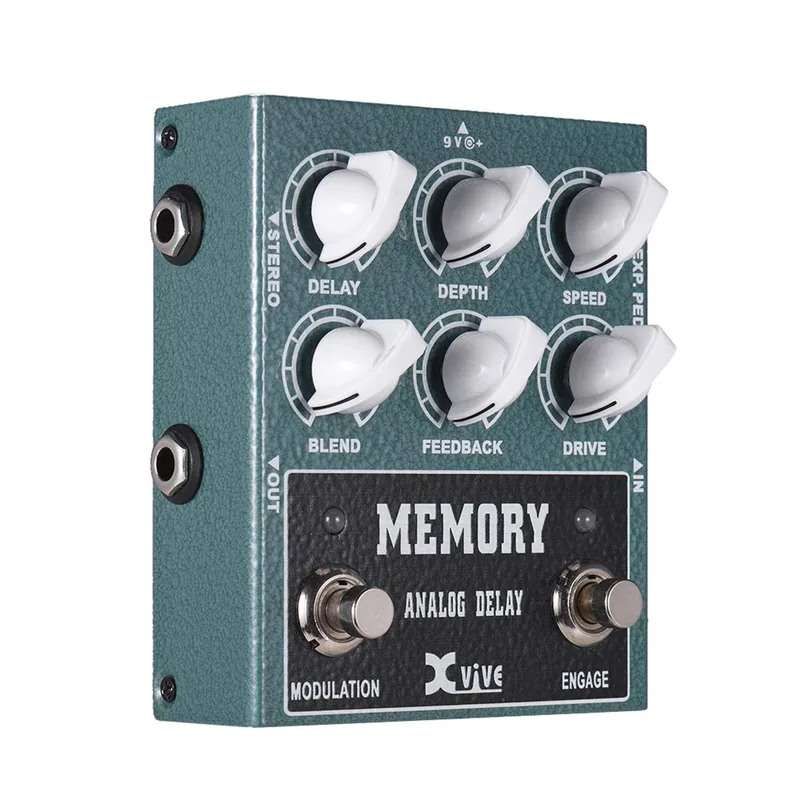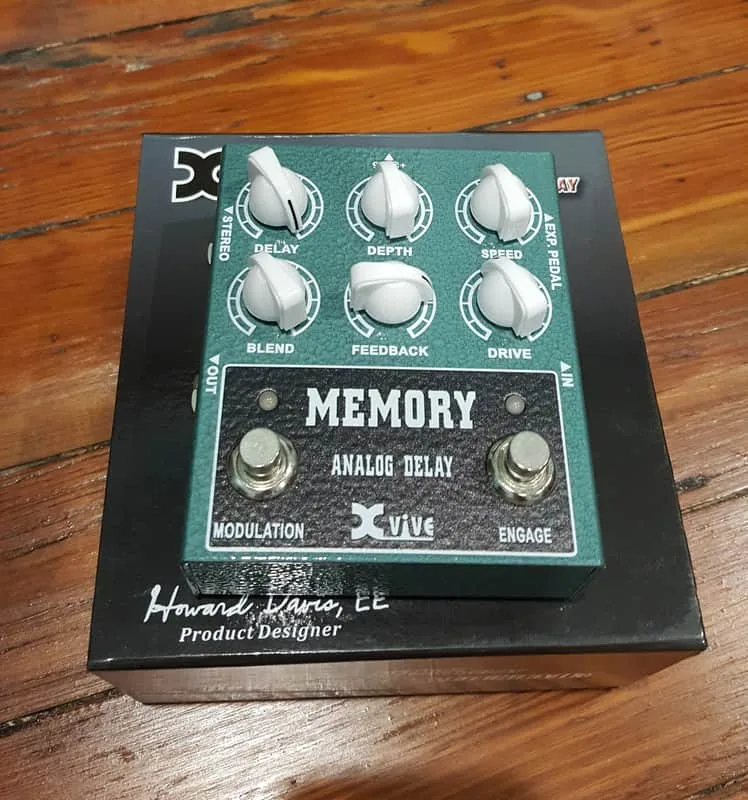

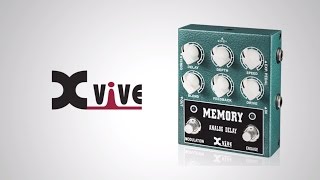
The Xvive Memory Analog Delay is a compact analog delay pedal from Xvive, designed by Howard Davis, the original designer of the Electro-Harmonix Deluxe Memory Man. It takes its inspiration from that classic big-box delay but builds on it with Xvive's own proprietary version of the Panasonic MN3005 BBD (bucket brigade device) chip that powered the original1. MusicRadar's reviewer Trevor Curwen summed it up as delivering "Familiar vintage analogue delay sounds in a reasonably sized (and priced) box"1.
The pedal offers up to 600ms of delay time, mono or stereo output, and two footswitches, with the extra one bringing in modulation set by Speed and Depth knobs1. Delay time, feedback and dry/wet blend are all adjustable, and delay time can be swept with an expression pedal if desired1.
An analog delay in the Memory Man mold
Analog delays work by passing your signal down a chain of bucket brigade stages, which gives the repeats a darker, softer character each time they circle around, in contrast to the cleaner repeats of a digital delay. The Memory Analog Delay follows the template of the Deluxe Memory Man, the Electro-Harmonix analog delay with modulation that Analog Man calls "one of the best sounding ANALOG DELAYS available"3.
Where the original DMM was a large unit, the Xvive packs the concept into a standard pedalboard-friendly box. MusicRadar's review team described it as "another Howard Davis riff on the DMM," using Xvive's own long-time-in-development proprietary version of the MN3005 BBD chip that powered the original2. Alongside the repeats, the modulation section adds movement to the echoes, and with the delay time turned right down, Curwen found "you can conjure up cool chorus and rotary speaker sounds"1.
The controls
The pedal keeps the DMM's core control set and adds a drive stage at the input1.
| Control | What it does |
|---|---|
| Delay time | Sets the spacing of the repeats, up to 600ms; can also be swept with an expression pedal1 |
| Feedback | Sets how many repeats you hear, from a single echo to runaway self-oscillation territory1 |
| Dry/wet blend | Balances your untouched signal against the delayed signal1 |
| Drive | An input knob that "can dial in a lovely degree of extra grit" into the repeats1 |
| Speed | Sets how fast the modulation moves1 |
| Depth | Sets how deep the modulation goes1 |
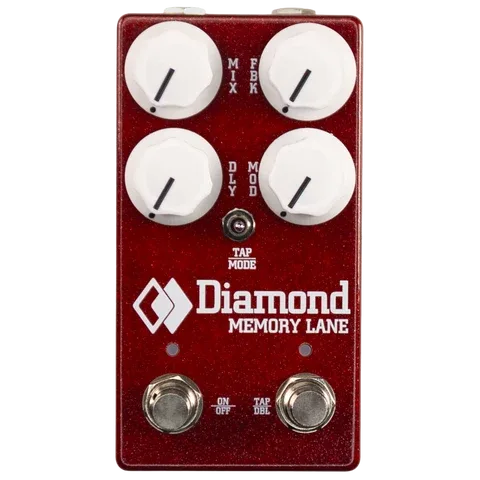
The second footswitch is the modulation switch: stepping on it brings in the Speed and Depth modulation on the repeats, the same basic idea the Deluxe Memory Man used for its chorus and vibrato sounds1. For comparison, the Diamond Pedals Memory Lane Analog Delay, another DMM-inspired pedal, gives its Speed knob a range of about 0.1 Hz to 10 Hz when maxed out4.
Where it comes from: the DMM and Howard Davis
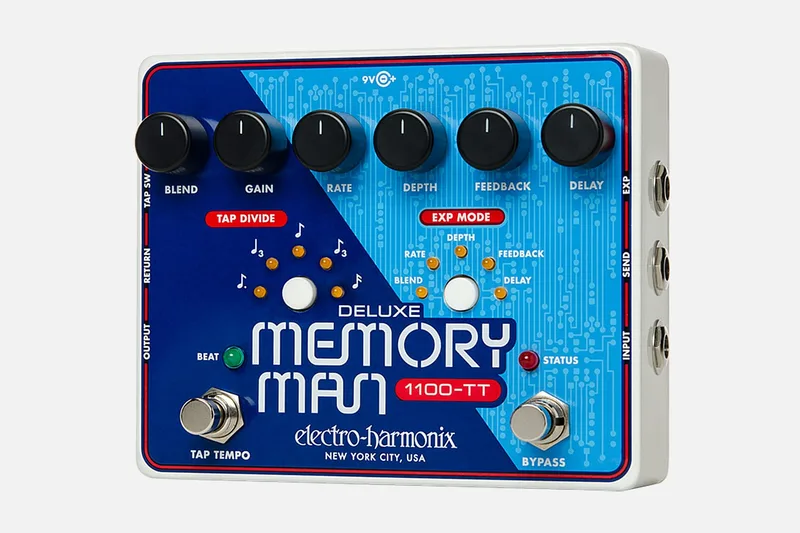
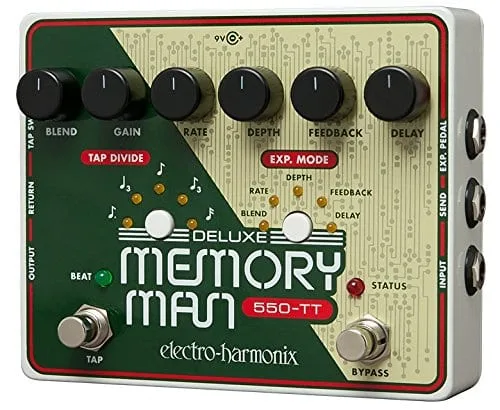
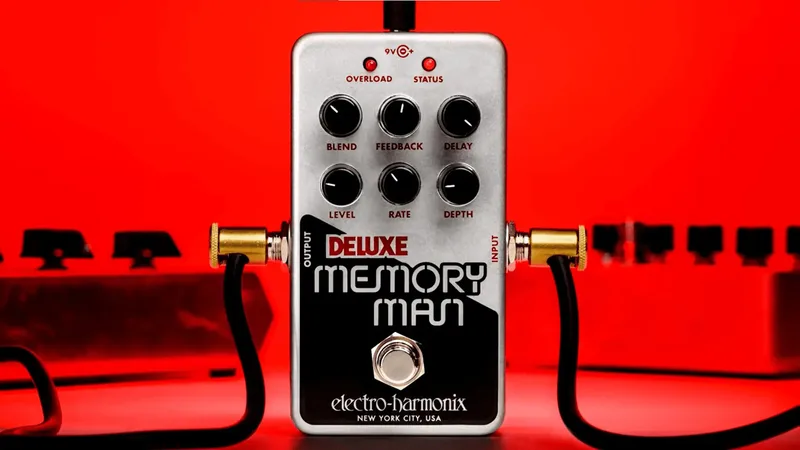
The lineage here is unusually direct. Howard Davis designed the original Electro-Harmonix Deluxe Memory Man, and the Xvive Memory Analog Delay is his own later take on that circuit2. The DMM itself has a long afterlife: it has been modded by Analog Man with four MN3005 chips, by Davis himself for extra headroom, and by FX Doctor for tap tempo and rate/depth control over the modulation5, and Electro-Harmonix has kept the format alive in versions like the Deluxe Memory Man TT-1100 Analog Delay, the 550-TT and the Nano Deluxe Memory Man.
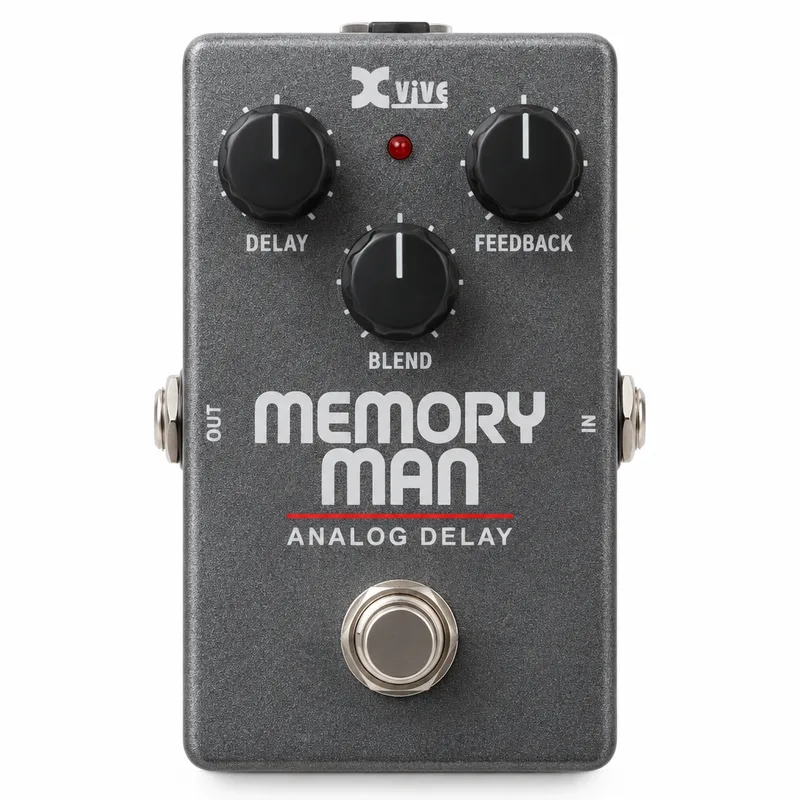
Xvive's own history with the design goes back to 2015, when the company announced a range of new pedals including the Memory Man Analog Delay (XW3, £109), described by Guitar Interactive Magazine as "an authentic, analog delay unit" designed by Davis, offering up to 600ms of delay time and complex rich modulation6. The Memory Analog Delay continues that line, with the same designer, the same 600ms ceiling and the same modulation concept in the current pedal1.
What reviewers said
MusicRadar's review was positive on both value and sound. Curwen's verdict listed "Good value. Great sounds." among the pedal's strengths1, and his review found the drive knob a genuine tonal asset rather than a gimmick, dialing in extra grit at the input1.
Videos
ProGuitarShopDemos
Sean Gibson
Alan Iarussi
Questions
Does the Xvive Memory Analog Delay have stereo outputs?
Yes. MusicRadar's review describes the pedal as having mono or stereo output, so it can run into a single amp or into two amps for a wider stereo spread of the repeats.
Can I control the delay time with an expression pedal?
Yes. MusicRadar's reviewer notes that delay time can be controlled with an expression pedal if desired, alongside the standard delay time, feedback and dry/wet blend knobs. This lets you sweep the delay time for pitch-bending repeats.
What does the second footswitch do on the Xvive Memory Analog Delay?
The pedal has two footswitches. The extra one brings in modulation, set by Speed and Depth knobs, in the style of the Deluxe Memory Man's chorus and vibrato section.
How long is the delay time on the Xvive Memory Analog Delay?
Up to 600ms, according to MusicRadar's review. With the delay time turned right down, the reviewer found you can also conjure up chorus and rotary speaker sounds.
Is the Xvive Memory Analog Delay a copy of the Electro-Harmonix Deluxe Memory Man?
Not a copy. It takes its inspiration from the Deluxe Memory Man and comes from that pedal's original designer, Howard Davis, but it uses Xvive's own proprietary version of the Panasonic MN3005 BBD chip that powered the DMM rather than the original circuit.
Sources (6)
- Xvive Memory Analog Delay review, MusicRadar, 2015-12-23
- J Rockett Audio Designs Clockwork Echo review, MusicRadar, 2021-12-23
- aNaLoG.MaN Guitar Effects Electro-Harmonix pedals, analogman.com, 2024
- Diamond Pedals Memory Lane Delay, Pedal of the Day, 2016-02-07
- Readers Pedalboards #5 Illustriously Illustrated, Origin Effects, 2017-02-13
- Xvive Release Selection of New Pedals Including First Artist-Inspired Line, Guitar Interactive Magazine, 2015-10-16