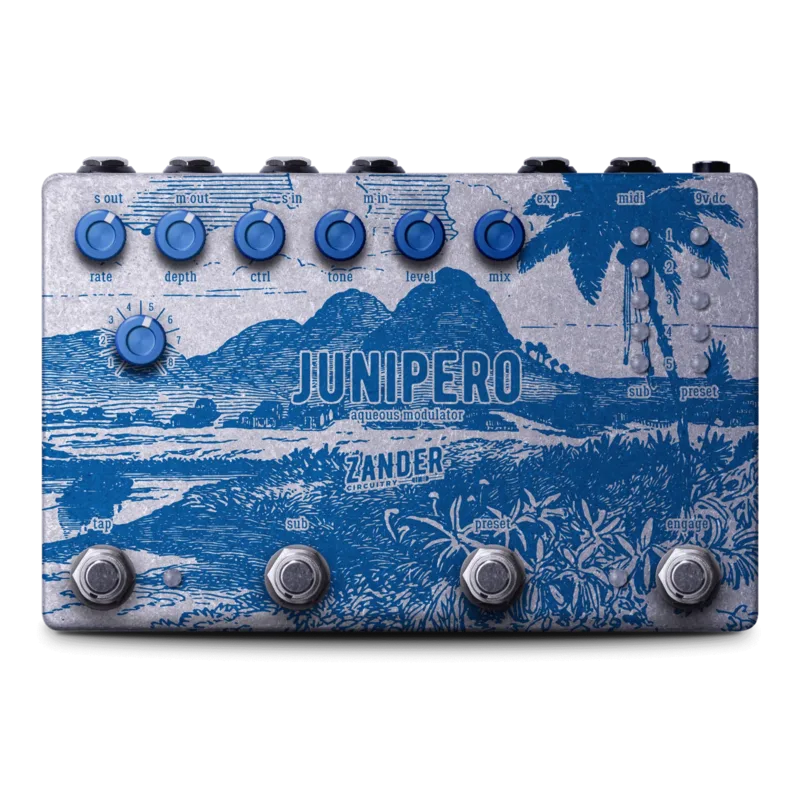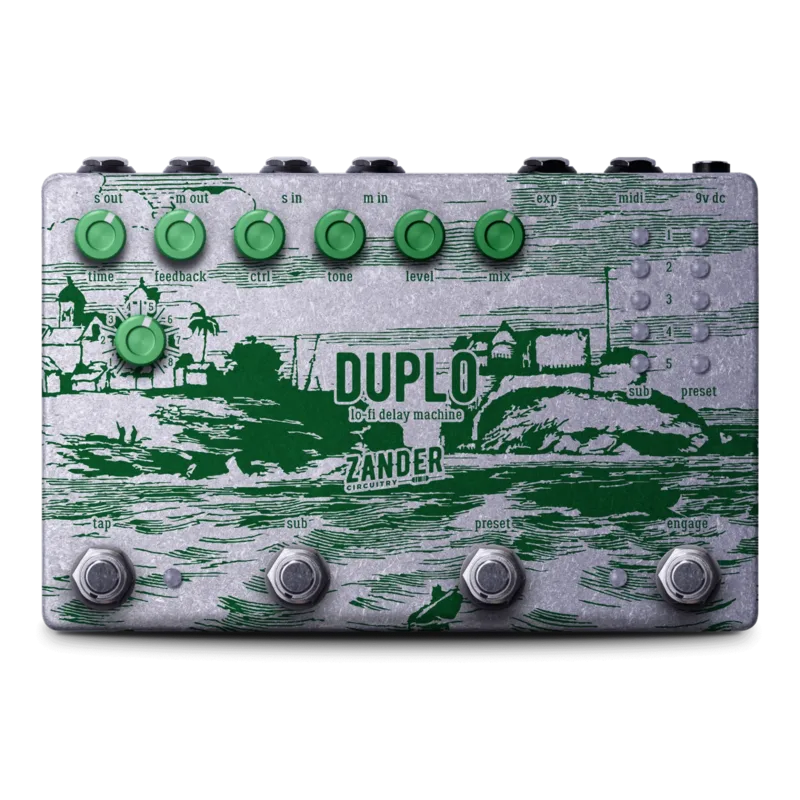

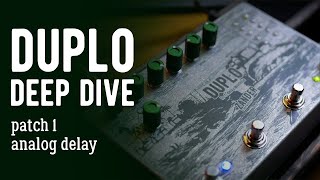

The Zander Circuitry Duplo is a lo-fi delay pedal with eight different modes, built to deliver what the maker calls "the classic, well-worn sound of vintage units." Rather than one delay voice, it covers a spread of characters: analog-style repeats with modulation and grit, tape-style multi-head echoes, and the aliasing artifacts of the PT2399 digital delay chip. It was released in January 2021, built on the four-footswitch format Zander Circuitry had already established with its Junipero pedal, a platform the maker used as the base for a line of multi-mode pedals1.
Zander Circuitry states the Duplo is not available for purchase in the UK or EU due to ROHS non-compliance, because of the optocouplers used in the pedal2.
The modes, from pink-box analog to PT2399
The Duplo's eight modes are where its character lives. Delicious Audio's Paolo De Gregorio described it as "the full-featured lo-fi delay machine you've been dreaming about, with eight different modes that'll bring buckets of character to your playing"1. The modes the maker and press describe:
| Mode | What it does | What the CTRL knob does |
|---|---|---|
| Analog | A throwback to the '80s, voiced to replicate "pink box" analog delay pedals | Adds modulation ramping to filtering and headroom reduction for analog-style distortion2 |
| Tape | The bright, crispy, fresh-out-the-box sound of a new tape delay unit | 1 |
| PT2399 | A more modern sound based around the digital delay chip prized by boutique builders in the early 2000s | Increases filtering and introduces aliasing2 |
| Multi-head (slapback/echo) | Tape-style delay with an extra tape head set up for a classic slapback sound | Changes the delay time of the second tape head, up to roughly 150 milliseconds2 |
| Multi-head (triplets) | Extra tape head set to triplets for intricate rhythms | Changes the volume of the second tape head2 |
| Multi-head (dotted eights) | Extra tape head set to dotted eights for intricate rhythms | Changes the volume of the second tape head2 |
| Multi-head (golden ratio) | "Pseudo-reverb magic of intricate dual repeats that crash into each other, without getting in their own way" | 1 |
The Analog mode is a deliberate nod to a specific sound: the "pink box" analog delay pedals of the 1980s. The PT2399 mode goes the other direction in time. The PT2399 is an echo processor that Aion FX describes as technically digital but warmer and analog-voiced, with characteristics similar to a tape delay unit, and with lower complexity and cheaper parts than a BBD-based delay3. Pedal of the Day notes it was the chip designs like this were built around in lo-fi echo projects4. Delicious Audio calls it "the digital delay chip prized by boutique builders in the early 2000s"1, and in the Duplo the CTRL knob deliberately pushes it into filtering and aliasing, the artifacts lo-fi players chase.
The controls and footswitches
The Duplo has four footswitches, a format inherited from the Junipero1, plus knobs for Time and CTRL:
| Control | What it does |
|---|---|
| Time knob | Delay time, 0 to 985 milliseconds2 |
| CTRL knob | Secondary parameter, different in each mode2 |
| Engage footswitch | Turn it on and off2 |
| Preset footswitch | Access your favorite sounds2 |
| Tap footswitch | Set the tempo2 |
| Sub footswitch | Pick the tap tempo subdivision2 |
Tap tempo comes with five subdivisions: quarter, eighth, dotted eighth, triplet, and sixteenth notes2. That pairs naturally with the multi-head modes, where a second tape head set to triplets or dotted eights can build intricate rhythms against the main repeat.
Power and connections: stereo, MIDI and expression
The Duplo runs on a 9V DC center-negative supply and draws 250 mA2. That current draw is well above what a standard 9V battery or a small daisy chain can comfortably supply, so a dedicated pedalboard power output is the practical choice.
Connections are all top-mounted: input and output jacks with full stereo options, an expression pedal input, and MIDI compatibility2. With a MIDI controller the preset count expands from the five onboard slots to 1282, which lets the pedal sit at the center of a larger rig. The expression input opens the Time and CTRL parameters to foot control, useful for the modes where CTRL sweeps filtering or second-head volume.
Zander Circuitry publishes an instruction manual for the Duplo, available as a download from the product page2.
Videos
Zander Circuitry
Zander Circuitry
Zander Circuitry
Questions
Why can't I buy the Zander Circuitry Duplo in the UK or EU?
Zander Circuitry states the Duplo is not available for purchase in the UK or EU because it is not ROHS compliant, owing to the optocouplers used in the pedal. Players in those regions cannot buy it directly from the maker.
How many presets does the Duplo hold?
The Duplo has space for up to five onboard presets, accessed from the Preset footswitch. It is also MIDI-compatible, and with a MIDI controller you can expand to 128 presets.
What is the maximum delay time on the Duplo?
The Time knob sets delay time from 0 to 985 milliseconds. In the Multi-head slapback mode, the CTRL knob changes the delay time of the second tape head up to roughly 150 milliseconds.
Does the Zander Duplo work in stereo?
Yes. The Duplo has top-mounted input and output jacks with full stereo options, so it can run as part of a stereo rig.
What tap tempo subdivisions does the Duplo have?
The Sub footswitch picks the tap tempo subdivision, with five to choose from: quarter, eighth, dotted eighth, triplet, and sixteenth notes. The Tap footswitch sets the tempo.
Sources (4)
- New Pedal: Zander Circuitry Duplo Lo-Fi Delay, Delicious Audio, 2021-01-19
- Duplo - Zander Circuitry, Zander Circuitry, 2020-09-11
- Vector Ambient Delay / MP Deep Blue Delay, Aion FX, 2019-03-03
- Friday Club ED-450b Echo Machine, Pedal of the Day, 2020-01-21