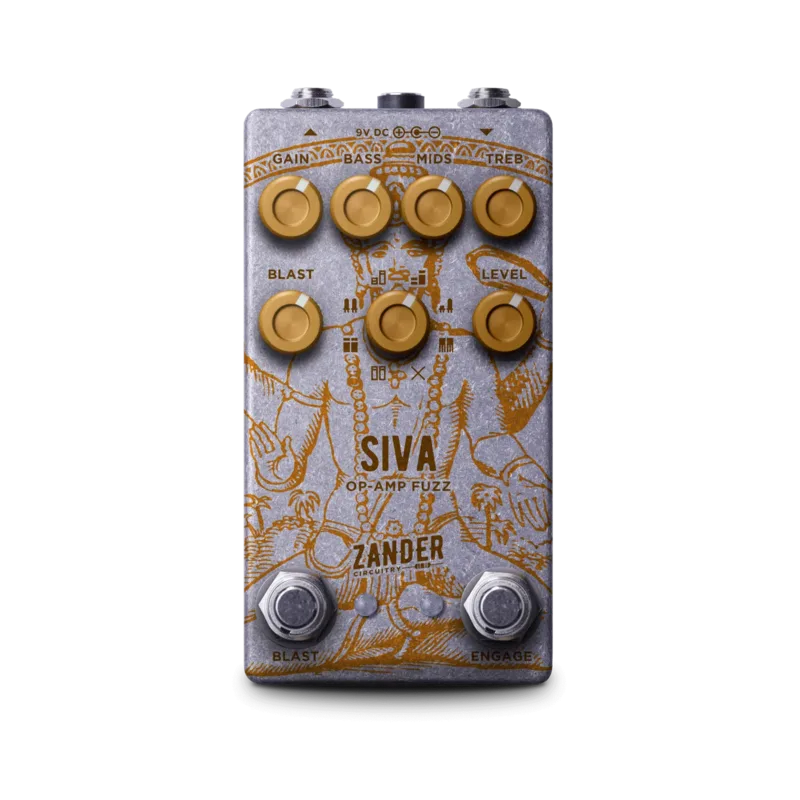


The Zander Circuitry Siva is an op-amp fuzz pedal, the company's take on the classic 1970s op-amp model of the 'Big M' fuzz circuit. Zander describes it as delivering crushing walls of gain and a sound that's bigger than 'big', and sets it apart from other Muff-style pedals with a powerful three-band tone stack, giving more control and creativity over the gain sound1. It sits in the fuzz and distortion family, alongside the maker's transistor-based American Geek1.
Where it came from and how it differs from the American Geek
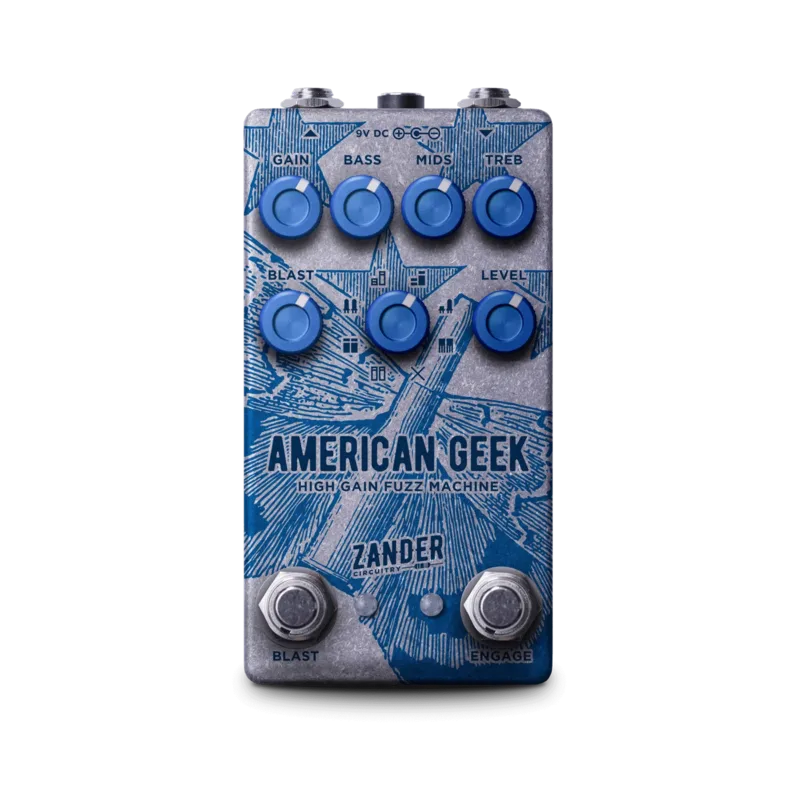
The Siva is one of two 'Big M' style fuzzes in the Zander Circuitry range. The American Geek is the company's transistor-based version of the same circuit; the Siva uses an op-amp design instead. Both pedals carry the same three-band tone stack, with the Siva as the op-amp alternative12. Reviewing a pair of the company's fuzzes, Guitar Pedal X's Stefan Karlsson called them "A fantastic pair of Multi-Muffs - one Transistor-based, and the other OpAmp / IC style Muff Circuit"3.
"The classic 1970s op-amp model has a tone and feel that’s all its own, delivering crushing walls of gain and a sound that’s bigger than ‘big’."
The controls
The Siva carries six knobs and two footswitches. The tone stack gives separate Treb, Mids and Bass controls, which is the pedal's main departure from a conventional Muff-style layout1.
| Control | What it does |
|---|---|
| Gain | Gain control |
| Level | Output volume |
| Treb | High end adjustment |
| Mids | Mid-range adjustment |
| Bass | Low end adjustment |
| Rotary | Clipping diode selector |
| Footswitch | Function |
|---|---|
| Engage | Turns the pedal on and off |
| Blast | Activates Blast mode |
Blast mode
The Blast footswitch turns the drive all the way up and activates a second volume control, for seamless transitions between low and high-gain sounds. In practice that means the pedal can be set for a moderate rhythm sound and pushed into full gain, with the second volume setting the level of the boosted sound1.
The clipping selector
The Rotary knob selects the clipping diodes, and each position changes the character of the gain1:
- Transistor/MOSFET: Similar to silicon, but sweeter and crunchier
- Silicon: Louder, brighter, and a little bit brittle
- LED: Louder again, with less saturation and more punch
- Asymmetrical LED: A more aggressive version of LED
- Germanium: Smooth, sweet, and classically 'amp-like'
- No diodes: Loads of output and much less gain
The No diodes position removes clipping from the circuit entirely, giving much less gain but lots of output, which shifts the pedal toward an overdrive-like character rather than full fuzz1.
Power and practicalities
The Siva runs on a 9V DC center-negative supply and draws 140 mA1. That draw is well beyond what a 9V battery or a low-current daisy-chain output typically provides, so plan a dedicated supply output for it on a board. The top-mounted in/out jacks and compact 67 x 122 x 60 mm enclosure suit tight pedalboard layouts1.
Videos
Zander Circuitry
Zander Circuitry
Zander Circuitry
Questions
Is the Zander Circuitry Siva based on the Big Muff?
Yes. Zander Circuitry describes the Siva as its take on the classic 1970s op-amp model of the 'Big M' fuzz circuit, the same circuit family the Big Muff belongs to. Guitar Pedal X characterised it as an OpAmp / IC style Muff circuit, and paired it with the company's transistor-based American Geek as a complementary pair of Muff-style pedals.
What is the difference between the Siva and the American Geek?
Both are Zander Circuitry fuzzes built on the 'Big M' circuit and both carry the same powerful three-band tone stack. The difference is the gain stage: the American Geek is the company's transistor-based version of the circuit, while the Siva uses an op-amp design. Guitar Pedal X described the two as a fantastic pair of Multi-Muffs, one transistor-based and the other op-amp/IC style.
What does Blast mode do on the Siva?
The Blast footswitch turns the drive all the way up and activates a second volume control, letting you move seamlessly between low and high-gain sounds during a performance. The other footswitch, Engage, turns the pedal on and off as usual.
What power supply does the Siva need?
The Siva runs on a 9V DC center-negative supply and draws 140 mA. That current draw is high enough that a battery or a shared daisy chain with other pedals may not be adequate, so a dedicated supply output is the safer choice.
Can the Siva be used with bass?
The maker's product page lists the Siva under fuzz and distortion and does not make a specific bass claim. What the pedal does offer that suits bass players is the three-band tone stack, including a dedicated Bass control for low-end adjustment, plus a No diodes clipping position with loads of output and much less gain.
Sources (3)
- Siva - Zander Circuitry, Zander Circuitry, 2024-01-01
- American Geek, Zander Circuitry, 2024-01-01
- Guitar Pedal X, Guitar Pedal X, 2024-06-24