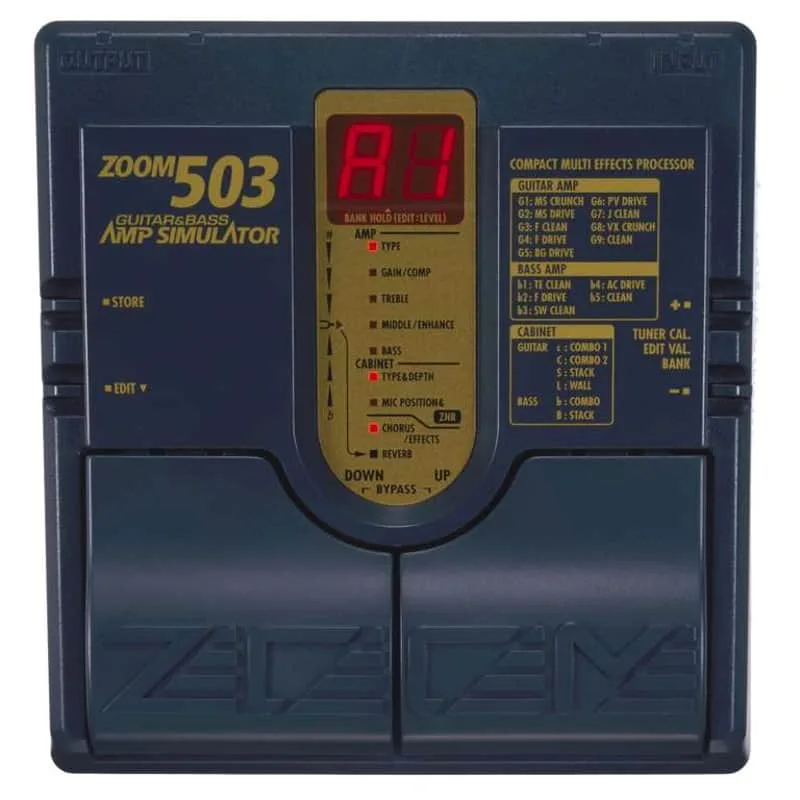

The Zoom 503 is a Zoom Guitar and Bass Amp Simulator, a foot pedal from the maker's 500 series of guitar foot pedals. Its primary aim, as Sound On Sound's John Walden put it in his October 1998 review, is to provide both the guitar and bass player with a range of different "classic" amplifier and speaker cabinet simulations, along with multi-effects1. It sits in the amp-and-cabinet modeling corner of the multi-effects family rather than being a single-effect stompbox.
What it is and how it is built
The 503 is constructed from molded plastic and measures about 15cm square by five cm high. Walden found it "seems robust", though he sounded a note of caution about the construction in his review1. The front panel includes two foot-operated pedals used for patch selection, and the central strip carries a two-digit LED that displays either the patch number or a parameter value when editing1.
On the rear panel there are two mono inputs labeled LOW and HIGH, recommended for guitars with humbucking and single-coil pickups respectively. The only other connection on the back panel is for the external power supply, which is included in the price, although the unit can also be powered from a standard 9V battery1. The processed signal arrives at the stereo output, which provides a feed to your guitar amp, mixer or headphones1.
Patches and banks
The 503 can store a maximum of 24 patches, arranged in six banks of four and labeled A1 to F4. As supplied, banks A to D are configured for guitar and E and F for bass, so the unit arrives sorted by instrument and you select patches with the two foot pedals1.
Amp types and how Gain behaves
A total of 15 amp and six cabinet types are available. Among the named models, the G2 "MS DRIVE" is a "British" tube stack amp in overdriven mode, the G6 "PV DRIVE" is a high-gain tube stack amp with heavy metal in mind, and the G7 "J CLEAN" is a clean style combo amp. On the bass side, b1 "TE CLEAN" is a clean bass amp with strong midrange and b4 "AC DRIVE" is an overdriven bass amp sound1.
The remaining model is configured as "flat" (FL), which allows access to the EQ, or the amp simulation can be turned off completely1.
How the Gain control behaves depends on the model you have dialed up1:
- For the overdriven amp types, the Gain setting adjusts the distortion intensity1
- For the "clean" amp models, the Gain setting adjusts the compressor on the guitar amps or the limiter on the bass amps1
That second behavior is worth knowing when you edit a patch: on a clean model, turning Gain up is not adding grit, it is pushing more compression or limiting into the sound1.
What reviewers said
Sound On Sound's verdict on the sound quality was strongly positive. Asked how the 503 sounded, Walden answered: "The short answer is very impressive." He noted that while some of the factory presets were a little toppy for his taste, simple editing sorted that, and described the overdriven amp types as producing sounds ranging from mild, edgy distortion suitable for blues through grungy, fat sounds to a smooth, really overdriven lead tone1.
Videos
Gearfacts
IdecsMusicConsulting
Questions
Can the Zoom 503 run on a battery?
Yes. Alongside the external power supply, which is included in the price, the 503 can also be powered from a standard 9V battery, so it can be taken to a gig or rehearsal without a mains adapter.
Does the Zoom 503 come with a power supply?
Yes. The back panel carries a connection for an external power supply, and Sound On Sound's 1998 review notes that the supply is included in the price of the unit.
What are the LOW and HIGH inputs on the Zoom 503 for?
The rear panel has two mono inputs labelled LOW and HIGH. LOW is recommended for guitars with humbucking pickups and HIGH for guitars with single-coil pickups, so you can match the input to the output strength of your instrument.
How many patches does the Zoom 503 hold?
The 503 can store a maximum of 24 patches, arranged in six banks of four and labelled A1 to F4. As supplied, banks A to D are configured for guitar and banks E and F for bass.
Can the Zoom 503 be used with bass?
Yes. It is sold as the 503 Guitar and Bass Amp Simulator, with amp models and factory patches for both instruments: banks A to D are configured for guitar and E and F for bass as supplied, and the clean bass amp models use a limiter where the guitar models use a compressor.
Does the Zoom 503 have a stereo output?
Yes. The signal arrives at a stereo output that provides a feed to your guitar amp, mixer or headphones, so it can be used direct as well as in front of an amplifier.
Sources (1)
- Zoom 503, Sound On Sound, 1998-10