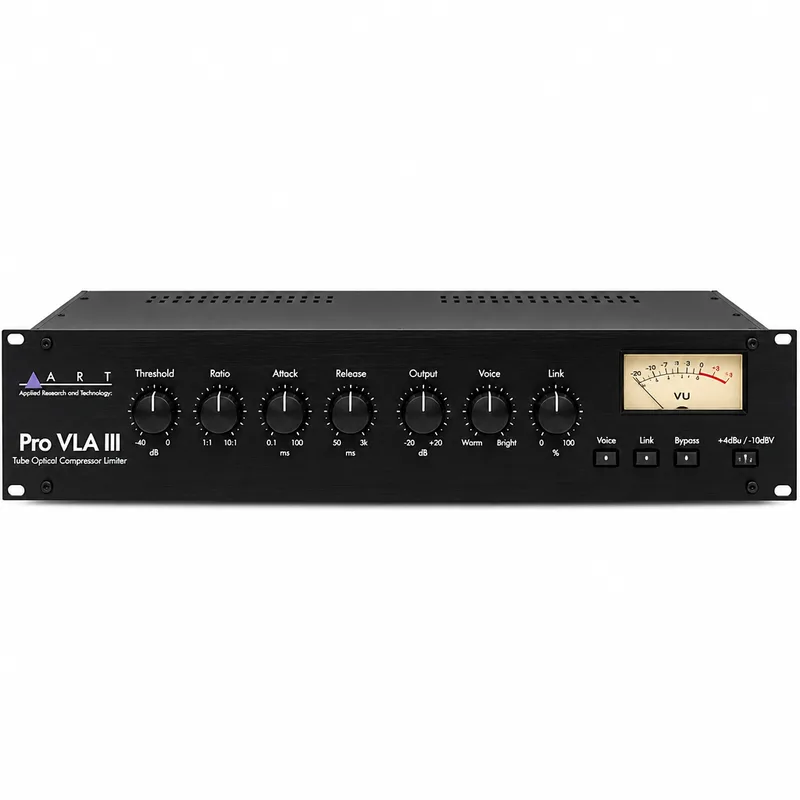


The ART Pro VLA III is a two-channel rack compressor and limiter from Applied Research and Technology, a "Multivoice Tube/Opto Compressor" aimed at tracking, mixing, mastering, live sound and broadcast audio1. Where a typical compressor pedal uses solid state feed-forward circuitry for level detection, the Pro VLA III uses an optical method, which ART describes as very musical, combined with a hand selected 12AT7 tube gain stage1. It is an analog unit, rack-mountable in an all-steel enclosure, and ART describes its sound as transparent and classic1.
How it works
The core of the unit is its level detection. ART explains that unlike typical compressors, which use solid state feed-forward circuitry to control level detection, the Pro VLA III uses the optical method, which the company calls very musical1. In practice this means a light-dependent element senses the signal level and controls gain reduction, an approach known for its smooth, program-dependent behavior. The signal then passes through the 12AT7 tube gain stage, and the Voice switch lets you choose whether the tube stays in the output path or is bypassed by a solid-state circuit1.
The controls
Each channel carries the same core control set, and a Link switch ties the two together for stereo work1.
| Control | What it does |
|---|---|
| Threshold | Sets the level at which the compressor engages; counter-clockwise lowers it, clockwise raises it1 |
| Ratio | Sets the compression slope, 1.25:1 to 20:11 |
| Attack | Sets how fast the unit responds to level increases by reducing gain, 0.25ms to 50ms1 |
| Release | Sets the recovery time, 150ms to 3s1 |
| Output | Variable output level, up to +20dB of gain1 |
| Voice | Switches the signal path from the tube output to a solid-state circuit; Tube position warms the source and clips peaks musically1 |
| Link | Ties both channels' output attenuation to the CH1 Output knob and moves CH1's detector controls and Bypass switch to the CH1 controls1 |
In Link Mode the Channel Two Output Level control changes roles: it becomes a Balance control, adjustable 7dB total from center, with one channel going up 3dB while the other goes down 4dB1. The unit runs in dual independent or stereo modes, and Link Mode gives you a master volume and balance control over both channels at once1.
Metering
The Pro VLA III gives you three views of what it is doing: VU metering of output levels, a 10-segment LED gain reduction meter, and an LED average/peak input level meter1. The meters follow the I/O level switch. "0" VU on the analog VU meter corresponds to +4dBu, about 0.75 volts RMS, when the Output level switch is set to +41. On the input LED meter, "0" corresponds to 0dBu in the +4 mode and -10dBV in the "-10" mode1.
Power and connections
The unit runs from an internal universal power supply designed for 100-240VAC, 50/60Hz mains, connected through an IEC connector that holds the mains fuse in a pull-out drawer1. The fuse is a T1A/250V type, and ART says to replace it only with the same spec1. There is no battery or pedalboard-style DC option; this is mains-powered studio gear.
Each channel offers an active balanced output on both a 1/4-inch TRS jack and an XLR jack, with matching XLR balanced and 1/4-inch TRS active balanced inputs1. Pin 2 is hot on XLR, tip is hot on TRS, and the output presents 100 ohms into a balanced or unbalanced load, with 10k ohm input impedance1. The inputs are designed for line level signals from -30dBm to +20dBm, and the +4dBu / -10dBV switch matches professional or consumer level gear1.
The Pro VLA III has a passive hardwire bypass, so it passes signal even with the power off. On power loss, Channel Two is bypassed, which matters if you are running a stereo signal in Link mode1.
Rack mounting and specifications
The unit mounts in a standard 19-inch rack with the supplied rackmount screw kit; ART says to remove the feet first and to leave 1U of space above and at least 10 cm (4 in) at the rear for ventilation1. The shipping carton contains the Pro VLA III, a QuickStart Manual and an IEC power cord1.
| Specification | Value |
|---|---|
| Frequency response | 10Hz to 50kHz (+0 / -1dB)1 |
| Dynamic range | >100dB1 |
| Noise | -99dBm 'A' weighted EIN (+4dBu mode); -107dBu ('A' weighted) in -10dBv mode1 |
| THD | <0.005% @ 0dBm out (solid state)1 |
| Maximum input | +20dBu (+4dBu mode) / +10dBv (-10dBv mode)1 |
| Maximum output | +23dBu (R load > 10k, 0.1% THD)1 |
| Maximum attenuation | 30dB1 |
| Dimensions (HWD) | 3.5" x 19" x 9.2" (8.9 cm x 48.3 cm x 23.4 cm)1 |
| Weight | 10.5 lbs / 4.76 kg1 |
One habit worth building: ART notes the tube circuitry needs between one and three minutes to warm up and stabilize from a cold power up, so let it settle before making final level judgments1.
Videos
Andrew Chapman Creative
David Larsen
Can't Afford To Record and ART Pro Audio
Questions
Can you use the ART Pro VLA III with a guitar?
Yes, with the right connections. The inputs are designed for line level signals from -30dBm to +20dBm, and a +4dBu / -10dBV switch lets you match professional or consumer level gear. A guitar needs to feed it a line level signal first, for example from a preamp, since the unit has no instrument input.
Does the Pro VLA III pass signal when it is turned off?
Yes. The Pro VLA III has a passive hardwire bypass, so the bypass works even if the power is off. Note that on power loss, Channel Two is bypassed, so in Link mode a stereo signal would fall back to one channel passing through.
What does the Voice switch do on the Pro VLA III?
It switches the signal path from the output of the tube to a solid-state circuit. In the Tube position ART says the tube warms the source material and clips peaks musically; the solid-state position takes the tube out of the output path.
What tube does the ART Pro VLA III use?
One hand selected 12AT7 tube gain stage. The tube is part of the gain stage that follows the optical level detection circuit, and ART describes the overall character as transparent and classic.
How long does the Pro VLA III take to warm up?
Between one and three minutes from a cold power up. ART states the tube circuitry needs that long to warm up and stabilize, so give it a moment before judging its sound or setting final levels.
Sources (1)
- om-PROVLAIII.pdf, Applied Research and Technology, 2026