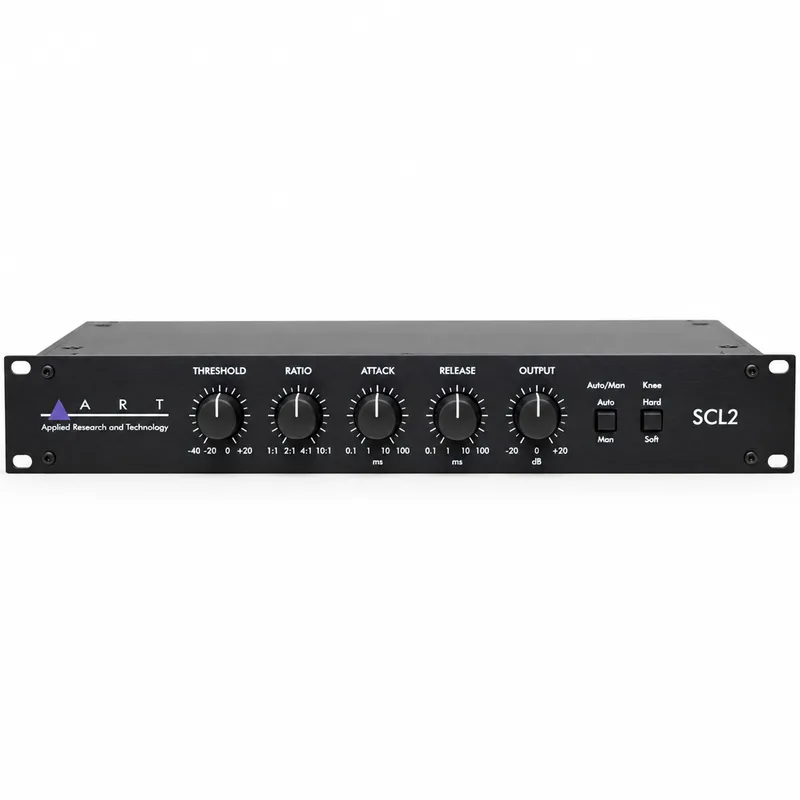


The ART SCL2 is a dual-channel rack unit from Applied Research and Technology that combines a compressor, expander, gate and limiter in one chassis. It is a studio and live-sound dynamics processor rather than a guitar pedal: its inputs are designed for line-level signals ranging from -30dBm to +20dBm, so it sits in a rack processing mixer channels, keyboards or recorded tracks rather than taking a passive guitar signal directly1. For players, it belongs to the same family of tools as compressor pedals, but at line level and in a 19-inch rack format.
ART houses the SCL2 in a rack-mountable, all-steel enclosure designed for continuous professional use, and covers it with a 3-year parts and labor warranty valid in the United States; units purchased outside the US are serviced by an authorized distributor1.
The controls
Each of the SCL2's two channels of dynamics processing carries the same control set, and the manual explains what each one does1.
| Control | What it does |
|---|---|
| THRESHOLD | Sets the point at which the SCL2 acts on a signal; counter-clockwise lowers the threshold, clockwise raises it |
| RATIO | Variable threshold and ratio controls; slope is variable from 1:1 to 20:1 |
| ATTACK | Sets the time the compressor/limiter takes to respond to increases in signal level; 0.25mSec. to 100mSec., variable |
| RELEASE | Sets how quickly gain reduction recovers; 100mSec. to 3 Sec., variable |
| OUTPUT | Channel 1 knob controls Channel 1 output level and serves as master output in Link Mode; Channel 2 LEVEL works as a balance control in Link Mode, muting the opposite channel 20dB at full turn |
| Auto/Man switch | In Auto mode the detector applies an optimized attack and release; ATTACK and RELEASE controls have no effect in Auto |
| Knee switch | Selects Hard or Soft knee operation |
The knee switch is worth a closer look for anyone comparing compressors. In Hard knee mode, gain reduction begins at full strength once the signal crosses the threshold. In Soft knee mode, the slope gradually increases over an input range of about 10dB, so compression eases in around the threshold rather than starting abruptly1.
The manual also gives starting points for common jobs. For vocal and instrument leveling, a good starting point for speech is a Ratio of 2:1 with gain reduction of 3 to 9dB1.
Stereo link and metering
The SCL2 offers selectable stereo linking of its two channels. In Link Mode, the gain reduction of the two channels is connected for stereo operation: Channel 1's controls become the master and Channel 2's controls are ignored, though the bypass switches remain independent. This keeps a stereo pair, such as a keyboard output or a stereo guitar rig, locked together so one channel does not duck while the other sails through1.
Metering comes from two LED systems. The Compressor Attenuation LED Meter shows gain reduction: the yellow (0) LED illuminates when the input signal reaches or exceeds the compressor detector threshold and results in a reduction of 0.5dB or more. The Output Level LED Meter displays the signal level at the output, where "0" corresponds to 0dBu (.775 VRMS) at the output jacks1.
Power and connections
The SCL2 runs on an internal power supply designed for 105 to 125VAC at 50 to 60Hz, drawing 60 Watts Maximum and 10 Watts Idle. Export units are configured for the country of destination. There is no battery or pedalboard-style DC option; this is mains-powered rack gear1.
The internal supply means the SCL2 runs from the mains, not from a pedalboard power supply or a daisy chain. It operates at 105 to 125VAC, 50 to 60Hz, drawing up to 60 Watts (10 Watts idle), and needs a rack or shelf of its own.
Connections are fully balanced. Each channel has XLR balanced inputs and outputs plus 1/4" TRS active balanced inputs and outputs. The inputs are designed for line-level signals from -30dBm to +20dBm, with a maximum input level of +21dBu and a maximum output level of +21dBu. Input impedance is 10k Ohms, and the output presents 100 Ohms into an unbalanced load or 200 Ohms into a balanced load. Output gain goes to +20dB max1.
The measured performance from the manual:
| Specification | Value |
|---|---|
| Frequency response | 10Hz to 100kHz (+/- 0.5dB) |
| Dynamic range | >124dB (20-20kHz) |
| Equivalent input noise | -97dBu (20-20kHz) |
| THD @ 0dBm out | 0.05% (typical) |
| Attack time | 0.25mSec. to 100mSec., variable |
| Release time | 100mSec. to 3 Sec., variable |
| Slope | 1:1 to 20:1, variable |
For service in the US, ART asks owners to request a return authorization through www.artproaudio.com by selecting "Support" and then "Return Authorization Request"; support can also be reached at support@artproaudio.com1.
Videos
askdrtk
brotherUU
Gadget RushX
Questions
Can the ART SCL2 be used with a guitar?
The SCL2 is built for line-level signals, with inputs designed for levels from -30dBm to +20dBm, not the low-level output of a passive guitar pickup. A guitar would need to feed a preamp or other device first to raise it to line level before reaching the SCL2.
Does the ART SCL2 have an auto attack and release mode?
Yes. The Auto/Man switch changes the detector to apply an optimized attack and release that ART says cannot be achieved with manual settings. In Auto mode the ATTACK and RELEASE controls have no effect.
What is the difference between hard and soft knee on the SCL2?
The Knee switch selects Hard or Soft knee operation. Soft knee gradually increases the compression slope over an input range of about 10dB, so gain reduction eases in around the threshold instead of starting abruptly as it does in Hard knee mode.
Does the ART SCL2 have balanced inputs?
Yes. Each channel has XLR balanced inputs and outputs plus 1/4 inch TRS active balanced inputs and outputs, so it connects to balanced or unbalanced studio and live gear.
How much does the ART SCL2 weigh?
The SCL2 weighs 4.7 lbs (2.1 kg), housed in a rack-mountable, all-steel enclosure designed for continuous professional use.
Sources (1)
- SCL2 manual, Applied Research and Technology (ART), 2025