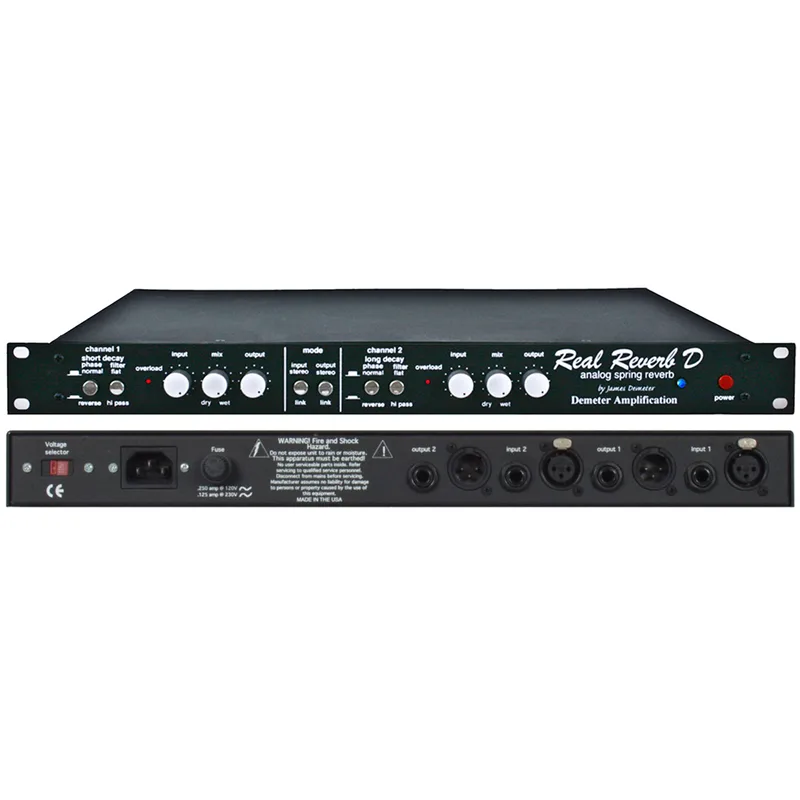
The Demeter RV-1D Real Spring Reverb is a single-rack-space unit that produces spring reverb with real mechanical springs rather than a digital algorithm. Demeter Amplification describes it as "spring reverb for the digital age," and the design centers on two Accutronics classic, full-size, 6-spring reverb tanks, one for each of the unit's two channels1. The unit has won a Pro Audio Review Excellence Award, according to the maker1.
Two channels, two tanks
The RV-1D's core layout is two independent reverb channels. Channel one has a short decay time of 1.5 seconds, and channel two has a longer decay time of 3.5 seconds. Each channel can be run separately, or the two can be linked, which lets a player send one signal through both tanks or treat the unit as two separate reverbs in a rack1.
Each Accutronics reverb tank is individually shielded with mu metal to reduce noise from stray magnetic fields. That matters for spring reverb in particular, because spring tanks are mechanical devices that can pick up hum from nearby transformers and power supplies1.
Controls
Per the maker, the front panel carries the following per-channel controls and indicators1:
- Reverb phase switch
- Low cut filter switch
- Input sensitivity control
- Overload indicator
- Mix control
- Output level control
The reverb phase and low cut switches give a player some shaping of the spring character, while input sensitivity and the overload indicator help match the unit to the level of the source, whether that is a console send or a line-level instrument signal1.
Power and connections
The RV-1D runs from AC mains at 230/115V AC, so it plugs into a wall outlet or power conditioner rather than a pedal-style DC supply. Internally, the power supply is fully regulated at plus or minus 18 volts, which Demeter says is for maximum headroom and quick transient attack, and it uses a custom built, shielded toroidal transformer for low noise1.
The RV-1D is a mains-powered rack unit at 230/115V AC. It is not designed to run from a pedalboard power supply or battery.
Connections are fully balanced on three-pin (XLR) or TRS connectors, using Analog Devices 2142 and 2143 audio devices. Input impedance is 10k ohms and output impedance is 10 ohms1.
Specifications
| Specification | Value |
|---|---|
| Channels | Two, each with its own reverb tank1 |
| Reverb tanks | Two Accutronics classic full-size 6-spring tanks1 |
| Decay times | 1.5 seconds short, 3.5 seconds long1 |
| Frequency response | 20 to 20 kHz1 |
| Signal to noise ratio | > 95dB1 |
| THD | > 0.1%1 |
| Maximum output | + 28dBv1 |
| Input impedance | 10k ohms1 |
| Output impedance | 10 ohms1 |
| Dimensions | 19" x 1.75" x 10"1 |
| Weight | 17 lbs1 |
| Shipping dimensions | 24 x 16 x 10 in1 |
| Operating voltage | 230/115V AC1 |
| Internal supply | Plus or minus 18V regulated1 |
Price and availability
Demeter lists the RV-1D at $999.00, with a current price of $899.00 as of 26 October 20261. The maker categorizes the unit as Pro Audio1.
Questions
How long are the decay times on the RV-1D?
Channel one has a short decay time of 1.5 seconds, and channel two has a longer decay time of 3.5 seconds. Each channel can be run separately or the two can be linked, so a player can use one short ambience, one long wash, or both together on a single signal.
Does the RV-1D use real springs?
Yes. The RV-1D uses two Accutronics classic full-size 6-spring reverb tanks, one for each channel. Each tank is individually shielded with mu metal to reduce noise from stray magnetic fields, which is one way the unit keeps spring reverb quiet in a rack environment.
How many rack spaces does the RV-1D take?
The RV-1D occupies a single rack space. Its chassis measures 19 inches wide, 1.75 inches tall and 10 inches deep, and the unit weighs 17 lbs, so it is heavier per space than a typical digital rack processor because of the two spring tanks inside.
Are the RV-1D inputs balanced?
Yes. The inputs and outputs are fully balanced, on three-pin or TRS connectors, using Analog Devices 2142 and 2143 audio devices. That makes the unit straightforward to patch into a studio console or rack system with balanced lines.
How much does the RV-1D weigh?
The RV-1D weighs 17 lbs. The weight comes largely from its two full-size spring reverb tanks and its power supply, which uses a custom built, shielded toroidal transformer.
Can the two channels be linked?
Yes. Each channel can be run separately, or the two channels can be linked. Channel one carries a short 1.5-second decay and channel two a longer 3.5-second decay, so linking gives access to both decay characters at once.
Sources (1)
- RV-1D Real Spring Reverb, Demeter Amplification