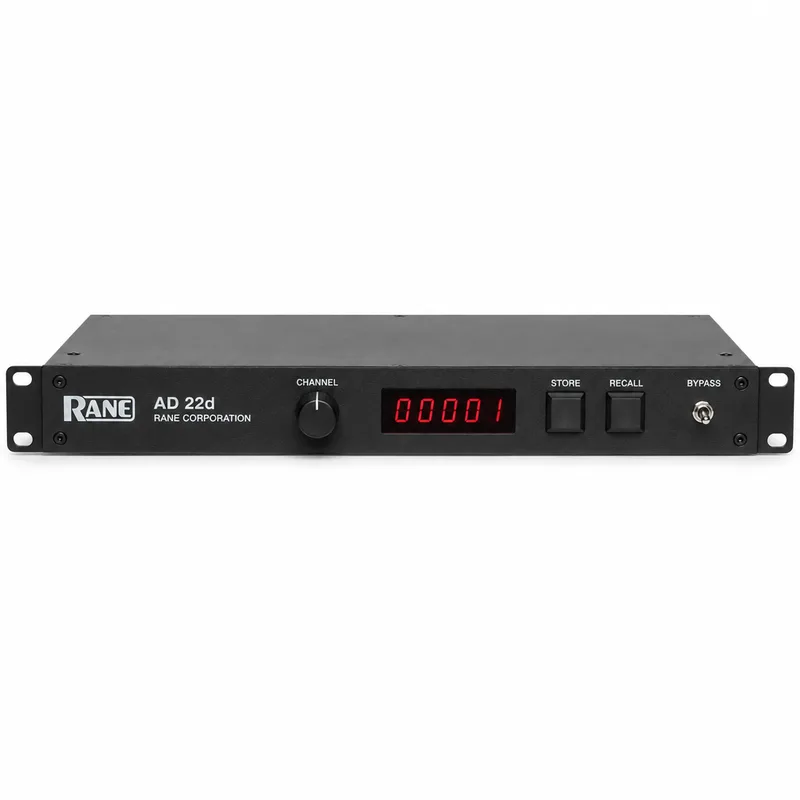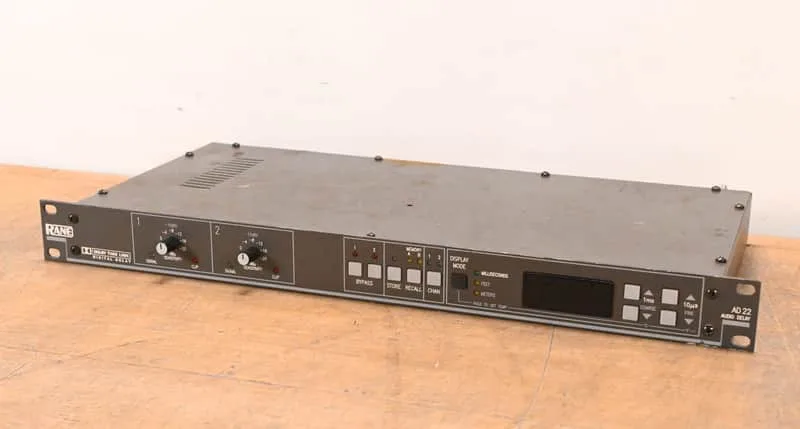
The Rane AD 22 is a two-channel digital audio delay built by Rane Corporation and housed in a single rack space12. It is an install and live sound piece rather than a stompbox: a 1U steel chassis with screw-terminal balanced inputs and balanced line driver outputs, designed to sit in a rack and delay line-level signals. Each output covers a delay range of 0.011 to 327.68 milliseconds, and configured internally as a mono device the unit provides twice that, 655.34 milliseconds2.
Where a delay pedal is built for repeats and ambience on a guitar, the AD 22 is built for precise, calibrated delay: aligning speakers to a source, creating a fixed offset, or delaying a feed by an exact time. Its digital conversion uses the Dolby Time Link 1-bit delta-sigma encode/decode circuit, shared with the related Rane AD 22d2.
A two-channel digital audio delay
The AD 22 is a two-channel device that can operate in three configurations: as two independent channels (dual mono), as a stereo pair where both channels are edited simultaneously, or, internally configured as a mono device, as a single delay with twice the range of one channel, 655.34 milliseconds2. In stereo edit mode the two current delay values are locked together, and adjusting the up/down buttons changes both values by the same relative amount, so a stereo pair stays matched2.
Each channel also holds two nonvolatile memories, A and B, so a channel can store two delay settings and swap between them1. The unit contains no wear parts, according to Rane's manual1.
The controls and display
The front panel is built around a 5-digit LED display that indicates the current delay value for the selected channel. When both channels are selected it shows the smaller of the two values, and on power-up it briefly shows the software revision and the stereo/mono configuration1.
| Control | What it does |
|---|---|
| Channel button | Selects which channel is being set, 1 or 22 |
| Up/down buttons | Set the delay of the selected channel2 |
| Recall button | Alternately recalls stored memories (A then B then A) for the selected channel(s)2 |
| Display Mode button | Switches the display; also used with up/down to edit the temperature setting12 |
| SENSITIVITY controls | Vary incoming signal levels to the A to D converter; output is adjusted so the unit always passes signal at unity gain12 |
| SIGNAL LEDs | Illuminate green 34 dB before clipping1 |
| CLIP LEDs | Illuminate red 4 dB before clipping at the A to D converter input1 |
The sensitivity controls set the input level to the converter and, because the output is adjusted along with it, the unit is always at unity gain: what goes in at the chosen level comes out at the same level12. The clip LEDs warn 4 dB before converter overload, and the signal LEDs light 34 dB before clipping, giving a wide window for setting levels1.
A recessed lockout switch disables all front panel controls except the CHAN and DISPLAY MODE buttons, useful in fixed installations where settings should not be disturbed1. Internal jumpers can enable or disable the BYPASS buttons in lockout mode; the default setting disables them12.
Remote recall and bypass
The rear panel has remote recall terminals for the two memories on each channel. Closing the connected switch recalls Memory B; opening it recalls Memory A. The terminals use CMOS (+5 volt) logic levels and sink only 3 mA maximum each1. Connecting the CH1 and CH2 terminals together on one side of the same switch permits stereo recall of Memories A and B, so both channels swap settings together1. The remote recall terminals cannot be locked out, so remote switching keeps working even with the front panel locked1.
Each channel has a hard-wired bypass. The fail-safe bypass relays mean the AD 22 passes audio while it is unpowered, so a dead supply does not take down the signal path1.
Power and grounding
The AD 22 uses an 18 volt AC center-tapped transformer only, fed by a remote AC power supply; Rane specifies the RS 1, RAP 10, or another Rane-approved supply, and the unit ships with one1. Maximum current from the remote supply is 650 mA RMS2. The 120 VAC supply model carries UL File no. E88261 and CSA File no. LR589482.
The AD 22 does not get chassis ground through the AC cord. A #6-32 screw and toothed washer is provided as a chassis ground point, which matters in installations where hum needs a proper earth reference1.
The temperature setting
The AD 22 is factory set for 22°C (71.6°F), and the manual pairs this with a constant 30% humidity to calculate the speed of sound, which is how the unit converts delay times into distance1. That conversion is the point of the setting: in speaker alignment work, a delay is often specified as a distance, and the speed of sound depends on air temperature. Adjustments are always in 1°C steps, or 1.8°F, regardless of which unit the display uses1. On the front panel, the 1 ms/Coarse buttons display temperature in degrees Celsius and the 10µsec/Fine buttons display degrees Fahrenheit2.
Specifications
| Specification | Value |
|---|---|
| Delay range per output | 0.011 to 327.68 ms2 |
| Mono configuration range | 655.34 ms2 |
| Channels | Two, dual mono / stereo / mono2 |
| Memories | Two nonvolatile (A and B) per channel1 |
| Conversion | Dolby Time Link 1-bit delta-sigma encode/decode2 |
| Construction | All cold-rolled steel2 |
| Size | 1.75"H x 19"W x 8.5"D (1U), 4.4 x 48.3 x 21.6 cm2 |
| Weight | 6 lb (2.7 kg) without power supply2 |
| Shipping | 4.25" x 20.3" x 13.75", 10 lb (4.5 kg)2 |
| FCC compliance | Class A digital device, Part 15 of the FCC Rules1 |
Questions
What is the maximum delay time on the Rane AD 22?
Each output offers a delay range of 0.011 to 327.68 milliseconds. If the unit is internally configured as a mono device, the two channels combine to provide twice the range of a single channel, 655.34 milliseconds. The minimum delay on any output is 0.011 milliseconds.
Does the Rane AD 22 pass audio when the power is off?
Yes. The AD 22 has fail-safe bypass relays that provide a hard-wired bypass per channel, so it passes audio while unpowered. This makes it safe to leave in a signal path even if its power supply fails or is disconnected.
What power supply does the Rane AD 22 use?
It uses an 18 volt AC center-tapped transformer only, supplied through a remote AC power supply. Rane specifies the approved models RS 1 and RAP 10, or another Rane-approved supply. Maximum current from the remote supply is 650 mA RMS.
Can the AD 22 run as a mono delay?
Yes. The unit can operate as two independent channels (dual mono), as a stereo pair with both channels edited simultaneously, or, when internally configured as a mono device, as a single mono delay with twice the range, 655.34 milliseconds.
Why does the Rane AD 22 have a temperature setting?
The temperature setting, factory set to 22°C (71.6°F), is used together with a constant 30% humidity to calculate the speed of sound, which lets the unit convert delay times into distance. This suits alignment work where delay compensates for speaker placement. Adjustments are always in 1°C steps, or 1.8°F.