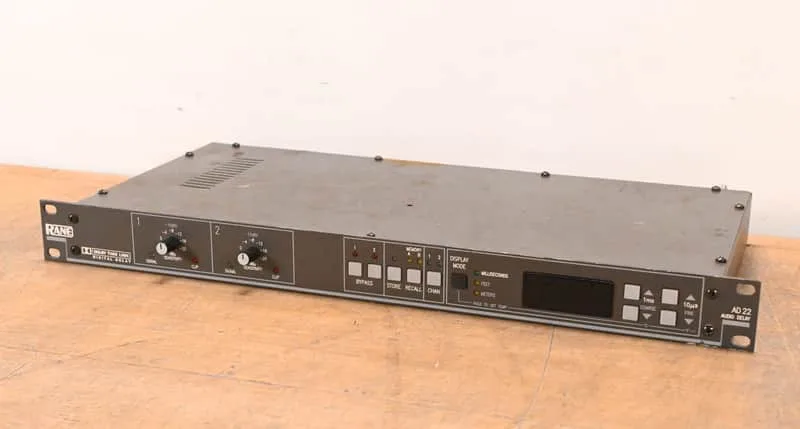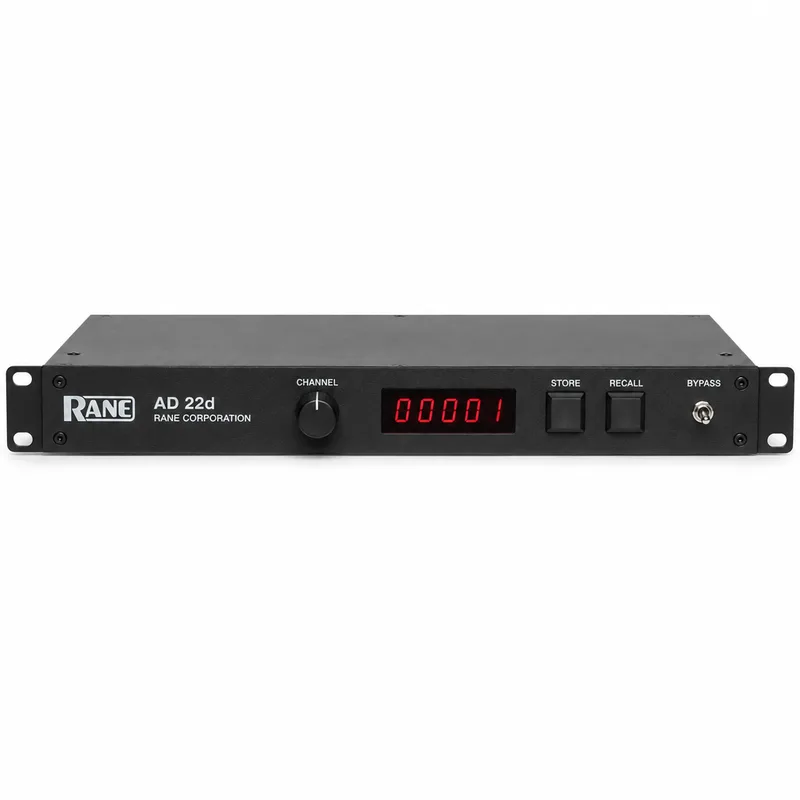

The Rane AD 22d is a two channel digital audio delay made by Rane Corporation, designed to sit in an industry standard equipment rack or on a table top rather than on a pedalboard1. It is a 1U unit, sized 1.75"H x 19"W x 8.5"D, in an all steel enclosure, weighing 6 lb without its power supply2.
Each of its two channels provides a delay range of 1.50 to 999.99 milliseconds, adjustable independently in 10 microsecond and 1 millisecond increments, with values shown on a 5 digit LED readout in milliseconds, feet or meters2. Where a guitarist would reach for a delay pedal with knobs for time and repeats, the AD 22d works like a piece of installed audio gear: XLR connections, stored memories, and remote recall terminals for switching between them.
Power and connections
The AD 22d does not run on a pedal-style supply. Rane's manual states plainly1:
"The AD 22d uses an 18 volt AC center-tapped transformer only."
Rane Corporation1
The 120 VAC model is listed as Class 2 equipment under the National Electrical Code, UL and CSA exempt2. The unit is built into an all-steel enclosure and weighs 6 lb (2.7 kg) without its power supply2.
Audio connections are balanced XLRs on both inputs and outputs, with pin 2 hot per AES standards, and the manual directs the user to balanced wiring only1. The outputs are electronically balanced, with a maximum output level of 20 dBu into loads above 2 kΩ and 18 dBu into loads above 600 Ω, at 1 kHz with Sensitivity set at +4 dBu2.
Controls, memories and bypass
The front panel is built around channel selection, memory storage and bypass rather than a row of effect knobs.
| Control | What it does |
|---|---|
| CHANNEL button | Advances the channel selection from CHAN 1 to CHAN 2 to BOTH1 |
| STORE button | Stores the current delay configuration into both channels' current memory, A or B1 |
| RECALL button | Alternately recalls stored memories A and B for the selected channel or channels1 |
| BYPASS buttons | Toggle each channel's hard-wired bypass; when the LED is on, that channel "functions like a wire"1 |
| SIGNAL LEDs | Illuminate green 34 dB before clipping1 |
| CLIP LEDs | Illuminate red 4 dB before clipping at the A to D converter input1 |
The STORE button saves the current delay configuration into both channels' current memory, A or B, and the RECALL button alternately recalls the stored Memories A and B for the selected channel or channels1. The CHANNEL button advances the channel selection from CHAN 1 to CHAN 2 to BOTH, so a setting can be stored or recalled on one channel or both at once1.
The hard-wired bypass is worth noting for anyone comparing this with a delay pedal: when a channel is bypassed it passes audio as a straight wire rather than through the converters1.
Audio specifications
The AD 22d converts audio at 24 bit resolution with a 50k Hz sampling frequency2. Rane's spec sheet gives the measured performance:
| Specification | Value |
|---|---|
| Frequency response | 20 Hz to 22 kHz, +0/-0.5 dB (+4 dBu, Sensitivity at +4)2 |
| Dynamic range | 101 ±2 dB (+4 dBu, Sensitivity at +4, 20 Hz to 20 kHz, A-weighted)2 |
| Signal-to-noise ratio | 85 ±2 dB (+4 dBu, Sensitivity at +4, 20 Hz to 20 kHz)2 |
| THD + noise | 0.05 ±.01 % (+4 dBu, Sensitivity at +4, 20 Hz to 20 kHz, 30k Hz BW)2 |
| Crosstalk | >90 dB (20 Hz to 20 kHz, +4 dBu, Sensitivity at +4 dBu)2 |
| Input headroom | 16 dB above the Sensitivity setting, 20 Hz to 8 kHz2 |
| Max input level | 20 dBu at 1 kHz with Sensitivity at +4 dBu2 |
| Max output level | 20 dBu (>2k ohm); 18 dBu (>600 ohm), 1 kHz with Sensitivity at +4 dBu2 |
| Overall system gain | 0 ±1 dB2 |
The Sensitivity controls set the proper internal levels for the audio converters; the manual's guidance is to set them fully counter clockwise, the +4 dBu position, for a +4 dBu input signal2. The signal present and clip indicators give visual confirmation that the input signal is in the optimal range, with the clip LED threshold 4 dB before converter overload and the signal present LED 34 dB below the clip point at 1 kHz2.
Where it sits among delay units
The AD 22d is a fixed-installation and live-sound delay rather than a stompbox. Its balanced XLR I/O, 1U steel chassis, remote power supply and remote memory recall all point to rack and console use, and its delay range tops out at 999.99 ms per output2. Players looking for a guitar-format delay with feedback and modulation controls will find that territory covered on the delay pedals page, and Rane's single channel sibling unit is covered separately as the Rane AD 22.
Videos
Dj Ultimate
Questions
Can you use the Rane AD 22d as a guitar delay effect?
It was not built as a guitar pedal. The AD 22d is a 1U rack or table top delay with balanced XLR inputs and outputs, pin 2 hot per AES standards, and it runs from a remote 18 volt AC power supply rather than a 9V pedal supply. A player with a rack rig and balanced line-level gear can use it, but it does not sit on a pedalboard.
What is the maximum delay time on the Rane AD 22d?
Each output offers a delay range of 1.50 to 999.99 milliseconds, adjustable independently in 10 microsecond and 1 millisecond increments. Delay values can be shown on the 5 digit LED readout in milliseconds, feet or meters.
Does the Rane AD 22d need a special power supply?
Yes. Rane specifies an 18 volt AC center-tapped transformer only, supplied by the model RS 1 or another remote AC power supply approved by Rane. Maximum current draw is 650 mA RMS from the remote supply, so a standard 9V DC pedal supply will not power it.
How many memories does the Rane AD 22d store?
Each channel has two nonvolatile memories, A and B, which need no batteries. The STORE button saves the current delay configuration into both channels' current memory, and the RECALL button alternates between memories A and B for the selected channel or channels.
Sources (2)
- AD 22d Manual, Rane Corporation, 2025
- AD 22d Data Sheet, Rane Corporation, 2025