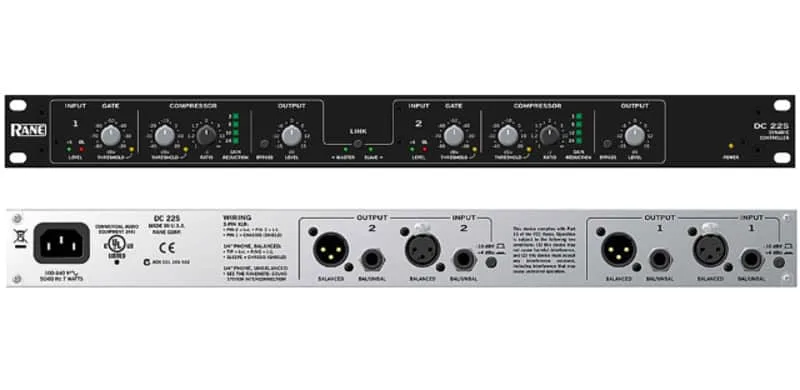

The Rane DC 22 is a two-channel rack compressor with a gate on each channel, made by Rane Corporation. Rane describes it as a Dynamics Controller that "combines quality compression and gate functions with simplicity," built around log rms detectors and Voltage Controlled Amplifiers (VCAs)1. It sits in a single rack space and is designed, in Rane's words, "for the working musician or DJ"1.
Rane positions the DC 22 across a range of jobs rather than one niche. Its listed applications include1:
- Two-Channel Compressor/Limiter and Gate
- Guitar & Bass Compression with Gate
- Post Production Dynamics Control
- Sound System with Compression and Gate
- Driver Protection
- Long Distance Line Driver1
For a player, that means it can smooth out a bass or guitar signal, tame peaks in a PA, or protect drivers, all from the same box. It is a line-level rack unit rather than a stompbox, so it belongs at the end of a signal chain or in a studio or live rack, not at the front of a passive guitar12.
What the DC 22 does: stereo compression with a gate
Each of the DC 22's two channels carries a compressor and a gate in one path. The compressor pulls down signals that rise above its threshold; the gate works the other way. Rane's data sheet explains the gate as "a downward expander, acting like a compressor running in reverse, making the quiet parts quieter," with the output reduced 2 dB for every 1 dB the input drops below the gate threshold1. In practice that means hum, hiss and idle noise fade away between phrases while the playing stays untouched.
The two sides of the unit are identical. As the manual puts it, "Channel 2 controls duplicate the controls in channel 1"2, so a stereo source gets the same treatment on both sides, or two mono sources get independent processing.
A four-segment meter on each channel indicates compression gain reduction, so you can see how hard the compressor is working at a glance1.
Controls
The front panel keeps things simple, with one set of controls per channel:
| Control | What it does |
|---|---|
| GATE THRESHOLD | Sets the point at which the input signal level causes the gate to become active2 |
| COMPRESSOR THRESHOLD | Sets the point at which the input signal level causes the compressor to become active2 |
| RATIO | Sets the compression ratio, from 1:1 up to infinity:11 |
| OUTPUT LEVEL | Sets output gain, ±15 dB range1 |
| GAIN REDUCTION LEDs | Show the amount of average signal reduction in dB2 |
| BYPASS | Compares the compressed and non-compressed signal, one per channel2 |
| LINK | Activates both compressors when either channel's signal exceeds the set threshold, preserving stereo imaging2 |
| Power | Standard power switch; a yellow LED lights when the DC 22 is ready2 |
The per-channel Bypass switch is worth noting for players comparing units: it is a quick A/B between the processed and unprocessed signal, which makes it easy to hear exactly what the compressor and gate are doing2.
Linking the channels
The LINK switch is how the DC 22 handles stereo material. In Link mode, "channel 1 becomes the Master and channel 2 the Slave," with Gate Threshold, Compression Threshold, Compression Ratio and Output Level all controlled from channel 11. Because both compressors activate when either channel crosses the threshold, one loud side cannot pull the image out of balance. With the Link switch off, the two channels are totally independent, which suits dual-mono uses such as running a bass and a vocal through the same unit1.
Compressor, limiter and gate specifications
The compressor side offers a threshold range of +20 to -40 dBu (±2 dBu) and a ratio range of 1:1 to infinity:1 (10% limit)1. The manual is direct about the top of that range: "With the Ratio set to ∞, the DC 22 acts as a Limiter," and it also acts as a limiter at a very high ratio of 10:12. That is what backs up the driver protection application: set the ratio high and the unit stops peaks rather than gently squeezing them.
The gate has a threshold range of -20 to -80 dBu (±2 dBu) and a fixed 2:1 ratio (10% limit)1. Its fixed 2:1 slope is gentler than a hard mute, so noise fades rather than chops.
The detector is a log rms type with a fixed response of 80 dB per second1. An rms detector tracks the average energy of the signal rather than instantaneous peaks, which generally gives a more musical, level-riding character than a peak detector.
Power and connections
The DC 22 runs from the mains, not a pedalboard supply: 120 V at 50/60 Hz, drawing 12 watts2. The data sheet lists agency approvals for a 120 VAC model and a separate 230 VAC model, so units configured for other mains voltages exist1; the manual's 120 V figure applies to the model it covers.
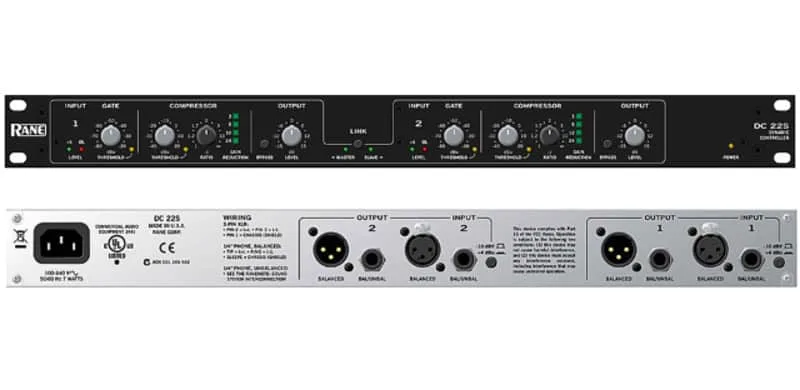
Each channel accepts either a balanced XLR or a balanced/unbalanced 1/4" TRS jack, but only one input per channel should be used2. The XLR inputs are active balanced with pin 2 "hot" per AES standards, and input impedance is 20k Ω common mode, each leg to ground1. Outputs are delivered by balanced XLR or unbalanced 1/4" TS jacks, and using both types at once is permissible to drive two devices2. The XLR outputs are active balanced at 100 Ω per leg; the 1/4" TS outputs are active unbalanced at 300 Ω1.
Gain is 0 or +12 dB (±0.2 dB) with +4 dBu / -10 dBV sensitivity, and output gain range is ±15 dB (±1.5 dB)1. Maximum input level is +22 dBu and maximum output level is +20 dBu into a 2k Ω load1.
Measurements
| Specification | Value |
|---|---|
| Frequency response | 20 Hz to 40 kHz, +0/-.5 dB into loads above 2k Ω1 |
| THD+Noise | 0.02% typ. at 1 kHz @ +4 dBu1 |
| THD vs amplitude | 0.05% max., 0 to +20 dBu @ 1 kHz1 |
| THD vs frequency | 0.02% max., +4 dBu, 20 Hz to 20 kHz1 |
| Signal-to-noise | 100 dBr typ., unity gain, re +4 dBu, 20 kHz BW1 |
| Common mode rejection | 40 dB min.1 |
The 20 Hz to 40 kHz response and low distortion figures are what make the unit viable for bass and for full-range PA work rather than guitar-only duty1.
Build and compliance
The enclosure is all steel, constructed from cold rolled steel, at 1.75"H x 19"W x 5.3"D (1U) and 5 lb (2.3 kg); shipping weight is 8 lb (3.6 kg)1. The 120 VAC model carries UL 6500 (file E193164) and cUL C22.2 (file E104174) listings, and the 230 VAC model carries CE-EMC and CE-Safety certifications1. The manual notes compliance with FCC Part 15 limits for a Class B digital device and with Canadian ICES-0032.
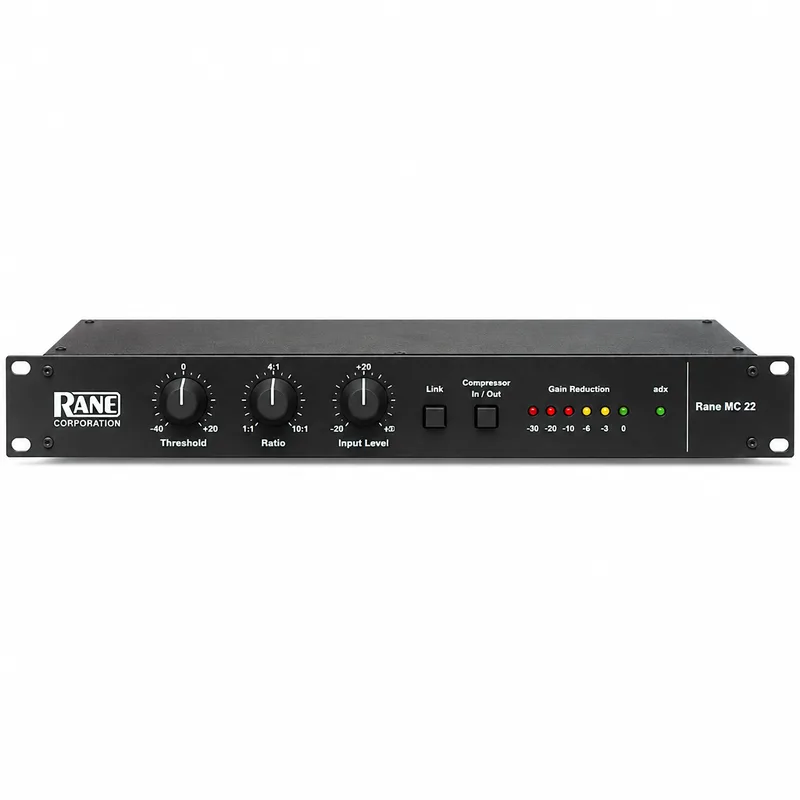
Rane also built the MC 22 and the DC 22S; players comparing Rane rack compressors can look at both alongside this one.
Videos
Tâm Chuyên Độ Chế Đèn Led
Questions
Can the Rane DC 22 be used for bass guitar?
Yes. Rane lists Guitar & Bass Compression with Gate among the DC 22's intended applications, alongside sound system compression, driver protection and post production dynamics control. Its frequency response runs from 20 Hz to 40 kHz, so it handles the low end of a bass signal without rolloff.
Does the Rane DC 22 work as a limiter?
Yes. The manual states that with the Ratio control set to infinity, the DC 22 acts as a limiter, and that it also acts as a limiter at a very high ratio of 10:1. This makes it usable for driver protection and for catching peaks in a live sound system.
How do you link the two channels on a Rane DC 22?
Press the LINK switch. Channel 1 becomes the Master and channel 2 the Slave, with Gate Threshold, Compression Threshold, Compression Ratio and Output Level all controlled from channel 1. Both compressors activate when either channel's signal exceeds the set threshold, which preserves stereo imaging. With the switch off, the channels are totally independent.
Can I plug a guitar straight into the Rane DC 22?
The DC 22 is a line-level rack unit, not a guitar preamp. Its inputs are balanced XLR or balanced/unbalanced 1/4 inch TRS jacks with 20k ohm input impedance, and its gain options are 0 or +12 dB with +4 dBu / -10 dBV sensitivity. A passive guitar signal is far below these levels, so it needs a preamp or pedal in front of it.
How many rack spaces does the Rane DC 22 take?
One. The DC 22 measures 1.75 inches high by 19 inches wide by 5.3 inches deep, which is a single rack unit (1U). It weighs 5 lb (2.3 kg) and is built in an all-steel, cold rolled steel enclosure.
Sources (2)
- DC 22 Data Sheet, Rane Corporation, 2025
- DC 22 Manual, Rane Corporation, 2025