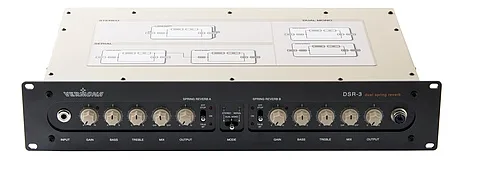


The VERMONA DSR-3 is a dual spring reverb: a two-channel rack unit built for studio use, specializing in processing stereophonic sound sources1. Where most spring reverbs, including Vermona's own pedal and half-rack units, give you one spring tank and one sound, the DSR-3 gives you two complete spring reverb channels, SPRING REVERB A and SPRING REVERB B, that can run as a coupled stereo pair, as two independent mono reverbs, or in series, one reverberating the other's output1.
Vermona developed it with the goal of providing spring reverb for processing stereo signals in professional use, with the parallel and serial operating modes added for creative potential2. It is a 19-inch rack unit that takes two rack spaces, 24.7 cm deep measured from the rear of the front panel, and weighs 7 kg3. Output balancing is carried out by custom-designed transformers4.
What it is and what it does to your sound
Spring reverb works by driving an audio signal through a set of suspended springs; the springs' motion is picked up and added back to the signal as reverb. The DSR-3 does this with two separate spring tanks and full studio-grade connections around them. Vermona describes the result as lush and full reverberation effects with depth and vintage charm3, and the unit's reverberation time sits between 1.75 and 3 seconds3.
Each channel has a two-band equalizer with BASS and TREBLE controls, matched to the specific frequency range of the springs4. The BASS control works at 50 Hz with ± 13 dB and the TREBLE control at 7 kHz with ± 22 dB3. Because a spring tank has its own frequency response, with strong coloration at both ends, an EQ voiced around that response is what lets you tame the boomy low end or the splashy top of the springs rather than fighting a generic shelving curve.
Vermona's own demo material for the DSR-3 covers a wide range of sources: Steinway grand piano, upright piano, jazz guitar, distorted electric guitar, banjo, acoustic guitar, bass guitar, saxophone and an acoustic kick drum4. That range is the point of the design: it is a studio processor for anything you want to send through springs, not a guitar-only box.
Stereo, dual mono and serial modes
The MODE switch selects one of three operating modes and determines if and how the two channels are interconnected1.
| Mode | How the channels work | What it is for |
|---|---|---|
| STEREO | The unit works as a stereo spring reverb. All controls of SPRING REVERB A, except the BYPASS/EFFECT STOP switches, also set SPRING REVERB B5 | Processing true stereo sources, or turning a mono signal into stereo, since the front input feeds both channels5 |
| DUAL MONO | Both channels work independently, as if you had two separate spring reverb units, each with its own signal and controls5 | Two different spring sounds at once; the front input can feed both channels the same signal for two differently voiced reverbs5 |
| SERIAL | SPRING REVERB A works as in DUAL MONO, and its output signal is fed into the input of SPRING REVERB B, which reverberates the already reverberated signal again; channel B's rear inputs are disconnected5 | Extremely lush reverb effects, springs into springs5 |
STEREO mode is the coupled mode, which Vermona calls perfect for use with stereo signals6. DUAL MONO is the mode to reach for when you want, say, a short bright spring on one channel and a darker, longer character on the other. SERIAL mode is the experimental one: reverb feeding reverb, which the manual notes can produce extremely lush effects5.
The controls
The front panel keeps things simple. Per channel you get the two-band EQ, and the shared MODE switch sets how the channels relate432. Each channel also has its own BYPASS/EFFECT STOP switch, which stays independent even in STEREO mode, when every other control of channel A also controls channel B1.
The rear panel carries the POWER switch, which turns the DSR-3 on and off, and the MAINS IN jack, which connects the unit to power via the supplied power cord1.
- BASS: 50 Hz, ± 13 dB, per channel3
- TREBLE: 7 kHz, ± 22 dB, per channel3
- MODE: selects STEREO, DUAL MONO or SERIAL1
- BYPASS/EFFECT STOP: per channel, independent of the mode coupling1
- POWER: rear panel on/off switch1
Bypass behavior
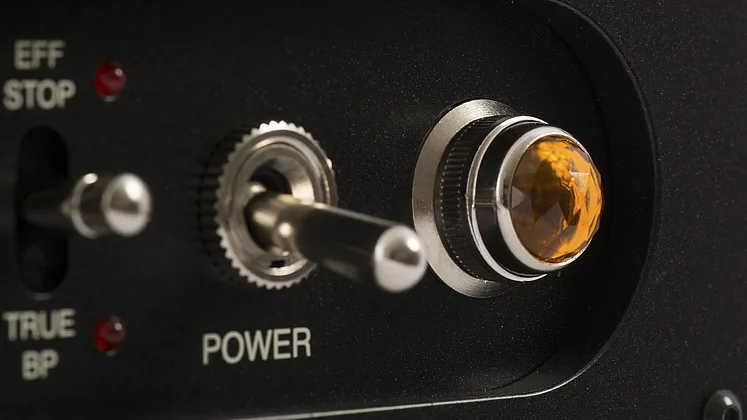
The bypass question has a two-part answer. In the TRUE BP position, the bypass works as a true bypass on the balanced XLR input and output pair, meaning the complete signal path, including input amplification, is bypassed5. With the unbalanced jack inputs and outputs, the input signal still passes through the input amplifier stage in TRUE BP1. So if you are running the unit on XLR connections in a studio patch, you get a genuine true bypass; on jack connections, a stage of the input path remains in the signal.
Power and connections
The DSR-3 runs on mains power, not a battery or a pedalboard supply. It has an internal PSU rated 90 V~ to 240 V~3, with a power consumption of 10 VA and a mains fuse of type L1AT1. You connect the supplied power cord to the MAINS IN jack on the rear panel1.
Connections are generous for a reverb unit:
- Front: one unbalanced 1/4-inch jack input, 1 MΩ impedance, max input level +18 dBu, feeding both channels in parallel3
- Rear: unbalanced 1/4-inch jack inputs per channel, 100 kΩ impedance3
- Rear: balanced XLR inputs per channel, 10 kΩ impedance3
- Outputs: unbalanced jack outputs and balanced XLR outputs per channel; the XLR and jack outputs work in parallel and carry the same signal1
The XLR outputs are balanced using a high-quality output transformer1, and Vermona states that output balancing as a whole is carried out by custom-designed transformers4. Signal-to-noise is specified as at least 94 dB for the direct signal and at least 70 dB for the effect signal, measured at XLR3.
The 1 MΩ front input is the guitar-friendly one: it presents the high input impedance an instrument pickup wants to see, and Vermona's demos put electric and acoustic guitars and bass through the unit43.
Hand-matched AccuBell springs and the Vermona spring reverb line
The DSR-3 uses two AccuBell type 9 spring tanks, selected3. AccuBell is the former Accutronics4, the long-established spring tank maker. Vermona goes a step further than simply buying tanks: the springs are manually checked, selected and matched with great care for perfect stereo sound4. Since two random spring tanks of the same type never sound identical, this matching is what makes the STEREO mode behave like a coherent stereo reverb rather than two slightly different units panned left and right.
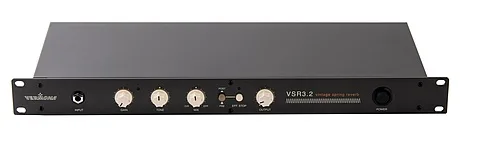
The DSR-3 sits at the top of a Vermona spring reverb line that shares the same spring source. Vermona notes that, just like in its valve-based ReTubeVerb, the classic VSR 3.2 and the Retroverb Lancet, the DSR-3 relies on the exceptional sound quality of AccuBell springs23. In a 2016 article presenting its four spring reverb units, Vermona positioned the DSR-3 as the one designed for studio use, equipped with two spring tanks for uncompromising stereo operation6. Where the ReTubeVerb and VSR 3.2 are single-tank designs and the Retroverb Lancet adds a filter and envelope generator to its springs, the DSR-3 is the two-channel, fully connected studio machine of the range.
The unit is assembled at Vermona's electroacoustic manufactory in Erlbach, Germany, in the region known as the Vogtland3. Vermona is the brand of HDB electronic GmbH5.
Videos
Attic Audio
Roberto Raineri-Seith
Stotz Daniel Philipp
Questions
Can you plug a guitar straight into the Vermona DSR-3?
Yes. The front panel has an unbalanced 1/4-inch jack input with a 1 MΩ impedance and a maximum input level of +18 dBu, which suits instrument-level signals. Vermona's own demos include jazz guitar, distorted electric guitar, acoustic guitar and bass guitar, so the unit was demonstrated with guitars plugged in directly.
Is the Vermona DSR-3 true bypass?
Partly. In the TRUE BP position the bypass is a true bypass on the balanced XLR input and output pair, removing the complete signal path including input amplification. With the unbalanced jack inputs and outputs, the input signal still passes through an input amplifier stage in TRUE BP.
How long is the DSR-3's reverb time?
Vermona specifies a reverberation time between 1.75 seconds and 3 seconds. That is the range of the AccuBell type 9 spring tanks, and it is not adjustable as a control; the tone of the reverb is shaped instead with the BASS and TREBLE equalizer on each channel.
What spring tanks does the Vermona DSR-3 use?
It uses two AccuBell type 9 spring tanks, selected by hand. AccuBell is the former Accutronics. Vermona checks and matches the springs manually so the two channels sound like a proper stereo pair rather than two random tanks.
Where is the Vermona DSR-3 made?
It is assembled at Vermona's electroacoustic manufactory in Erlbach, Germany, in the region known as the Vogtland. Vermona is the brand of HDB electronic GmbH, the same company behind the ReTubeVerb, VSR 3.2 and Retroverb Lancet.
Sources (6)
- dsr3-manual-en.pdf, Vermona (HDB electronic GmbH), 2017
- VERMONA - DSR-3, VERMONA (Elektroakustische Manufaktur)
- VERMONA - DSR-3, VERMONA (Elektroakustische Manufaktur)
- VERMONA - DSR-3, VERMONA (vermona.com)
- dsr3-manual-de.pdf, VERMONA / HDB electronic GmbH, 2017
- VERMONA - Ist Federhall noch aktuell?, VERMONA (vermona.com), 2016-09-01