
The VERMONA ReTubeVerb is a tube spring reverb built into a 19 inch rack chassis, made by VERMONA, the Elektroakustische Manufaktur in Germany1. Instead of modeling reverb in a chip, it sends the signal through a real spring tank and runs the audio path through tubes, which VERMONA describes as "an uncompromising unification of valve-technology and mechanical reverberation"1. The company pitches it as "highest quality spring reverberation for pure vintage tone"1, aimed, in its own words, at players who want warm, slightly compressed vintage sounds2.
Each unit is hand-assembled in VERMONA's electroacoustic manufactory, with quality control carried out alongside assembly1. VERMONA also points to the unit's robustness and daily usability as part of its design3.
A tube-driven spring reverb in a rack
Spring reverb works by driving an audio signal through a set of suspended metal springs and picking up the wobbly, ringing result at the other end. The ReTubeVerb keeps that mechanism fully analog and puts tube circuitry around it, which VERMONA describes as an uncompromising unification of valve technology and mechanical reverberation4. The result, in the maker's words, is tube-driven spring reverb aimed at players who want warm, slightly compressed vintage sounds, with the springs themselves generating the reverb rather than a digital algorithm.
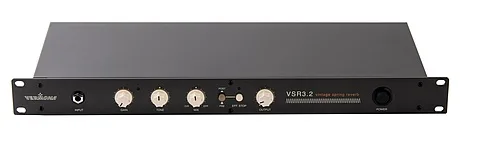
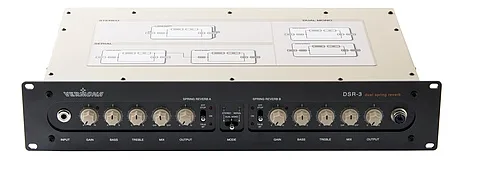
The tube stage is what separates the ReTubeVerb from VERMONA's other spring reverb units, the Vermona VSR 3.2 and the VERMONA DSR-3. VERMONA describes the ReTubeVerb as a tube-driven unit aimed at lovers of warm and slightly compressed vintage sounds21, and the maker's own tagline for it is "Highest quality spring reverberation for pure vintage tone."1 It is the rack-mounted, tube-driven option in the lineup, a 2 U unit combining valve technology with mechanical spring reverberation. For more on the effect type generally, see reverb pedals.
Controls
The ReTubeVerb carries a three-band EQ for shaping the signal, with fixed center frequencies3:
| Control | Center frequency |
|---|---|
| Bass | 80 Hz |
| Middle | 700 Hz |
| Treble | 6500 Hz |
Those three points let you darken the spring character, pull out boxiness in the mids, or tame the metallic top end that springs can produce, all before the signal leaves the unit1.
Power and connections: inputs, outputs and levels
The ReTubeVerb is built to sit between instruments, line-level gear and balanced studio connections, and its three inputs reflect that1. The front panel jack is the instrument-friendly one, with a 1 megohm input impedance and a nominal sensitivity of -20 dBu, so a guitar or bass can plug straight in1. The rear connections cover line and balanced sources, with a level switch that changes the sensitivity depending on what is feeding it1.
| Input | Sensitivity (nominal) | Impedance |
|---|---|---|
| 1/4 inch jack, front | -20 dBu | 1 MΩ |
| 1/4 inch jack, rear (switch at 0 dB) | +5 dBu (switch at -20 dB) | 100 kΩ |
| XLR (switch at 0 dB) | -14 dBu (switch at -20 dB: +6 dBu) | 600 Ω |
On the output side, the unit offers both a 1/4 inch jack output and an XLR output, with a maximum output level of +12 dBu1. The jack output has an impedance of 1.2 kΩ and the XLR output 200 Ω, the lower XLR figure suiting long balanced runs to a mixer or interface1.
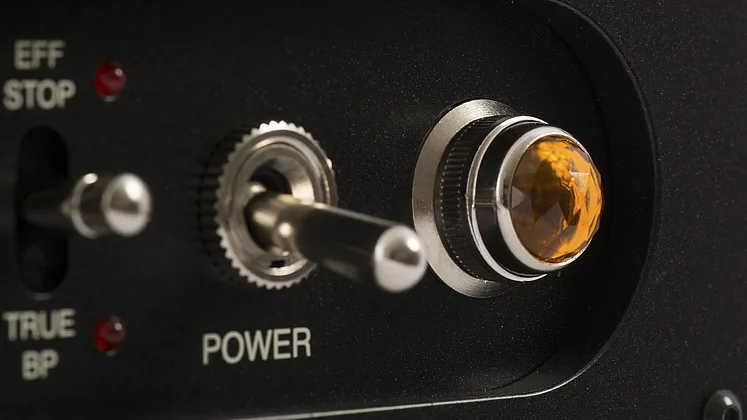
The ReTubeVerb runs on an internal power supply, not a wall wart or battery. It accepts mains voltages of 100 V to 120 V or 220 V to 240 V, so it works on US 120V power as well as European mains1. That internal supply, the spring tank and the steel chassis are why it weighs 7 kg1.
Measured performance
VERMONA publishes signal measurements for the unit1:
| Measurement | Value |
|---|---|
| Signal-to-noise ratio, effect (jack) | > 60 dB |
| Signal-to-noise ratio, direct (jack) | > 80 dB |
| THD + noise, direct (XLR) | < 1% at 1000 Hz |
The direct signal path is measurably cleaner than the effect path, which is what you would expect from a design where the wet signal deliberately passes through tubes and springs1.
What reviewers said
The German online magazine Amazona.de published a test of the ReTubeVerb5. VERMONA announced the review on its own news page, linking directly to the article on Amazona.de5.
Videos
Calvin Cardioid
Questions
What tubes does the Vermona ReTubeVerb use?
The ReTubeVerb uses four tubes: two ECC 83s, one ECC 81, and one EM 84. The EM 84 is a magic eye tube that serves as a level indicator, while the ECC 83 and ECC 81 tubes handle the audio path around the mechanical spring reverb.
Can I plug a guitar straight into the ReTubeVerb?
Yes. The front panel 1/4 inch jack input has a 1 megohm input impedance and a nominal sensitivity of -20 dBu, which is the kind of high-impedance input an electric guitar expects. The rear jack and XLR inputs are aimed at line-level gear instead.
How heavy is the Vermona ReTubeVerb?
It weighs 7 kg, about 15 pounds, and measures 455 mm wide by 340 mm deep by 95 mm high. That weight comes largely from the mechanical spring reverb tank and the internal power supply, so plan for a sturdy rack.
Does the ReTubeVerb work on 120V US power?
Yes. Its internal power supply accepts mains voltages from 100 V to 120 V as well as 220 V to 240 V, so it can run on US wall power without an external converter. The unit needs to be set up for the correct voltage range.
Sources (5)
- VERMONA - ReTubeVerb, Vermona (Elektroakustische Manufaktur)
- VERMONA - Retroverb Lancet als Drumsynthesizer, VERMONA / Elektroakustische Manufaktur, 2024-02-21
- VERMONA - ReTubeVerb, Vermona (Elektroakustische Manufaktur)
- VERMONA - ReTubeVerb, VERMONA - Elektroakustische Manufaktur
- VERMONA - ReTubeVerb Testbericht auf Amazona.de, VERMONA, 2017-08-22