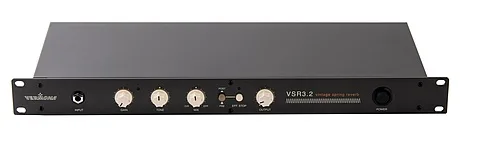


The Vermona VSR 3.2 is a rack-mounted vintage spring reverb. Where most modern reverb pedals simulate rooms digitally, the VSR 3.2 relies on what Vermona calls "the proven old mechanical way to create reverberation": an actual spring tank, driven and recovered by analog circuitry, that physically vibrates to produce the reverb tail1. Vermona describes the result as "that magic 60's reverb which is slightly metallic and dense at the same time"1.
The unit is deliberately simple. Vermona says that, just like its predecessors, the VSR 3.2 takes "a straight-forward and honest approach: signal in - spring reverb - vintage sound"2. It fits in a 19-inch rack at one rack unit, and Vermona describes its chassis as extremely solid, suited to straining live situations as well as studio use2.
How it works and what it does to your sound
Spring reverb is the technology behind the reverb built into countless 1960s guitar amps. A driver circuit converts the input signal into a physical vibration that travels down suspended springs, and a pickup at the other end converts it back into an electrical signal. The reflections bouncing along the springs produce the reverb, and the metal of the springs colors it, which is where the slightly metallic character comes from.
The VSR 3.2 uses a large type 9 reverberation spring made by AccuBell, formerly Accutronics1. Vermona's German product page describes the controls as a mix of direct and effect signal plus input and output level controls, so the player sets how much spring tail comes through and matches levels to the rest of the rig41. On top of the spring itself, the unit carries an equalizer that Vermona says is "exactly adapted to the springs' frequency response," so the EQ compensates for how the tank colors the signal rather than acting as a general tone shaper12.
The control set is small. Vermona notes that despite few controls, the reverb can be conditioned for each use case5:
| Control | What it does |
|---|---|
| Mix | Blends the dry and effect signal14 |
| Input level | Sets the level feeding the spring circuit14 |
| Output level | Sets the unit's output level14 |
| Equalizer | Voiced to match the springs' frequency response1 |
Connections and plugging in a guitar
The VSR 3.2 can be run directly with instruments or in effects paths, so a guitar can go straight into it or it can sit in an amp's effects loop3. The front panel input is the instrument-friendly one: an unbalanced 1/4-inch jack with a 1 MΩ impedance and a maximum input sensitivity of -40 dBu14. The rear panel adds two more jack inputs at line-ish levels, one with a maximum input sensitivity of 0 dBu and 100 kΩ impedance, the other at -20 dBu and 10 kΩ impedance4.
The outputs are where Vermona's own pages disagree. The English product page lists one 1/4-inch jack output with a maximum output level of 0 dBu1, while the German page lists two jack outputs, the second with an output sensitivity of -20 dBu4. Both come from the maker, and the conflict is unresolved, so treat the output count and the second output's level as uncertain.
Measured performance on the direct signal is a signal-to-noise ratio greater than 80 dBu and THD plus noise under 0.1 percent; the effect path's signal-to-noise ratio is listed as greater than 70 dBu14.
The VSR 3.2 needs an external DC adapter supplying 12 V at 1000 mA1. That is a different voltage and far more current than a standard pedal supply delivers, so it cannot share a typical pedalboard daisy chain.
History and earlier VSR models
The VSR 3.2 is the successor to earlier VSR models, and Vermona says it keeps the same straight-forward approach as its predecessors2. Vermona's own news page noted in April 2024 that the unit had "nearly 10 years on its back," placing its release around 2014 or 20155. The same post called it "a highly current representative of its kind," arguing it remains relevant despite its age5.
Spring reverb is a running theme in Vermona's lineup, and the VSR 3.2 has been part of it for a long time: by 8 April 2024 the unit had been around for nearly 10 years, yet Vermona still called it a thoroughly current representative of its kind35. In that article Vermona summed up the VSR 3.2's philosophy plainly:
"Das VSR 3.2 kann genau eine Sache richtig gut: Federhall." (The VSR 3.2 does exactly one thing really well: spring reverb.)
In April 2024, Amazona.de published an extensive test review of the VSR 3.2 by reviewer costello, with audio examples; Vermona's announcement of the review notes it includes a look into the history of the spring reverb and references to other Amazona.de articles on the topic5.
Videos
Davii Heidini
synthe sizer83
Davii Heidini
Questions
What does VSR stand for on the Vermona VSR 3.2?
VSR stands for Vintage Spring Reverb. Vermona itself spells this out, and the name fits what the unit does: it is a dedicated spring reverb unit that relies on the old mechanical way of creating reverberation rather than digital processing.
What spring tank does the Vermona VSR 3.2 use?
It uses a type 9 reverberation spring from AccuBell, formerly known as Accutronics. The type 9 is a large spring with a medium decay time between 1.75 and 3.0 seconds, which gives the unit its long, characterful spring tail.
Can I plug a guitar straight into the VSR 3.2?
Yes. The VSR 3.2 can be operated directly with instruments or in effects paths. The front panel has an unbalanced 1/4-inch jack input with a 1 megohm impedance and a maximum input sensitivity of -40 dBu, which suits instrument-level signals.
What power supply does the Vermona VSR 3.2 need?
It runs on an external DC adapter supplying 12 V at 1000 mA. That is a higher current draw than most compact pedals need, so it is not something to share with a typical 9V pedal power supply.
How many rack spaces does the VSR 3.2 take?
It takes a single rack space. The VSR 3.2 fits in a 19-inch housing at one rack unit high, about 190 mm deep, and weighs 2.5 kg.
Sources (5)
- VERMONA - VSR 3.2, Vermona (Elektroakustische Manufaktur)
- VERMONA - VSR 3.2, Vermona (Elektroakustische Manufaktur)
- VERMONA - Ist Federhall noch aktuell?, VERMONA (vermona.com), 2016-09-01
- VERMONA - VSR 3.2, VERMONA (vermona.com)
- VERMONA - VSR 3.2: Testbericht auf Amazona.de, VERMONA (vermona.com), 2024-04-08