| Type | Plug-in compressor (plugs directly into the guitar)1 |
| Original maker | Dan Armstrong, distributed by Musitronics4 |
| Circuit | JRC4558D dual op amp (half used), two 2N5457 JFETs, 1N100 germanium diode1 |
| Power | 9V DC battery2 |
| Input impedance | 80k ohms2 |
| Output impedance | 1800 ohms2 |
| Signal-to-noise ratio | 86 dB2 |
| Dimensions | 2¼ in long, 2¼ in wide, 1¼ in high2 |
| Weight | 4½ oz including battery2 |
| Status | Original discontinued; widely available as kits and clones5 |
The Orange Squeezer is a small compressor designed in the Dan Armstrong circle and distributed by Musitronics, the company behind the Mu-Tron III. Unlike a stompbox, the original unit plugged directly into your guitar: a rectangular block about 2¼ inches square that sat between your guitar's output jack and the cable, squeezing the signal before it ever reached an amp12. General Guitar Gadgets calls it "the little plug-in compressor behind Mark Knopfler's Sultans of Swing tone," and Analog Man's manual describes it as "legendary for its smooth compression and 'squashing' tone as used on many" classic albums by Steely Dan, the Doobie Brothers and Dire Straits13.
What makes it interesting to circuit builders is how little it does its job with. The whole compressor is half of a JRC4558D dual op amp, two 2N5457 JFET transistors and a germanium diode, running off a single 9V battery1. That simplicity is why it has become one of the most copied compressor circuits in DIY pedal building, with kits and commercial pedals from several makers still drawing on it today.
How the circuit works: FET compression around a JRC4558
The Orange Squeezer is a feedback compressor built around a JFET as the gain-control element. GuitarPCB's build document for its Julius board, which is based on the famous Orange Squeezer circuit, explains where the action happens: "The compression actually occurs at the junction of the 82K resistor and the first JFET"6. The op amp is not doing the compressing; it is amplifying a signal that has already been controlled by the JFET acting as a voltage-controlled resistor.
The signal flow works like this:
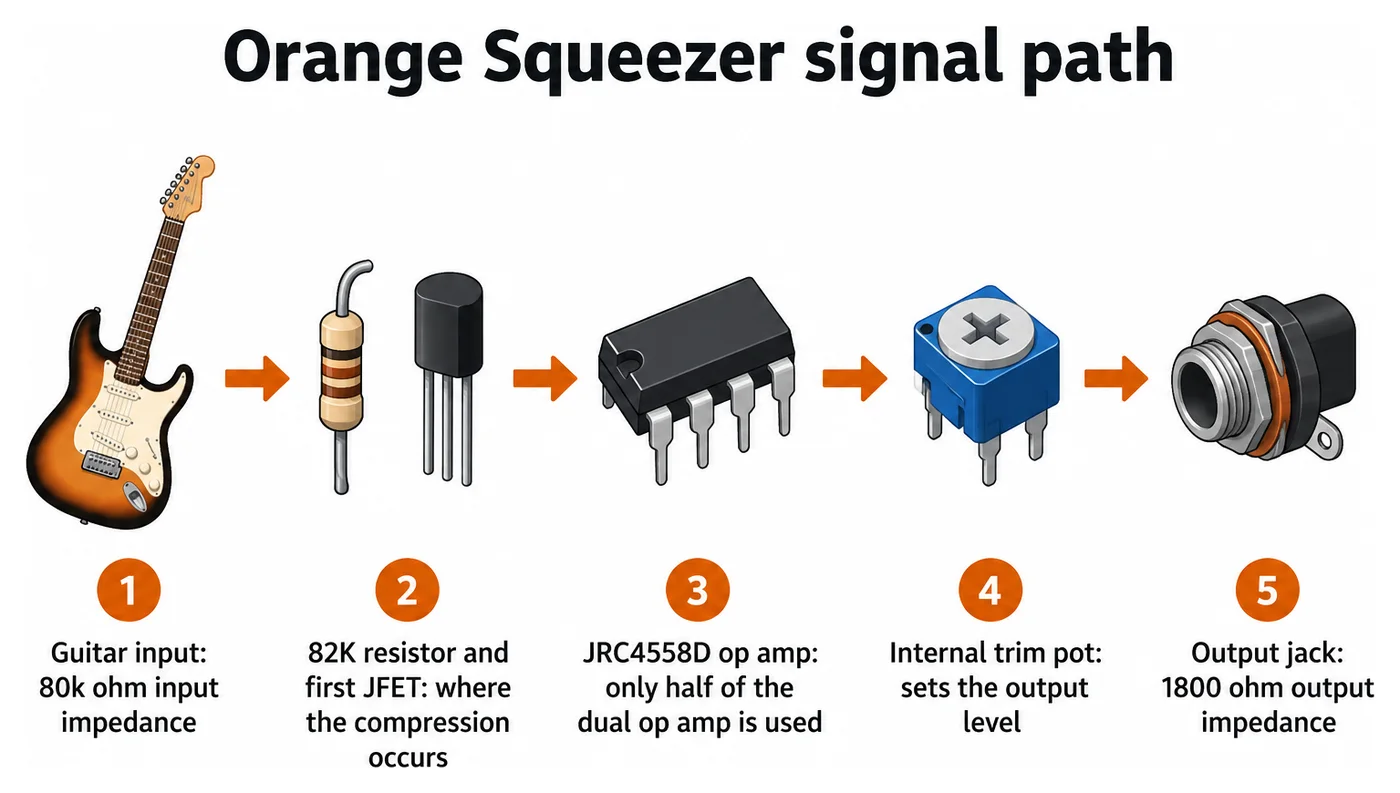
A side chain feeds part of the input signal to a rectifier, and more input signal turns the first JFET on harder, cutting the signal reaching the op amp6. Two 470K resistors at the JFET gate reduce gain but linearize the JFET's response, so the control action stays smoother than a bare JFET would be6. GuitarPCB's analysis notes that the op amp's gain setting is the closest thing the circuit has to a compression control, which tells you how fixed the compression character is: you are not shaping attack and release curves, you are setting how hard the whole thing works6.
Two parts do the character work. The 1N100 germanium diode sets the compression threshold, and General Guitar Gadgets is firm that silicon must not be substituted: "D1 must be germanium (1N100 or similar); it sets the compression threshold and silicon changes the behaviour"1. The JFETs are 2N5457s, and the kit supplier includes them as parts "the circuit depends on"1.
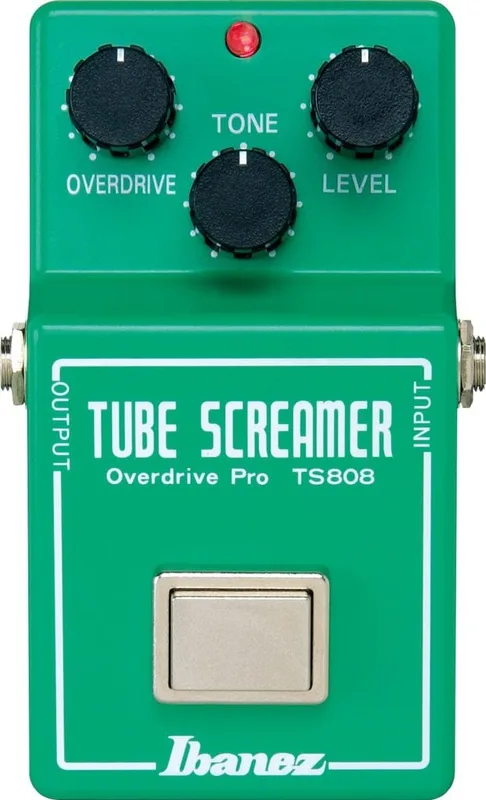
The op amp itself is a JRC4558D, with only half of the dual package used1. Analog Man's page on the original confirms it "used a 4558 chip"7. That chip has a following of its own: GuitarPCB's technical analysis notes that "many designers included this part in some of the most successful effects like the Orange Squeezer, DOD YJM 30, Boss OD1," the Tube Screamer and Peavey equipment8. So the same op amp sitting in this little compressor also sits in some of the most copied overdrive circuits ever built, including the Tube Screamer.
A plug-in compressor, not a pedal
The form factor is the thing that surprises players who meet the circuit through a modern clone. The original had no footswitch, no enclosure on the floor and no knobs on the outside. It plugged directly into your guitar and hung there while you played1. At 4½ oz including the battery and 2¼ by 2¼ by 1¼ inches, it was sized to sit in the jack without dragging the guitar down2.
That layout has practical consequences a player should know:
- No bypass. A plug-in unit has no switch, so the compressor is always in the signal path while it is plugged in.
- No external controls. The only adjustment is an internal trim pot for output level2.
- Battery only. The power source is a 9V DC battery, with no DC jack on the original2.
- Low input impedance. At 80k ohms the input loads the guitar more than a modern buffered pedal would, which is part of why replicas and originals can sound different in front of different pickups2.
The 86 dB signal-to-noise ratio was respectable for a battery-powered box of its era2. The 1800 ohm output impedance means it drives a cable reasonably well for a passive-ish source, though it is not the near-zero output impedance of a modern buffered output2.
Specs and controls
| Specification | Value |
|---|---|
| Power source | 9V DC battery2 |
| Input impedance | 80k ohms2 |
| Output impedance | 1800 ohms2 |
| Signal-to-noise ratio | 86 dB2 |
| Dimensions | 2¼ in l. x 2¼ in w. x 1¼ in h.2 |
| Weight | 4½ oz including battery2 |
| Op amp | JRC4558D, half used1 |
| Transistors | Two 2N5457 JFETs1 |
| Threshold diode | 1N100 germanium1 |
Adjusting the output
The original's only control is the internal trim pot that "allows the user to adjust the desired output level"2. Setting it means opening the case. On the replica side, General Guitar Gadgets' OSQ kit gives you two build options: an external volume control wired from the O1 pad, or an internal trimmer volume using the O2 pad1. The kit also carries a "No Volume Pot" option for builders who want to match the original's fixed layout9. Bias is set with a 10k trimmer: turn it counter-clockwise until the sound dies, then clockwise to the point of best compression; past that point the circuit distorts1.
Who designed it, and where it came from
The circuit carries Dan Armstrong's name, but the design credit is more specific. In a Premier Guitar interview, Mike Beigel of Musitronics said of the Dan Armstrong operation: "He had an engineer named George Merriman who designed all the products except the Orange Squeezer," and of the Squeezer itself, "which I had a bit of a hand in, though he did most of it"4. So George Merriman did most of the design, with Beigel contributing, under the Dan Armstrong brand distributed by Musitronics4.
Analog Man's page adds a note on provenance: originals were made in the US, and "some were made in the UK in later years but they are generally not considered as good as the US made originals"7. Dan Armstrong remains a registered trademark, a point Analog Man's own manual is careful to state10.
The Knopfler association is the circuit's famous story. General Guitar Gadgets passes it along as stompbox folklore, naming Mark Knopfler of Dire Straits and Jeff "Skunk" Baxter of Steely Dan and the Doobie Brothers as users1. Analog Man's manual likewise credits the "squashing" tone on many Steely Dan, Doobie Brothers and Dire Straits albums3. It is a widely repeated story rather than a verified rig document, but it is the reason many players first look this circuit up.
Pedals based on the Orange Squeezer circuit
Because the original is a plug-in that runs on a 9V DC battery and plugs directly into the guitar, most players today meet the circuit through a replica. The options fall into a few groups2111.
Kits
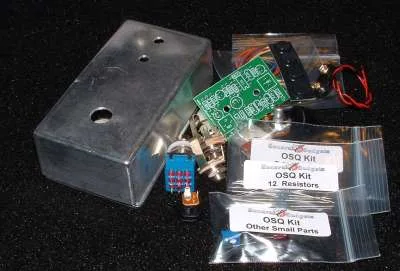
- General Guitar Gadgets OSQ: a stompbox replica kit, $44 complete with every part including the germanium diode and the 2N5457 JFETs the circuit depends on. It adds a DC jack and a 9V battery option, a stereo input jack and a mono output jack, plus the volume and bias options described above1.
- Jeds Peds Orange Squeezer kit: a DIY pedal kit that "compares to the Dan Armstrong Orange Squeezer." Jeds Peds calls it "a straight forward build, no specialist skill required," though also "an ambitious beginner project, perhaps mostly suited to those who have built a couple of pedals before." The buyer identifies components, calculates resistor codes and solders them in place, and supplies one knob12.
- GuitarPCB Julius: a build document for a board "based on the famous Orange Squeezer circuit," and the source of the detailed circuit explanation above6.
Commercial pedals
| Pedal | Maker | Relationship to the circuit |
|---|---|---|
| Juicer | Analog Man | "An improved version of the Dan Armstrong Orange Squeezer"3 |
| Module 4 | DryBell | Orange mode recreates the Squeezer's compression, with settings at the original dot markers13 |
| Zesty Comp | Fredric Effects | "Takes as its starting point the highly regarded and much recorded Dan Armstrong Orange Squeezer compressor"14 |
| Boostron II (SQUEEZE channel) | Musitronics Mu-Tron | "Takes the tried and true Orange Squeezer compressor circuit and redefines it to a whole new professional-grade level"15 |
The Boostron II is a notable one because it comes from Mu-Tron itself, the company that distributed the original. Its SQUEEZE channel runs the Squeezer circuit at a higher voltage, and the maker says that at the higher voltage "this compressor is so amazingly quiet that you may just leave it on"16.
DryBell's Module 4 takes a different approach: it is a dual-voice compressor with a toggle between a transparent modern FET voice and the warm vintage-style Orange Squeezer voice, and DryBell says you can "easily recreate that signature compression by setting the controls to the original Orange Squeezer dot markers"13. The VFE Triplet, documented by Madbean Pedals, also uses an Orange Squeezer-based compressor section, shared with the Madbean "Cupcake" compressor17.
The original Orange Squeezer is discontinued and battery-only. If you want the circuit with a bypass switch, a DC jack and an external volume control, you are looking at a replica kit or a commercial pedal, not an original unit.
Is an original worth a lot?
Originals are long out of production, and US-made units are the ones players favor over the later UK-made ones7. The circuit's fame keeps demand alive through the replica market instead. For comparison, the General Guitar Gadgets replica kit is $44 as a complete kit1, which sets the floor for what it costs to get the circuit onto a pedalboard today.
Pedals on this page
Questions
Did Mark Knopfler use an Orange Squeezer on Sultans of Swing?
That is the story in stompbox folklore, and General Guitar Gadgets calls the Orange Squeezer the little plug-in compressor behind Mark Knopfler's Sultans of Swing tone. Analog Man's manual also credits it on many Dire Straits, Steely Dan and Doobie Brothers albums. It is folklore rather than a documented rig sheet, but the association is the main reason the circuit is still copied today.
Who designed the Orange Squeezer?
The circuit carries Dan Armstrong's name, but in a Premier Guitar interview Mike Beigel of Musitronics said his engineer George Merriman did most of it, with Beigel himself having a bit of a hand. Beigel noted Merriman designed all the other Dan Armstrong products except the Orange Squeezer, which they shared.
Is an original Orange Squeezer worth a lot?
Originals are no longer made and US-made units are the ones players want. Analog Man notes some later units were made in the UK but are generally not considered as good as the US originals. Any asking price you see for an original should be treated as unverified, since no current market figure is documented.
Does the Orange Squeezer need a battery?
The original runs on a single 9V DC battery and has no other power option, since it plugs straight into the guitar with no room for a jack. Replica kits change that: the General Guitar Gadgets OSQ kit supports a 9V battery and adds a DC jack, so a modern build can run off a pedalboard supply.
How do you adjust the output on an Orange Squeezer?
The original has no external volume knob. An internal trim pot lets you set the desired output level, which means opening the case to change it. Replica kits offer either an external volume control or an internal trimmer, and General Guitar Gadgets also sells a No Volume Pot option that matches the original layout.
What op amp is in the Orange Squeezer?
A JRC4558D dual op amp, and only half of it is used. The same chip later turned up in the Boss OD-1, the Tube Screamer and other well known effects, which is why the 4558 has its own following among builders. The compression itself happens at a JFET ahead of the op amp, not inside it.
Sources (17)
- Orange Squeezer™ Clone Kit: Dan Armstrong Compressor Pedal, General Guitar Gadgets, 2014-05-12
- Dan Armstrong, Musitronics Mu-Tron
- JuicerManual2020.pdf, Analog Man Guitar Effects, 2020-11
- Builder Profile: The Mu-tron Story, www.premierguitar.com, 2013-09-12
- Drybell Module 4 Compressor, Delicious Audio, 2024-01-11
- Julius Build Document, GuitarPCB.com, 2018-06
- Analog Man Orange Squeezer information, Analog Man (analogman.com), 2015
- JRC4558 Analysis, GuitarPCB
- Little Box Enclosure Wiring: Pedal Kit Assembly Guide, generalguitargadgets.com, 2014-05-22
- Analog Man Bi-CompROSSor Manual October-2001, Analog Man Guitar Effects
- [PEDALS VS FOOD
- Orange Squeezer, Jeds Peds (jedspeds.co.uk)
- DryBell Module 4: Orange Squeezer + True FET Compression, DryBell Guitar Effects, 2026-09-24
- Zesty Comp compressor, fredric.co.uk
- Boostron II, Musitronics Mu-Tron
- Mu-News November, 2019, Musitronics Mu-Tron, 2019-11
- Microsoft Word, Madbean Pedals, 2019