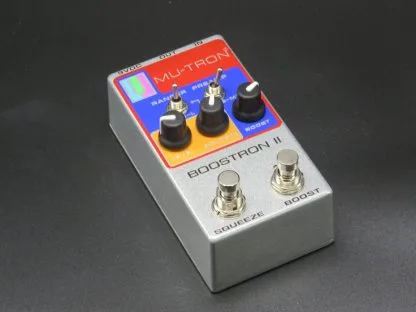

The Mu-Tron Boostron II is a dual-effect boost pedal that puts three types of clean boost on one channel and a high-headroom, low-noise compressor on the other. Each channel has its own footswitch, so the two halves work independently: you can run the boost alone, the compressor alone, or both at once1.
The compressor side is built on a well-known lineage. Mu-Tron takes the Dan Armstrong Orange Squeezer compressor circuit and, in the company's words, redefines it "to a whole new professional-grade level"1. Mu-Tron describes the result as a compressor so clean you may not notice it is on, with an interactive reaction to your dynamics2.
What the boost channel does
The BOOST channel is switchable between three different classic preamp circuit designs, which Mu-Tron says are the circuits from which many boost circuits have been derived123. Each preamp has its own internal level control, and a single Boost knob sets the master level of the preamp boost signal43.
Mu-Tron describes the boost as transparent, allowing pure line amplification of your instrument, enriching harmonic overtones and expanding frequency response across the full-range audio spectrum13. In other words, it is a clean boost rather than an overdrive or distortion pedal: it pushes level and opens up the sound rather than adding clipping of its own.
Three preamp circuits: RR, SB and MU
A Preamp switch on the face of the pedal selects between the RR, SB and MU circuits1. Mu-Tron's November 2019 announcement, which introduced the Boostron II as in development on the company's new platform, named the three choices as the Blaster, the Ranger and the MU5.
The Ranger circuit gets an extra control the other two do not: a Ranger switch with H, M and L positions that selects the EQ curve for the RR circuit only1. That gives the Ranger setting three distinct voicings, while SB and MU run at their fixed character.
| Switch | What it selects |
|---|---|
| Preamp (RR/SB/MU) | Which of the three preamp circuits the boost channel uses1 |
| Ranger (H/M/L) | The EQ curve, for the RR circuit only1 |
The compressor channel
The SQUEEZE channel is a dedicated Dan Armstrong Orange Squeezer compressor with squeeze and level controls5. The Squeeze knob controls the amount of compression of the squeeze signal, and the Level knob controls its master level43.
Mu-Tron says the compressor runs at a higher voltage than the original Squeezer design, which is part of the dual-rail power supply shared with the Micro-Tron IV and the Octavider+1. In the 2019 announcement the company wrote:
Controls and footswitches
The pedal keeps its control set small. Two knobs, two small switches and two footswitches cover everything:
| Control | What it does |
|---|---|
| Boost | Master level of the preamp BOOST effect signal3 |
| Squeeze | Amount of compression of the SQUEEZE effect signal3 |
| Level | Master level of the SQUEEZE effect signal3 |
| Preamp (RR/SB/MU) | Selects the preamp circuit3 |
| Ranger (H/M/L) | Selects the EQ curve for the RR circuit only1 |
| BOOST footswitch | Engages the preamp1 |
| SQUEEZE footswitch | Engages the compressor1 |
Because the two footswitches are independent, the pedal works as a boost, a compressor, or both at once1.
Power and connections
The Boostron II runs on a 9V DC supply and uses the same dual-voltage power supply design as the Mu-Tron Micro-Tron IV and Octavider+1. That dual-rail design is what gives the pedal its high headroom and low noise, and it is what lets the compressor section run at a higher internal voltage than a standard 9V pedal would1.
Connections are simple: one 1/4" input jack and one 1/4" output jack1. The pedal sits in Mu-Tron's mini-mu enclosure, measuring 4.75" x 2.5" x 2.25" and weighing 1 lb1.
Versions: Vintage Silver and Black Limited Edition
The Boostron II comes in two finishes. The standard Vintage Silver version lists at $279.001. The Black Limited Edition lists at $299.003. Both carry the same feature set, the same analog signal path, the same 9V DC power requirement, the same dimensions and weight, and the same 1 year limited warranty13.
Mu-Tron also sells a Vintage Silver A-stock option at $264.00. These are pedals with minor cosmetic imperfections to the case; Mu-Tron says they still carry the regular warranty and have no internal issues4.
| Version | Price | Notes |
|---|---|---|
| Vintage Silver | $279.001 | Standard version |
| Black Limited Edition | $299.003 | Limited edition finish |
| Vintage Silver A stock | $264.004 | Minor cosmetic imperfections to the case, regular warranty, no internal issues |
Where it came from
The Boostron II was announced in Mu-Tron's November 2019 news as the next pedal in development on the company's new platform, following the Micro-Tron IV and Octavider+5. The design pairs the three classic preamp boost circuits on one side with the Orange Squeezer compressor, a circuit originally associated with Dan Armstrong, on the other5. The pedal is made in the USA1.
Videos
Mu Tron
Questions
Is the Mu-Tron Boostron II analog?
Yes. Mu-Tron describes the Boostron II as high-fidelity, analog signal processing. Both the boost channel with its three preamp circuits and the Orange Squeezer-based compressor channel are analog, and the pedal runs on a 9V DC supply.
Can I use the boost and compressor channels at the same time?
Yes. The Boostron II is an independent dual effect, with the boost preamp on one footswitch and the compressor on the other. Each channel has its own footswitch, so you can run either one alone or both together.
What do RR, SB and MU stand for on the Boostron II?
They are the three classic preamp circuit designs selectable on the boost channel. Mu-Tron's 2019 announcement named them as the Blaster, the Ranger and the MU, classic preamp boost circuits from which many boost circuits have been derived. The Ranger circuit also gets its own H/M/L EQ switch.
Where is the Mu-Tron Boostron II made?
Mu-Tron lists the Boostron II as Made in the USA. The pedal is built in the company's mini-mu enclosure and carries a 1 year limited warranty.
Sources (5)
- Boostron II Vintage Silver, Musitronics Mu-Tron
- Boostron II, Musitronics Mu-Tron
- Boostron II Black Limited Edition, Musitronics Mu-Tron (mu-tron.com)
- Boostron II Vintage Silver A stock, Musitronics Mu-Tron (mu-tron.com)
- Mu-News November, 2019, Musitronics Mu-Tron, 2019-11