| Type | Envelope filter pedal with synthesizer sounds2 |
| Maker | Musitronics Corp., Rosemont, New Jersey2 |
| Released | 19721 |
| Designer | Mike Beigel67 |
| Status | Original discontinued; product line sold to ARP in 19788 |
| Power | ±9 volts from 2 NEDA 1604 batteries, or the Musitronics Model PS-1 Battery Eliminator2 |
| Gain range | 0.1 to 40, driven from a low impedance source2 |
| Input impedance | 1 megohm at lowest GAIN setting, variable to 3.3K ohms at maximum gain2 |
| Output impedance | 600 ohms2 |
| Dimensions | 8¾″ long, 5″ wide, 3⅛″ high2 |
| Weight | 3¼ pounds without batteries2 |
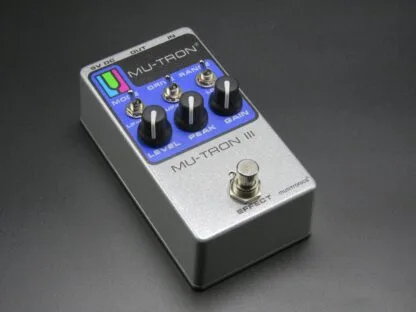
The Mu-Tron III is an envelope filter pedal released in 1972 by Musitronics Corp. of Rosemont, New Jersey, designed by Mike Beigel1. Instead of a foot rocker like a wah pedal, it reads the envelope, or "volume picture," of every note you play and uses it to sweep a filter, producing what the original ad called "an easily-controlled, articulated, vowel-like sound" that moves as fast or slow as you play2. It is the pedal that defined the envelope filter category, and its circuit, a bipolar-powered state-variable filter swept by photo-couplers, is still being reissued and cloned today.
For a player, the appeal is touch response. Pick harder and the filter opens further; play softly and it barely moves. The effect is often described as an automatic wah, and the Mu-Tron III is the circuit most later envelope filters, from Electro-Harmonix's Q-Tron to Behringer's B-TRON III, trace their lineage to345.
Where the Mu-Tron III came from
Mike Beigel designed the Mu-Tron III, and the pedal's core idea came from synthesizer practice: its circuit line is derived from the Guild synthesizer's "timbre generator" and one of its four voltage-controlled filters9. The pedal was at first called the Auto-Wah, and early units were sold at E.U. Wurlitzer in Boston, where they sold well enough that more were made9. As Beigel put it, "We used a dual supply instead of a single supply so the effect could have a wide dynamic range"10.
The company's run included a change of ownership: late-'70s versions of the Mu-Tron III, made when Musitronics was owned by ARP, have a built-in power supply10. For many years, the performance of any given Mu-Tron III was based on the electrical performance of its photo-couplers, which did not all behave the same, so individual units could differ in feel11. The design's influence continued long after, through later pedals built on the same circuit.
Jerry Garcia is listed by Musitronics among the line's past endorsers or users12, which is part of why the pedal stays tied to the Grateful Dead sound in players' minds.
How it works: an envelope-controlled filter with photo-couplers
The Mu-Tron III is an envelope-controlled filter, a type often called an autowah1353. The signal path has two jobs. First, an envelope follower tracks the volume shape of your playing. Second, that envelope voltage drives a filter whose cutoff frequency moves up and down with it. The result is a wah-like sweep that follows your dynamics instead of your foot.
What makes the Mu-Tron III's version of this distinctive is how the envelope drives the filter. The original units used photo-couplers, components that combine a light source and a light-sensitive resistor in one package, sometimes called optocouplers, photocouplers or vactrols11. The vintage pedals used the Hamamatsu 0805a photo-coupler14. The envelope voltage drives the light, the light changes the resistance, and that resistance sets the filter's frequency. Musitronics notes that for many years the performance of any given Mu-Tron III was based on the electrical performance of its photo-couplers, which did not all behave the same11. Two original pedals could sound noticeably different, and the company's modern Opto-Mod Red module deliberately models "an older Mu-Tron III which has drifted out of factory calibration"15.
The filter itself is a state-variable type, a synthesizer topology that provides lowpass, bandpass and highpass outputs from one core circuit, which is exactly what the pedal's MODE switch selects between16.
The controls: filter modes, gain and the range switch
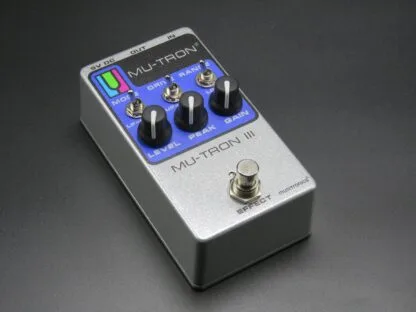
The original Mu-Tron III keeps its control set small. The MODE switch selects the type of filter: lowpass, bandpass or highpass2. The GAIN control sets how hard your signal drives the envelope and the filter, which is the main way you tune the pedal's sensitivity to your instrument and touch17. The RANGE switch emphasizes high or low frequencies, and the DRIVE switch shifts the filter up or down for two totally different effects18.
How each mode behaves, as Musitronics describes it on its modern versions of the circuit1719:
| Mode | What it passes | What it attenuates |
|---|---|---|
| LP (lowpass) | All signals below the peak | Signals above the peak |
| BP (bandpass) | Signals only near the peak | Signals below and above the peak |
| HP (highpass) | All signals above the peak | Signals below the peak |
The modern Mu-Tron III+ adds internal DIP switches: two tailor the high and low frequency ranges, three control how the unit follows the dynamics of the instrument, and one lets the low-battery LED double as a sweep limit indicator18. It also carries a true, passive bypass switch for routing the audio around the effect18.
Power: ±9V from two batteries
The original Mu-Tron III runs on ±9 volts, supplied by 2 NEDA 1604 batteries, or by the Musitronics Model PS-1 Battery Eliminator, which made batteries unnecessary220. The bipolar supply is part of the synthesizer heritage of the circuit and is one of the things that makes cloning the pedal more involved than a typical 9V fuzz build16.
The ±9V requirement means the original pedal cannot simply share a standard single-supply 9V daisy chain with modern pedals. The PS-1 Battery Eliminator was Musitronics' own answer for powering it from the wall220.
The pedal needs a minimum input signal of 1.5 mV from a 600 ohm source for the full Mu-Tron effect, and its maximum undistorted output is 3.6 volts RMS2. Its input impedance varies from 1 megohm at the lowest GAIN setting to 3.3K ohms at maximum gain, so the GAIN control also changes how the pedal loads whatever is in front of it2.
Versions from Musitronics to ARP
The Mu-Tron III's production history splits into eras:
- Original run: the Mu-Tron III was made in the US, and late-'70s versions, produced when Musitronics was owned by ARP, have a built-in power supply10.
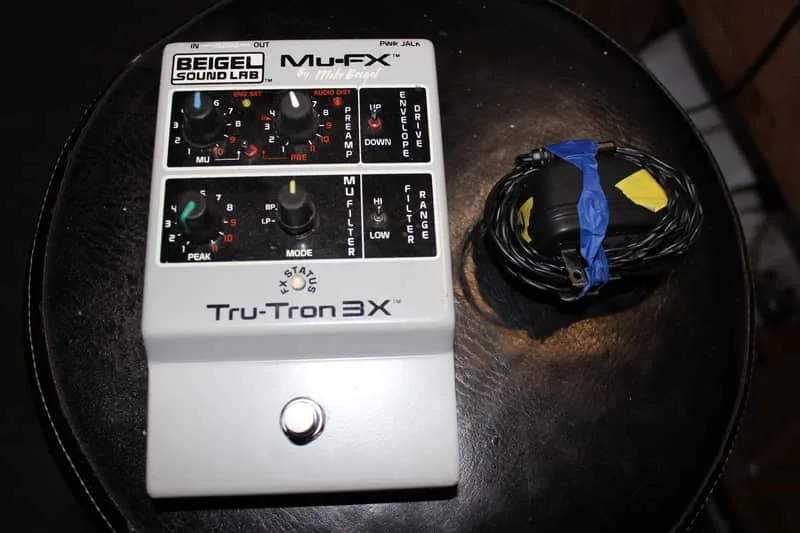
- Modern re-issue: the Beigel Sound Lab Tru-Tron 3X is described by its maker as the authorized modern all-analog re-issue and refinement of the classic Mu-Tron III envelope filter, with higher Q than the original Mu-III when needed21.
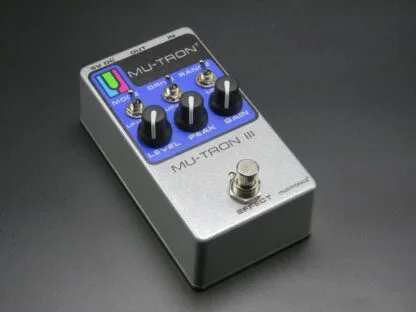
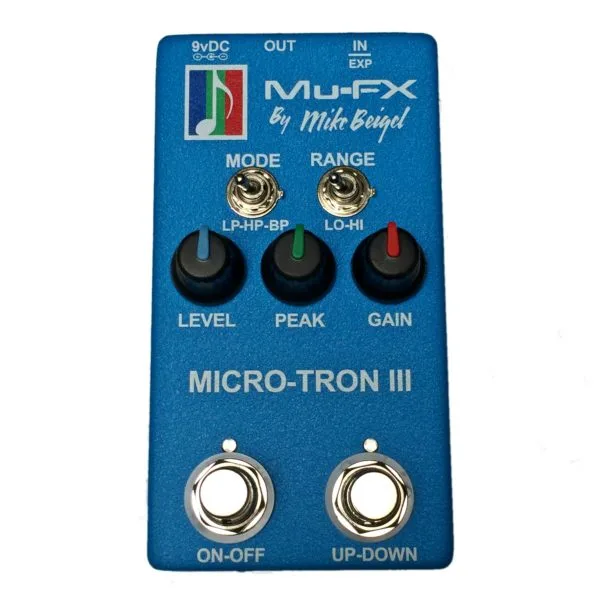
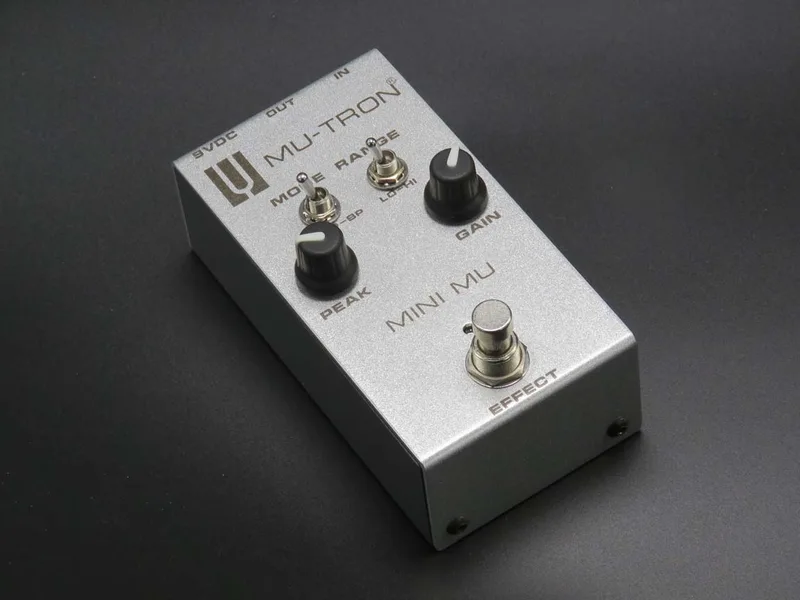
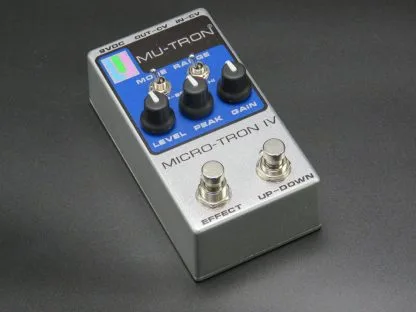
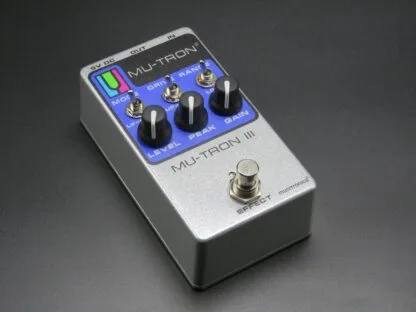
Alongside these, Musitronics' current lineup carries several pedals described as reincarnations of the classic Mu-Tron III envelope filter: the Mu-Tron III Vintage Silver, built with the same circuit in a modern enclosure and made in the US22; the Mu-FX Micro-Tron III221719; the Micro-Tron IV, based on the Micro-Tron III19; and the Mini Mu, which the maker says is true to the original Mu-Tron III gain circuit and opto-coupler design221719. The Vintage Silver's bypass is selectable between "Bleed" and "Active" on an internal control, with the bleed mode letting the pedal act as a clean boost when bypassed22.
The descendants: Q-Tron, Mini Q-Tron and Tru-Tron 3X
The Mu-Tron III's design carried forward into later pedals from Mike Beigel. The Beigel Sound Lab Tru-Tron 3X is described by its maker as the authorized modern all-analog re-issue and refinement of the classic Mu-Tron III envelope filter21. It offers higher Q than the original Mu-III when needed, giving a player a stronger, more resonant filter sweep than the 1970s unit could produce2123.
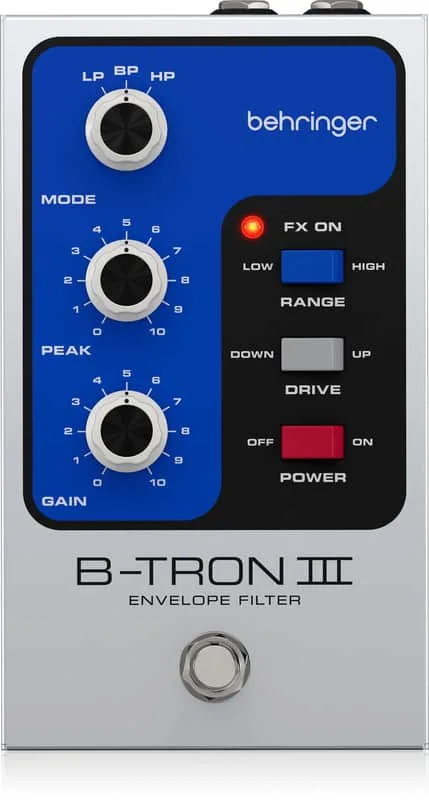
The Mu-Tron III's reach extends beyond its own brand. Behringer's B-TRON III has been described as a not-so-subtle $69 replica of the Mu-Tron III envelope filter524, and HeadRush's Auto Wah modeling stompbox is stated by its maker to be based on a Mu-Tron III envelope filter24.
Building a Mu-Tron III clone
The Mu-Tron III is a well-documented DIY project. General Guitar Gadgets' Neutron is a kit based on the Musitronics Mu-Tron III, which the maker calls "one of the most famous and best sounding Envelope Filters ever made"25. Builders who have completed the project report that it is a great pedal, with lots of cool sounds, including phaser-like sounds on the down sweep controlled by picking velocity, though one noted it is not easy to wire26.
A clone builder should expect two things that differ from a typical pedal build: the bipolar ±9V supply, and the photo-couplers. The original Hamamatsu 0805a photo-couplers are no longer common parts, and Musitronics notes that the character of any Mu-Tron III depends heavily on the electrical behavior of the photo-couplers used1411. That is also why original units vary so much from pedal to pedal, and why the company now offers Opto-Mod modules, including one that models a drifted, out-of-calibration vintage unit1415.
Pedals on this page
Questions
Who designed the Mu-Tron III?
Mike Beigel designed the Mu-Tron III. He released it in 1972 through Musitronics Corp., the company he founded in Rosemont, New Jersey. Beigel later reinvented the Mu-Tron sound for Electro-Harmonix in the 1990s and designed the Mu-FX Tru-Tron 3X, which became the official successor to the Mu-Tron legacy in 2013.
What did Jerry Garcia use the Mu-Tron III for?
Jerry Garcia is listed by Musitronics among the Mu-Tron line's past endorsers or users. The Mu-Tron III translates the envelope, or volume profile, of each note into a vowel-like filter sweep, which is the kind of touch-responsive wah effect players associate with his use of the pedal.
When was the Mu-Tron III discontinued?
Musitronics Corp. operated until 1978, when its Mu-Tron product line was sold to ARP. The original 1972 Mu-Tron III therefore left production with that sale. The circuit returned later through Electro-Harmonix's Q-Tron in 1996 and Mike Beigel's own Mu-FX Tru-Tron 3X in 2013.
What is the difference between lowpass, bandpass and highpass on a Mu-Tron?
The MODE switch selects the filter type. Lowpass passes signals below the sweep peak and attenuates those above it, highpass passes signals above the peak and attenuates those below, and bandpass passes only the signals near the peak, attenuating both sides. Each mode accents a different region of the audio spectrum.
Sources (26)
- Mike Beigel, Musitronics Mu-Tron (mu-tron.com)
- Mu-Tron III, Musitronics Mu-Tron
- The Best Guitar Effects Pedals of All Time, GuitarPlayer (www.guitarplayer.com), 2021-06-25
- Electro-Harmonix Unveils the Nano Q-Tron Envelope Filter, GuitarPlayer (www.guitarplayer.com), 2021-12-03
- Behringer blasted by Mu-Tron III maker over $69 replica, Guitar World, 2025-02-17
- Knight School Filter (Built Pedal), Catalinbread Effects
- Mu-FX Tru-Tron 3X, Musitronics Mu-Tron
- Mu-FX Tru-Tron 3X, Vintage Guitar magazine, 2015-09-04
- Builder Profile: The Mu-tron Story, www.premierguitar.com, 2013-09-12
- How the Mu-Tron III became a vintage pedalboard icon, Guitar World, 2026-02-09
- Mu-Tron Opto-Mod Modules for Micro-Tron IV, Musitronics Mu-Tron
- Artists - Musitronics Mu-Tron, Musitronics Mu-Tron
- VFE_SPS_MiniMu.pdf, madbeanpedals.com, 2024-04-25
- Mu-Tron Opto-Mod Modules for Micro-Tron IV, Musitronics Mu-Tron
- Mu-Tron Opto-Mod Red+, Musitronics Mu-Tron
- Knightpass Filter, Catalinbread Effects
- Mu-FX Micro-Tron III, Musitronics Mu-Tron
- Mu-Tron III+ Envelope Controlled Filter, Musitronics Mu-Tron
- Micro-Tron IV, Musitronics Mu-Tron
- Mu-Tron PS-1, Musitronics Mu-Tron
- NAMM 2014: Beigel Sound Lab announces Tru-Tron 3X pedal, MusicRadar, 2014-01-27
- Mu-Tron III Vintage Silver, Musitronics Mu-Tron (mu-tron.com)
- Beigel Sound Labs Unveils the Tru-Tron 3X, Premier Guitar, 2014-01-22
- HeadRush Auto Wah, HeadRush (revalver.headrushfx.com), 2026
- Mu-Tron™ III Clone (Neutron): Envelope Filter PCB & Schematic, General Guitar Gadgets, 2014-05-14
- Guitar FX Layouts: Mutron III, Guitar FX Layouts (tagboardeffects.blogspot.com), 2014-06-19