

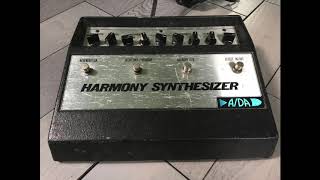
The A/DA Harmony Synthesizer is a vintage harmonizer pedal released in 1979 and designed by A/DA founder David Tarnowski. Despite the name, Premier Guitar's Tom Hughes describes it as "actually a rather elaborate analog delay and pitch transposer," marketed as a synthesizer. It sits in the octave and pitch family, and Hughes notes that when it arrived in 1979, "there really wasn't anything else quite like it"1.
What it is and how it works
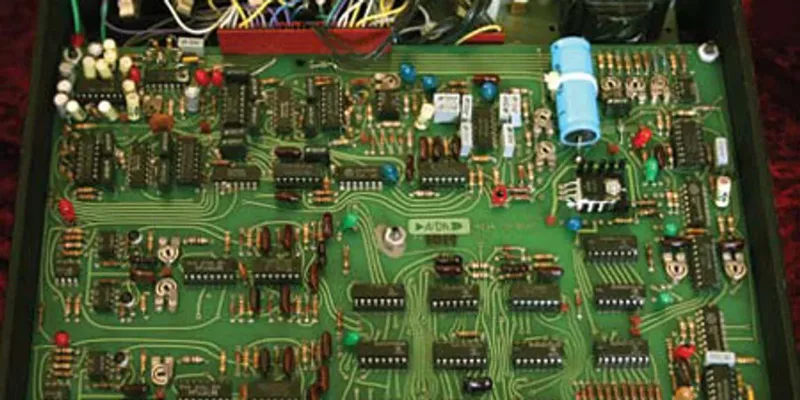
The Harmony Synthesizer is unusual among harmonizers in being entirely analog. Hughes calls it "the only harmonizer that uses 100 percent analog circuitry," built around a circuit he describes as "painfully complex"1. In appearance it resembles "an overgrown A/DA Flanger," and at 11 inches by 9 inches it is one of the larger vintage stompbox-type effects1.
What sets the circuit apart:
- Entirely analog signal path, which Hughes says no other harmonizer uses1
- 42 integrated circuits in total1
- Two Reticon SAD1024A delay chips at its core1
- 14 internal trim-pots inside the case1
The player-facing controls are nine knobs and four footswitches1.
| Feature | Detail |
|---|---|
| Signal path | 100 percent analog1 |
| Core chips | Two Reticon SAD1024A analog delay chips1 |
| Integrated circuits | 421 |
| Internal trim-pots | 141 |
| Player controls | Nine knobs, four footswitches1 |
| Case size | 11 inches by 9 inches1 |
These are rare units with no readily available full schematic. Hughes reports at least a couple of examples in need of repair and few technicians willing to service them1.
What reviewers said
Craig Anderton, reviewing the unit in Device magazine in 1979, wrote from an engineer's standpoint1:
"It's amazing that this box even exists at all"
Tom Hughes, writing for Premier Guitar, is candid about the sound:
"The sound quality is pretty lo-fi by anyone's standards, especially when compared to something like an Eventide Harmonizer."
He adds that the pitch is likely to drift after tuning an interval1. The trade-off is the all-analog signal path, which no digital harmonizer offers1.
| A/DA Harmony Synthesizer | Eventide Harmonizer | |
|---|---|---|
| Signal path | Fully analog1 | Digital1 |
| Sound quality | "Pretty lo-fi by anyone's standards," per Hughes1 | The comparison point Hughes uses for better fidelity1 |
| Tuning | Pitch likely to drift after tuning an interval1 | Not remarked on by Hughes1 |
Repair and servicing
The Harmony Synthesizer has a reputation among technicians. Howard "Mick" Davis, an Electro-Harmonix design engineer, told Premier Guitar1:
"Most EH products are welcome, but the A/DA Harmony Synth is a pretty hairy unit that is not on my preferred list."
With 42 ICs, 14 internal trim-pots and no full schematic readily available, few technicians are willing to take one on1.
Price
As a rare vintage unit, the Harmony Synthesizer commands high prices secondhand. Premier Guitar's history of vintage guitar synth pedals notes that one was posted on Reverb for $5,0002.
Videos
Darren Shroeger
Darren Shroeger
Rafmax Fx
Questions
Is the A/DA Harmony Synthesizer analog or digital?
It is fully analog. Premier Guitar's Tom Hughes called it the only harmonizer that uses 100 percent analog circuitry. The circuit is built around 42 integrated circuits, including two Reticon SAD1024A delay chips, and it works as an elaborate analog delay and pitch transposer rather than a digital pitch shifter.
Who designed the A/DA Harmony Synthesizer?
It was designed by David Tarnowski, the founder of A/DA. The unit arrived in 1979 and, according to Premier Guitar's Tom Hughes, there was nothing else quite like it on the scene at the time.
How does the A/DA Harmony Synthesizer compare to an Eventide Harmonizer?
Tom Hughes of Premier Guitar described the Harmony Synthesizer's sound quality as pretty lo-fi by anyone's standards, especially compared to an Eventide Harmonizer. He also noted that the pitch is likely to drift after tuning an interval. Its selling point is that the whole circuit is analog, where the Eventide units are digital.
Why is the A/DA Harmony Synthesizer hard to repair?
The circuit is very complex, with 42 ICs and 14 internal trim-pots inside the case, and no full schematic is readily available. Howard Davis, an Electro-Harmonix design engineer, called it a pretty hairy unit that is not on his preferred repair list, and few technicians are willing to service them.
How much does an A/DA Harmony Synthesizer cost?
One was posted on Reverb for $5,000, according to a 2021 Premier Guitar history article on vintage guitar synth pedals. Prices vary unit to unit, and condition matters given the repair difficulties.
Sources (2)
- Inside the A/DA Harmony Synthesizer, Premier Guitar, 2010-09-21
- Monster Mutilators: Vintage Guitar Synth Pedals, Premier Guitar, 2018-06-07