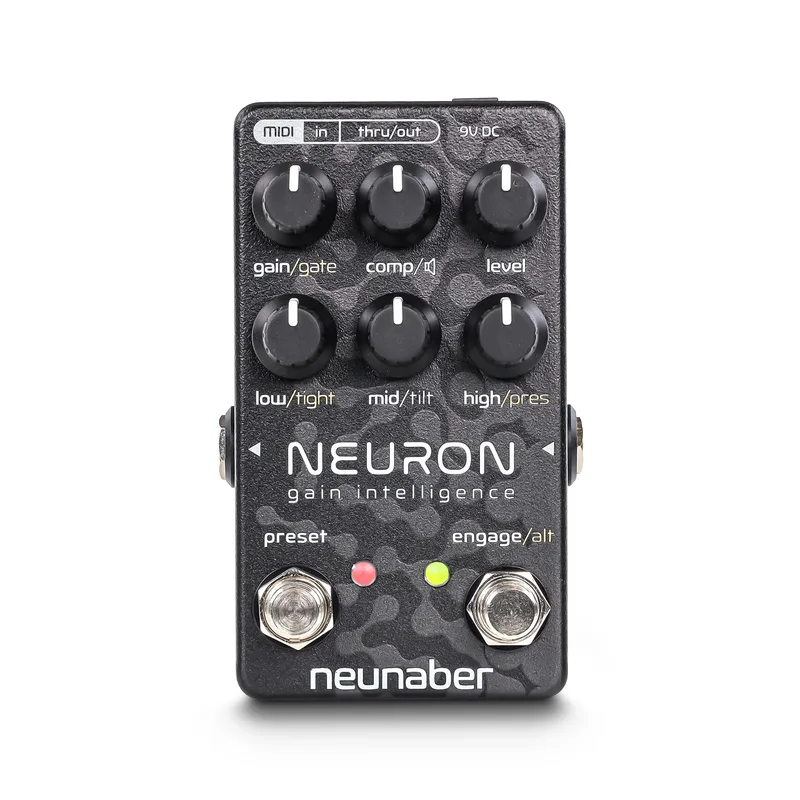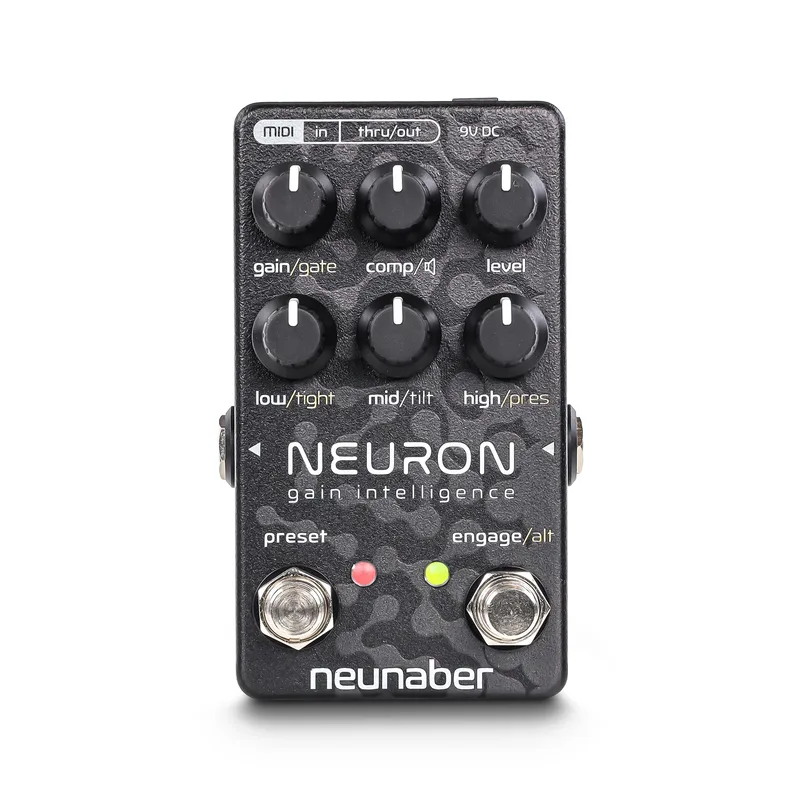


The Neunaber Neuron, sold as the Neuron Gain Intelligence, is a digital guitar preamp in a compact pedal. Neunaber describes it as "a dynamic multistage guitar preamp with compressor, noise gate, speaker simulator, presets and MIDI in a compact pedal form"1. It produces amp tones from sparkling clean to heavy distortion, and its integrated compressor constrains the drive level for smooth, consistent tone23.
What sets it apart from most amp-sound pedals is its design philosophy: Neunaber states it is a unique design based on years of research into amps and pedal circuits, and "is not a model, emulation or simulation of any particular amp"1. It runs at a 96 kHz sample rate with a minimum latency of 0.315 ms1.
What it does: a digital amp-sound pedal with a built-in compressor
The Neuron sits in the preamp pedals family rather than being a straightforward overdrive or distortion pedal. The manual says it "achieves a seamless array of incredible amp tones in a compact pedal, from sparkling clean to heavy distortion"3. Because it is a preamp rather than a stompbox clipping stage, it is designed to be the amp-shaped part of your signal chain, either into a real amp, a powered speaker, or direct to a recording interface.
The built-in compressor is part of how the pedal manages its gain. Neunaber says the "integrated compressor constrains the drive level for smooth, consistent tone"6. For players coming from a separate compressor pedal, this means the Neuron handles that job internally rather than leaving it to another box. It also includes studio-quality noise reduction for higher gain settings, which Pedal of the Day noted in its review7.
The circuit is not a copy of anything specific. Pedal of the Day described it as "the culmination of years of researching both solid state and tube amplifiers," with new algorithms semi-based on those amps but with an original and distinct flavor7. Their verdict on the result:
"Not an emulation of any specific gear, but a pathway to new and creative enjoyment, the Neuron truly does represent a 'g'"7
Pedal of the Day, March 20197
Presets, MIDI and the controls
The Neuron stores settings as presets and gives you several ways to reach them178:
- On the pedal: up to 6 presets via the Preset footswitch, or 7 including Manual Mode, where the Preset LED is off and the knob settings are used directly9
- Over MIDI: up to 24 presets recalled via MIDI Program Change commands3
- Via software: unlimited presets using the Neuron Commander software1
The onboard presets correspond to the first MIDI presets, so a MIDI controller simply extends the same bank9. All controls are accessible from a MIDI controller, and the pedal is compliant with MIDI Specification CA-0333. MIDI Control Change command 113 saves the current preset, and the preset LED color can be changed over MIDI as well3. This puts it in the same practical territory as other MIDI pedals for players running larger boards.
The Preset footswitch selects a stored preset, and its LED illuminates when a preset is active3. Preset parameters include the High EQ and the other stored knob settings9.
Speaker simulator
A setup control turns the internal speaker simulator on and off. Full counter-clockwise (a yellow-green LED) switches it off, for use with an external speaker simulator, an amp head and cabinet, or a combo amp. Full clockwise (a blue LED) switches it on, for running direct to a recording interface, mixer, powered speaker or headphone amp3.
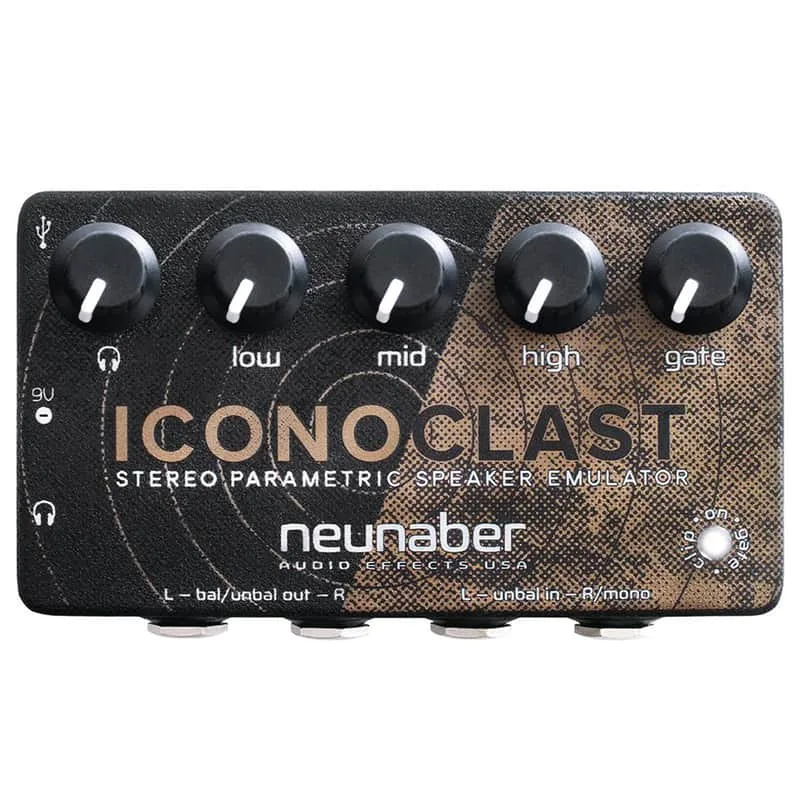
The Speaker Simulator is a global setting, independent of the preset selection, so it applies no matter which preset you have loaded3. Neunaber says the filter "is voiced to sound similar to Iconoclast with default settings and tone knobs at 12 o'clock," and it is not adjustable3. Players who want more control over their direct tone can switch it off and use a separate speaker simulation pedal instead.
Power and connections
The Neuron runs on a 9 to 12 V DC input from a standard 9V pedal power supply, drawing 70 mA12. Neunaber recommends a 9 V DC adapter rated at 100 mA or greater2.
Neunaber recommends an isolated 9V or 12V pedal power adapter, and discourages powering the Neuron in a daisy-chained connection where the total current exceeds 500 mA6.
The power connector is center-negative, 5.5 mm OD x 2.1 mm ID, the common pedal standard1. The input is instrument level at -10 dBV nominal with a 1 MΩ input impedance, and the output impedance is 1 kΩ16.
Where it came from
The Neuron was announced in January 2019 ahead of the NAMM show, where Gearnews reported Neunaber was "about to launch what the company is calling a 'hyper-realistic' guitar preamp pedal"10. Premier Guitar's announcement quoted company founder Brian Neunaber and reported the pedal was expected to ship in mid-February 2019 at an MSRP of $2995. Delicious Audio had covered a prototype before release8.
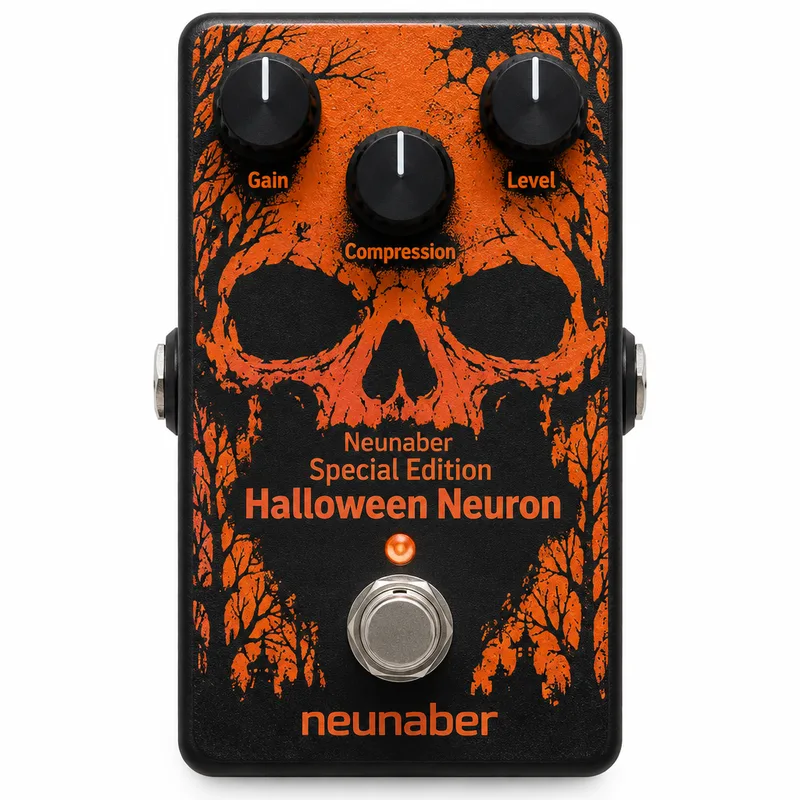
Neunaber Technology LLC is a small family-owned and operated business; its products are developed and manufactured in Orange, California, USA4. Later in 2019, Guitar World reported a Special Edition Halloween Neuron, a limited edition skull graphic version of the drive/preamp with the same switchable speaker simulator, true bypass switching and MIDI preset access11.
What reviewers said
Pedal of the Day reviewed the Neuron in March 2019 and framed it as a preamp rather than a drive pedal, noting the true bypass "ensures consistent sound from your original source when the pedal is in bypass mode"7. The review highlighted the preset storage, up to 6 via the onboard footswitch or up to 24 via MIDI, and the studio-quality noise reduction at higher gain settings7. Its overall take was that the pedal is not an emulation of any specific gear but a creative tool in its own right7.
Videos
Pete Thorn
Andertons Music Co
The Pedal Zone
Questions
Is the Neunaber Neuron an amp modeler?
No. Neunaber describes it as a unique design based on years of research into amps and pedal circuits that is not a model, emulation or simulation of any particular amp. Pedal of the Day called it not an emulation of any specific gear, but a pathway to new and creative enjoyment. It is best understood as a digital preamp with its own character.
How many presets does the Neunaber Neuron hold?
Up to 6 presets are accessible from the pedal's own Preset footswitch, or 7 including Manual Mode. With a MIDI controller you can recall up to 24 presets, and the Neuron Commander software allows unlimited presets. The onboard presets correspond to the first MIDI presets.
Does the Neunaber Neuron have a cab simulator?
Yes. A Speaker Simulator setup control turns the internal speaker simulator on or off. It is a global setting, independent of preset selection. Neunaber says the filter is voiced to sound similar to its Iconoclast with default settings and tone knobs at 12 o'clock, and it is not adjustable.
Is the Neunaber Neuron true bypass?
Yes. The pedal uses relay-based true bypass switching, so your original signal passes through unchanged when the pedal is bypassed. Guitar World and Pedal of the Day both confirmed the true bypass switching in their coverage.
Who designed the Neunaber Neuron?
The Neuron comes from Neunaber Technology LLC, founded by Brian Neunaber, who is the company's founder and designer. Neunaber products are developed and manufactured in Orange, California, USA, by a small family-owned and operated business.
Sources (11)
- Neuron - Gain Intelligence - Quilter Labs, Quilter Labs (neunaber.net)
- Neuron - Gain Intelligence - Quilter Labs, Quilter Labs (neunaber.net)
- Neuron Gain Intelligence User Guide, Quilter Labs, 2019
- Neuron - Gain Intelligence (Deutsche) - Quilter Labs, Neunaber Technology LLC, 2019
- Neunaber Audio Announces the Neuron, Premier Guitar, 2019-01-17
- Neuron Gain Intelligence User Guide, Neunaber Technology LLC, 2019
- Neunaber Audio Neuron Gain Intelligence Preamp, Pedal of the Day, 2019-03-29
- Neunaber Neuron Gain Intelligence, Delicious Audio, 2020-03-24
- Neuron Commander User Guide, Neunaber Audio (Quilter Labs)
- NAMM 2019: Neunaber to present “hyper-realistic” Neuron guitar preamp pedal, gearnews.com, 2019-01-18
- Go trick-or-treating with Neunaber's Special Edition Halloween Neuron pedal, Guitar World, 2019-10-30