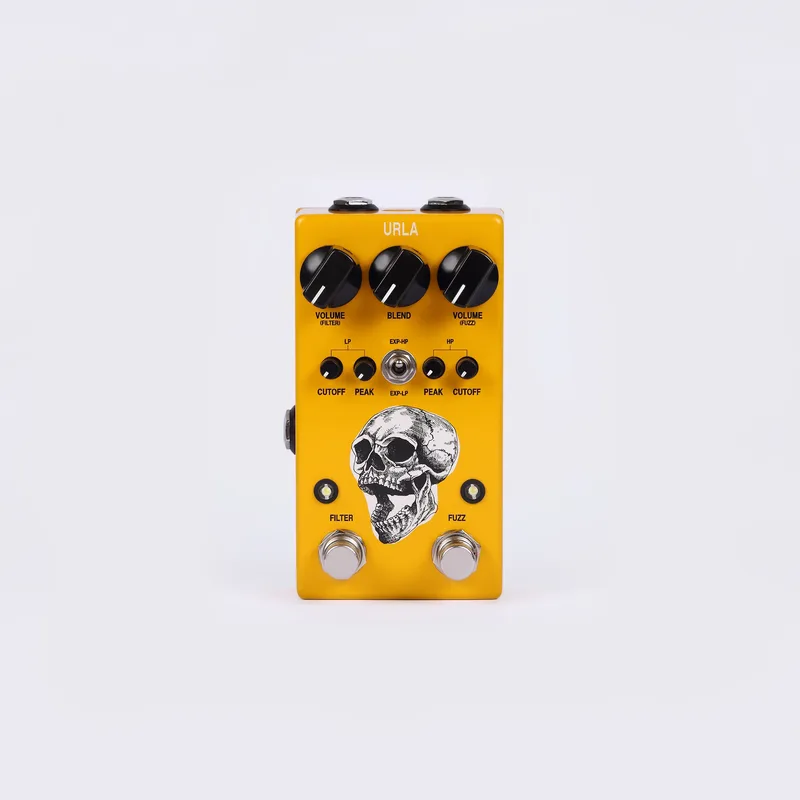


The AC Noises URLA is a fuzz pedal that combines two distinct effects in one unit: a CMOS fuzz followed by a synth-based dual resonant filter. The name comes from the Italian verb meaning "scream" in the second person imperative, which suits the character the maker describes: an overdriven, brutal, and glitchy fuzz with a distinctive gated quality1.
The URLA was listed as sold out on the maker's product page as of 26 October 20261.
How the circuit works
The fuzz section is not a traditional transistor fuzz. According to AC Noises, the CMOS fuzz operates on digital logic, producing a square wave output regardless of the input signal. That is what gives the pedal its gated, glitchy edge rather than the looser sag of a transistor-based design1.
The filter section after it is a faithful replica of the analog filter section from the Korg MS-20 synthesizer. It consists of a high-pass and low-pass filter connected in series, each with its own controls, so the fuzz tone can be narrowed, swept, or pushed into resonant synth-like territory1. Players interested in this kind of tone shaping may also want to read about filter pedals more broadly.
Controls
| Control | What it does |
|---|---|
| VOLUME (fuzz) | Adjusts the output level of the fuzz effect1 |
| VOLUME (filter) | Sets the output level of the dual filter section1 |
| CUTOFF | Determines the frequency at which the high-pass and low-pass filters begin to attenuate, with a wide range from 0Hz to 15kHz1 |
| BLEND | Mixes the fuzz sound with the original signal, from almost completely dry to 100% wet, via an analog jFET blend1 |
| EXP toggle | Selects whether an expression pedal controls the high-pass or low-pass filter cutoff1 |
The BLEND control is worth noting for players who run the pedal before a driven amp or with other dirt: because it is an analog jFET blend, the dry signal can be kept underneath the fuzz rather than replaced by it1.
Expression pedal input
The URLA provides an expression input for real-time control of either the high-pass or low-pass filter cutoff, depending on the position of the EXP toggle switch. The maker states it works with any standard expression pedal, so no special model is needed1. With the fuzz feeding the MS-20-style filters, foot control of the cutoff turns the pedal into something closer to a playable synth filter. See expression pedals for compatible options.
Power and switching
The URLA runs on 9V DC center negative and draws a minimum of 100 mA1. That figure matters on a crowded board: a supply output rated below 100 mA, or a shared daisy-chain leg already feeding other pedals, may not run the URLA reliably. Bypass is true bypass, managed by a soft switch plus a programmed relay1.
Videos
AC noises
Demos In The Dark
Noise Generator
Questions
What does the AC Noises URLA name mean?
AC Noises names the URLA after the Italian verb meaning "scream" in the second person imperative. The name fits the pedal's character: the maker describes the CMOS fuzz section as producing an overdriven, brutal, and glitchy sound with a distinctive gated quality, followed by a resonant dual filter that shapes it further.
Can the URLA be used with an expression pedal?
Yes. The URLA provides an expression input for real-time control of either the high-pass or low-pass filter cutoff, depending on the position of the EXP toggle switch. It works with any standard expression pedal, so a player can sweep the filters by foot while playing.
Is the AC Noises URLA true bypass?
Yes. The switching system is true bypass, managed by a soft switch plus a programmed relay, according to the maker's product page.
What power does the AC Noises URLA need?
The URLA runs on 9V DC center negative and draws a minimum of 100 mA. Because of that current draw, a low-output daisy-chain output or a small battery-style supply may not be enough; a dedicated 9V supply output rated for at least 100 mA is the safe choice.
Why does the URLA fuzz sound gated?
The gated quality comes from the circuit's design. Unlike traditional transistor-based fuzz circuits, the CMOS fuzz in the URLA operates on digital logic, producing a square wave output regardless of the input signal. The maker describes the result as an overdriven, brutal, and glitchy sound with a distinctive gated quality.
Sources (1)
- AC noises URLA, acnoises.com