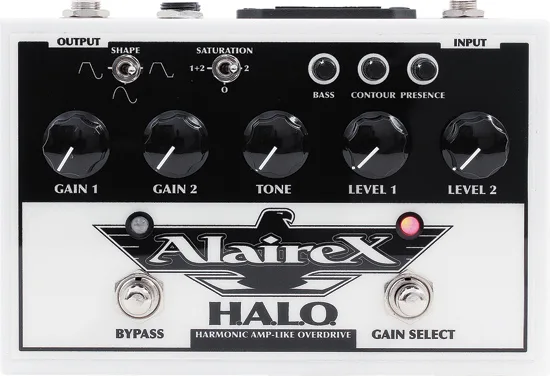


The Alairex H.A.L.O. is an overdrive pedal built as two separate analog overdrive channels in one box, each with its own Gain and Level controls. It was the first product released by the company, reviewed by Vintage Guitar in April 2014 at a list price of $3991. The maker's designer is guitarist Alex Aguilar, a veteran player and former guitar-mag columnist who runs the effects company1.
Controls and layout
The H.A.L.O. carries two footswitches, left and right, each paired with an LED that shows which channel is active1. Between them sits a three-way Shape toggle that sets the distortion character:
| Toggle position | What it does |
|---|---|
| Left | Asymmetrical clipping, darker overdrive and distortion |
| Middle | Clean boost |
| Right | Symmetrical clipping, brighter overdrive and distortion |
The review also describes Saturation and Bass, Contour and Presence tone controls alongside the Shape toggle1.
What it sounds like
Vintage Guitar's reviewer described the H.A.L.O. as offering "a universe of clean boost, natural overdrive, and even-order harmonic distortion," with serious sustain and super-dynamic touch-sensitivity, and angelic harmonic overtones1. On the limits of the circuit, the same review concluded:
"The H.A.L.O. doesn't do full-on metal, but it'll push a high-gain amp over the cliff with upscale complexity and dynamic responsiveness1."
The pedal was tested with Teles, Strats, combo amps, and high-gain heads1. For players weighing it against simpler single-channel circuits, the two-channel layout and clipping options place it closer to a flexible overdrive than to the narrower voicing of a one-trick circuit; see Overdrive Pedals for the wider field, or Boss SD-1 vs Ibanez TS9 Tube Screamer for how classic single-channel drives differ.
Power
The H.A.L.O. runs on a 9-volt battery or an external power supply of 9 or 18 volts DC1. The 18-volt option means a standard pedalboard supply set to 9 volts works, and players whose supplies offer an 18-volt output can use it without an adapter.
Videos
(株) オカダインターナショナル
guitarmoderne
Questions
Can the Alairex H.A.L.O. run on 18 volts?
Yes. Vintage Guitar's review notes the pedal is powered by a 9-volt battery or an external power supply of 9 or 18 volts DC. Running at the higher voltage is an option the pedal accepts, but the review does not describe any tonal difference between the two settings, so treat 9 volts as the baseline and 18 volts as a supported alternative.
Does the H.A.L.O. take a 9-volt battery?
It does. According to Vintage Guitar's April 2014 review, the H.A.L.O. is powered by a 9-volt battery, or by an external power supply of 9 or 18 volts DC. That gives players the choice of running it battery-only on a small board or from a standard pedalboard supply.
What does the three-way toggle on the H.A.L.O. do?
It is a Shape toggle that controls the pedal's distortion characteristics. The left position gives asymmetrical clipping with a darker overdrive and distortion, the middle position is a clean boost, and the right position gives symmetrical clipping with a brighter overdrive and distortion, per Vintage Guitar's review.
Can the Alairex H.A.L.O. do metal tones?
Not on its own, according to Vintage Guitar's reviewer, who wrote that the H.A.L.O. does not do full-on metal but will push a high-gain amp over the cliff with upscale complexity and dynamic responsiveness. Players after metal tones would pair it with a high-gain amp rather than expect the pedal to supply them alone.
How much does the Alairex H.A.L.O. cost?
Vintage Guitar's April 2014 review lists the price at $399. That figure dates from the pedal's release, when the H.A.L.O. was the first product the company had put out, so current street prices may differ.
Sources (1)
- Alairex H.A.L.O., Vintage Guitar magazine, 2014-07-22