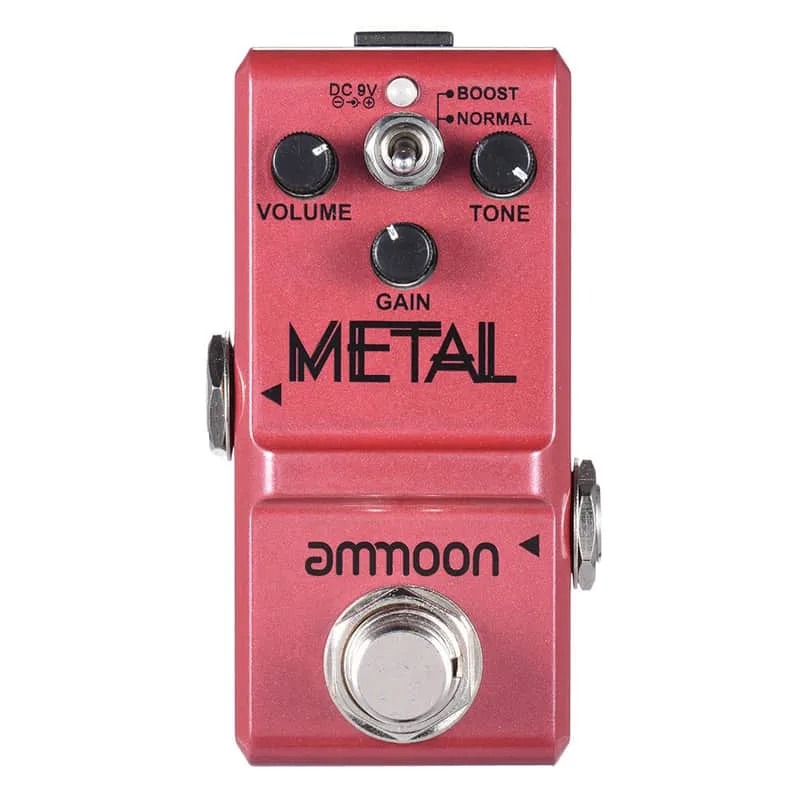

The Ammoon Heavy Metal Distortion is a heavy metal distortion guitar effects pedal built in a super mini size enclosure with a durable aluminum alloy case. It is an analog circuit, runs on 9V DC center negative power, draws 31mA, and uses a true bypass footswitch for switching on and bypass status. The maker's product information lists it with volume, gain and tone adjusting knobs, an LED light for showing the working status, and two modes, BOOST or NORMAL1.
Controls and the two modes
The pedal keeps its face simple: three knobs and a footswitch.
| Control | What it does |
|---|---|
| Volume | Sets the pedal's output level |
| Gain | Sets the amount of distortion |
| Tone | Shapes the treble character of the distortion |
| Footswitch | True bypass switching on and bypass status, with an LED showing working status |
All three knobs and the footswitch come from the maker's product information1.
The two modes give the pedal two gain voices. In NORMAL, the pedal runs its standard distortion voicing; BOOST pushes the circuit harder for a heavier, more driven character. That makes it possible to move between a rhythm and a lead setting without turning knobs mid-song1.
How it compares
Ammoon's mini distortion pedals share this compact format. The closely related Rowin LEF-605 Heavy Metal, a sibling design in the same family of mini pedals, uses a micro two-way switch to select Low and High distortion modes: the maker's description says "The Low has less driven distortion shaping and suits various Classic 80's mid driven type tones, The High offers a very" driven HIWATT type distortion2. The Ammoon Heavy Metal Distortion's BOOST and NORMAL modes serve a similar purpose, giving two levels of drive from one small box.
If you are comparing across the wider field, the pedal sits among distortion pedals generally, as distinct from overdrive pedals, which push an amp's front end more gently, or fuzz pedals, which clip in a different way altogether.
Power and placement on a board
The pedal runs on 9V DC, center negative, and draws 31mA. In a super mini enclosure there is no battery compartment, so it needs a 9V DC power supply on the board.
At 31mA, the current draw is modest, and the pedal will sit comfortably on a standard output of most pedalboard power supplies1. The true bypass switching means the pedal stays out of the signal path when it is off, which helps keep the clean tone intact on a board with several pedals in line1.
Videos
umay iskandar
Questions
Is the Ammoon Heavy Metal Distortion true bypass?
Yes. The pedal uses a true bypass footswitch for switching on and bypass status, according to the maker's product information. That means when the pedal is off, your guitar's signal passes through without the distortion circuit in the way, which matters on a crowded pedalboard where every stage of circuitry can affect the tone.
What power supply does the Ammoon Heavy Metal Distortion use?
The pedal runs on a 9V DC supply with a center negative plug, the standard arrangement for most compact pedals. Because it is a super mini size enclosure, there is no room for a battery compartment, so plan on a dedicated 9V DC outlet on your power supply rather than sharing a daisy chain with digital pedals.
Is the Ammoon Heavy Metal Distortion analog or digital?
It is an analog circuit. The maker's product information lists the circuit type as analog, meaning the distortion is produced by physical components rather than digital processing. Analog distortion pedals of this kind are typically valued for how they respond to changes in playing dynamics and guitar volume.
What do the BOOST and NORMAL modes do?
The pedal supports two modes, BOOST or NORMAL. NORMAL is the pedal's standard distortion voicing, while BOOST pushes the circuit harder for a more driven, heavier distortion character. Switching between them gives you two levels of gain from one small pedal without touching the knobs.
How much current does the Ammoon Heavy Metal Distortion draw?
The pedal draws 31mA, according to the maker's product information. That is a modest draw by pedal standards, so it fits comfortably on the standard 9V DC outputs of most pedalboard power supplies without needing a high-current outlet.
Sources (2)
- Heavy Metal Distortion by Ammoon, RockBoard PedalPedia, 2026
- LEF-605 Heavy Metal by Rowin, RockBoard PedalPedia, 2026