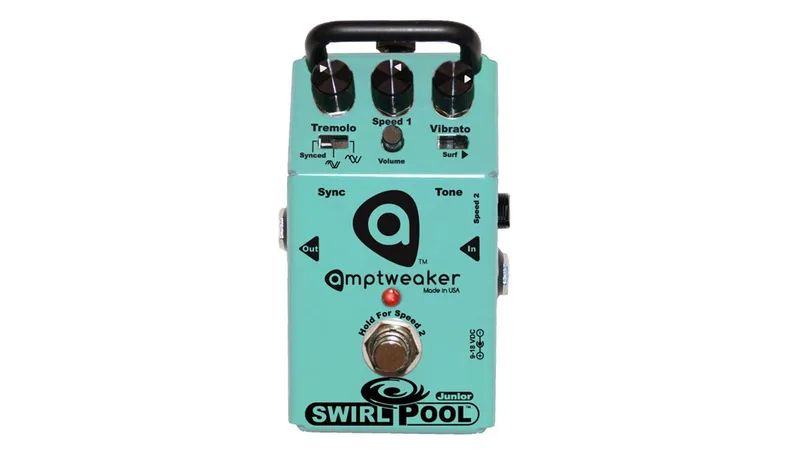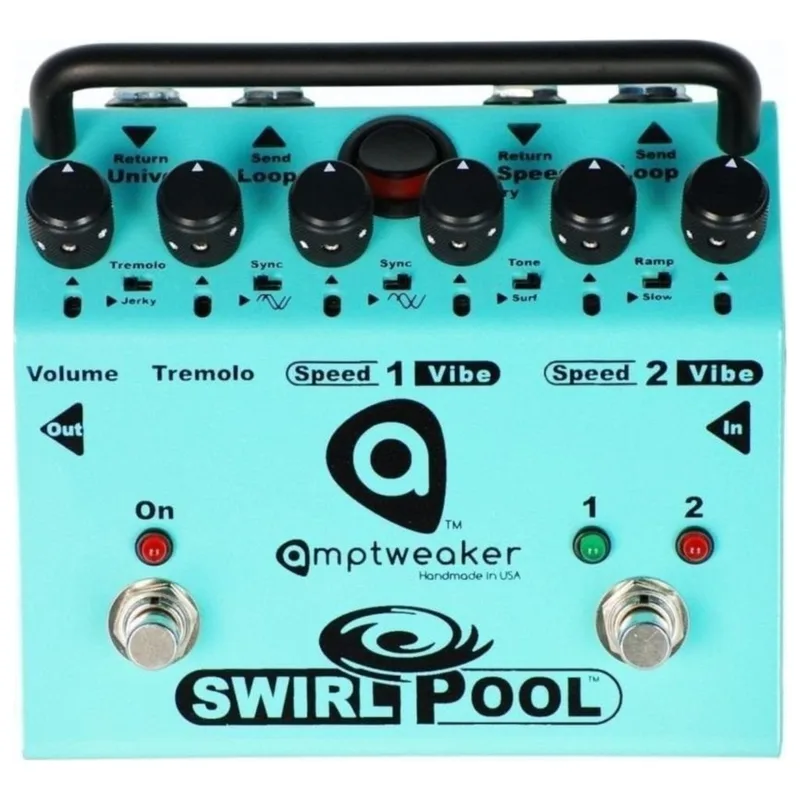


The Amptweaker SwirlPool is an analog tremolo and vibrato pedal, introduced by Amptweaker in January 2011 as the company's first pedal outside the distortion family1. Where most pedals treat tremolo (volume pulsing) and vibrato (pitch wobble) as separate effects, the SwirlPool runs both from a single LFO, the low-frequency oscillator that drives the modulation. Amptweaker says the design takes its cue from the synchronized tremolo and vibrato circuits found in some vintage 60s amplifiers2.
The point of sharing one LFO is that the two effects stay locked together as they move. As Amptweaker described it at launch:
"By blending tremolo and vibrato that share an LFO, the resulting combination can provide a subtle vocal quality or a dramatic pitch shift."1
The company also says it is easy to get many different tremolo, vibrato and rotary speaker tones made famous in the 60s and 70s, tones still in common use1.
What the SwirlPool does
The circuit lineage matters here. Vintage amplifiers of the 60s, in some designs, drove their tremolo and vibrato from the same oscillator, so the volume dip and the pitch bend happened together. The SwirlPool recreates that relationship in pedal form, and Delicious Audio describes the same idea in the Swirlpool Jr as "reminiscent of the synchronized Tremolo and Vibrato circuits common in some vintage amplifiers from the '60s"4. Because the depth of each effect is adjustable, the blend can lean toward either side, or sit in the middle where Amptweaker says the combination takes on a vocal quality1.
Controls, footswitches and modes
| Control or switch | What it does |
|---|---|
| Footswitch 1 | Operates bypass2 |
| Footswitch 2 | Switches between two tremolos, Speed 1 and Speed 22 |
| Ramp switch | Slows the ramping between speeds1 |
| Jerky mode | Switches the tremolo to sound "jerky" rather than smooth1 |
| Alternative mode | Disables the tremolo for Speed 2, so the footswitch selects either tremolo or pure vibrato2 |
The two-speed setup is the pedal's working method in normal use: dial in one speed, dial in another, and tap between them. The ramp switch then governs how the pedal travels from one to the other, with the slower setting giving a gradual glide between speeds rather than an instant jump1. In the alternative mode, the second footswitch becomes a tremolo/vibrato selector, since Speed 2's tremolo is switched off and only the vibrato remains2.
Power and bypass
The SwirlPool will not work with a standard 9V power supply. It requires an 18V DC supply or two 9V batteries, through a standard 2.1mm by 5.5mm barrel jack with center ground3.
This rules out the most common pedalboard power arrangement, a 9V daisy chain or typical isolated output, unless the supply can deliver 18V. Players using battery power need two 9V batteries rather than one. The pedal is true bypass, so the signal path is out of the circuit when the effect is off1. The current draw figures reported for the pedal disagree: Pedal of the Day lists 43mA consumption on batteries, while a figure of 62mA also appears in the same coverage3.
The Swirlpool Jr
- Mini switches beneath the Tremolo and Vibrato controls alter the LFO settings and vibrato types5
- The Jr can slightly shift the LFOs to create a variety of swirly effects4
- Its true-bypass footswitch can be held to move to a second speed setting5
What reviewers said
MusicRadar's review, by Trevor Curwen, summed up the pedal as follows:
"Fantastic vintage trem and vibrato sounds. Innovative."2
The same review found not much to avoid, describing two complementary effects integrated seamlessly overall2. Pedal of the Day's 2015 review covered the pedal's controls, loops and power requirements in detail, noting its handmade-in-the-USA construction and steel housing3.
Videos
Premier Guitar
Mike Hermans
musictoyznetwork rasch
Questions
Will the Amptweaker SwirlPool run on a 9V power supply?
No. The SwirlPool works with two 9V batteries or an 18V DC supply, and it will not work with a single 9V supply. Its DC adapter jack is a standard 2.1mm by 5.5mm barrel with center ground, so it needs an 18V-capable power source rather than the common 9V pedal supply.
Is the Amptweaker SwirlPool true bypass?
Yes. The SwirlPool uses true bypass switching, so with the effect off the signal passes through without the circuit in the path. The pedal has two footswitches: one operates bypass, while the other switches between the two speed settings.
How much current does the Amptweaker SwirlPool draw?
The reported figures disagree: Pedal of the Day's review lists 43mA current consumption on batteries, while another figure from the same review gives 62mA. Either way it is a modest draw, but the power requirement is 18V DC or two 9V batteries, not a standard 9V supply.
What is the difference between the SwirlPool and the Swirlpool Jr?
The Swirlpool Jr, shown at NAMM 2019, is a mini version of the fairly large original SwirlPool. It keeps the same circuit idea, synchronized tremolo and vibrato reminiscent of vintage 60s amplifiers, and adds mini switches beneath the Tremolo and Vibrato controls that alter LFO settings and vibrato types, plus a true-bypass footswitch that can be held to move to a second speed setting.
Can the SwirlPool do rotary speaker sounds?
Yes, according to Amptweaker. The company says it is easy to get many different tremolo, vibrato and rotary speaker tones made famous in the 60s and 70s, because the pedal blends tremolo and vibrato sharing one LFO, which can produce anything from a subtle vocal quality to a dramatic pitch shift.
Sources (5)
- Amptweaker Launches SwirlPool Tremolo/Vibe Pedal, Premier Guitar, 2012-01-16
- Amptweaker SwirlPool review, MusicRadar, 2014-11-27
- Amptweaker SwirlPool Tremolo/Vibrato, Pedal of the Day, 2015-02-27
- Amptweaker Swirlpool Jr Tremolo, Delicious Audio, 2019-02-05
- NAMM 2019: Amptweaker's Swirlpool tremolo/vibe pedal gets compacted, MusicRadar, 2019-01-23