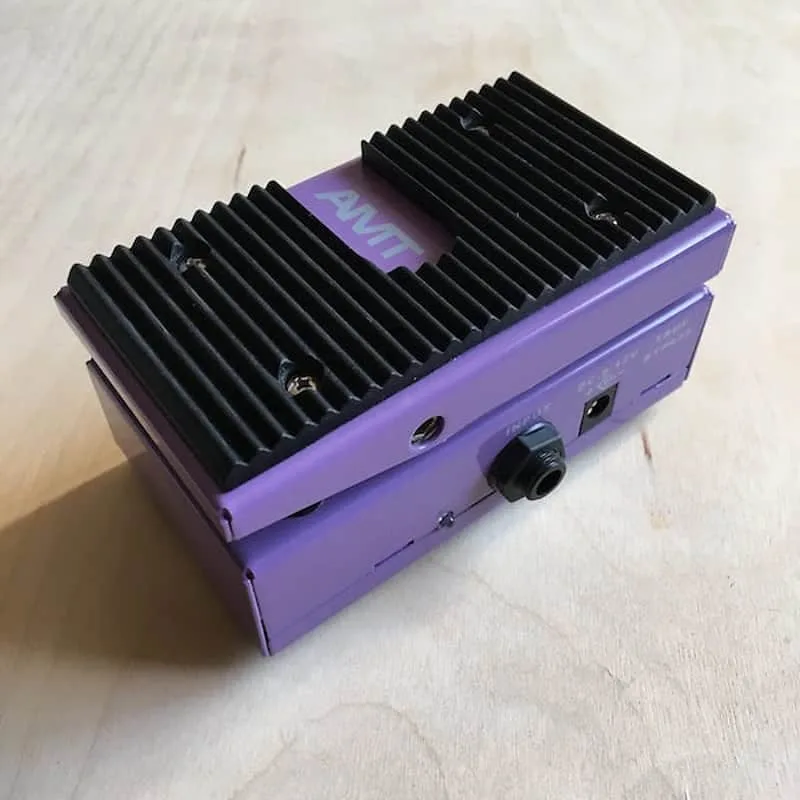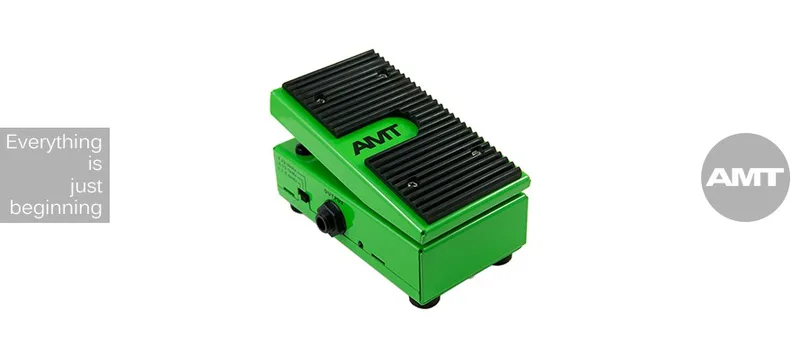


The AMT WH-1 is a compact wah pedal from AMT Electronics, sold under the name Japanese Girl. It is an optical version of the classic wah-wah effect: instead of a potentiometer linked to the treadle, the frequency sweep is controlled by light, which AMT says increases the service life of the effect by eliminating potentiometer maintenance and replacement1. The circuit is 100% analog and built around what the maker calls an original JFET-based design, credited with low noise and an expanded frequency tuning range1.
The current Japanese Girl Wah WH-1 goes beyond a plain wah. AMT's product material lists an analog preamp with Clean, Low gain and High gain modes, a power amp with 9 types, an IR cabsim with one IR for both L/R channels per preset, parametric Pre/Post EQ, Hi/Low pass filters plus Presence, and a noise gate as a global setting23. Per preset, the pedal stores the IR cabsim setting along with a delay or reverb effect4.
An analog optical wah with a JFET circuit
A traditional wah pedal sweeps a bandpass filter by turning a potentiometer as you rock the treadle. That pot is a mechanical part that collects dust and wears out, and replacing it is a known maintenance chore for wah owners. The WH-1 replaces that mechanism with optical frequency control, so the sweep depends on light rather than a rubbing contact. AMT states this "increases the service life of the effect eliminating frequent replacements of maintenance and" the potentiometer itself1.
The audio path is fully analog. AMT describes the WH-1 as a "100% analog WAH-WAH effect" built on an original JFET-based circuit design, which the maker credits with low noise and an expanded frequency tuning range1. On the question of how it behaves with gain, AMT says the WH-1 "boasts great versatile sound and processes both clean guitar sound and Ultra high gain overdrive equally well"1. The maker's demo material also shows a noise gate available as a global setting, a useful companion when running the pedal into high-gain3.
The controls: three-way range switch and toe-press on/off
The WH-1 keeps its control surface minimal. The range is chosen with a 3-way switch for bandpass filter range selection, and the effect is switched on and off by pressing the movable front end part of the pedal51.
| Control | What it does |
|---|---|
| 3-way range switch | Selects the bandpass filter range: 0.2-1 kHz, 0.3-1,5 kHz, or 0.4-2 kHz16 |
| Toe press on the movable front end | Switches the effect on and off1 |
The three ranges let you place the sweep lower or higher in the spectrum, which changes the vowel character of the wah. The lowest setting keeps the effect in bass and low-mid territory, while the highest reaches up to 2 kHz for a more vocal, treble-forward cry. Switching the effect on and off is done by pressing the movable front end of the pedal with your toe, the same motion many players already use on a wah1.
Power and connections
The WH-1 runs on a DC adapter or a 9V battery, with the adapter range given as 9 to 12V1. RockBoard's PedalPedia listing gives the supply as 9V DC, center negative, with a current draw of 1mA5. That draw is low enough that a battery is a realistic long-term power source, and the listed weight of 0.45 kg is stated without a battery installed1.
The maker's page lists the power options as "DC adapter or 9-12V 9V battery"1. Read plainly, the adapter range is 9 to 12V and the battery is a 9V type; RockBoard's listing confirms 9V DC center negative for adapter use15.
The enclosure is a steel heavy body, which AMT says is stable and responds confidently to foot control, and the whole pedal measures 110 x 62 x 58 mm, small enough that the maker notes it "fits easily into your guitar case"1.
Versions: WH-1, WH-1B and the Japanese Girl name
The pedal is sold as the WH-1 Japanese Girl, a name AMT has used since at least 2016, when the maker's media index listed the "AMT WH1 Japanese Girl mini wah"6. The current Japanese Girl Wah WH-1 carries the preamp, power amp, IR cabsim and EQ feature set described above2.
Alongside it, AMT offers the WH-1B. Both are 100% analog optical wahs with the same JFET-based circuit, true bypass, and toe-press switching, and both are listed as available now17. The difference is one feature:
| WH-1 | WH-1B | |
|---|---|---|
| Circuit | Original JFET-based design, 100% analog17 | Original JFET-based design, 100% analog1 |
| Bypass | True bypass1 | True bypass7 |
| On/off | Press the movable front end of the pedal1 | Press the movable front end of the pedal7 |
| Treadle tension | Not listed | Adjustable by means of an axial screw7 |
| Status | Available now1 | Available now7 |
So the WH-1B adds an axial screw for adjusting pedal movement, letting you set how the treadle feels underfoot. Players who want a looser or stiffer sweep get that option on the B version7.
AMT's media index also records the band Mamas Gun using the WH-1 during a live performance at the Greenroom Festival in 20156, and lists a review of the WH-1 Japanese Girl Wah on Ultimate Guitar among its press coverage6.
Videos
AMT Electronics
Brett Kingman
Prymaxe
Questions
Is the AMT WH-1 true bypass?
Yes. AMT Electronics lists true bypass among the WH-1's features, so with the effect switched off the guitar signal passes through without active circuitry in the path. The effect itself is engaged by pressing the movable front end of the pedal with your toe.
Does the AMT WH-1 take a 9V battery?
Yes. AMT specifies power from a DC adapter or a 9V battery, with an adapter range of 9 to 12V. The listed weight of 0.45 kg is given without a battery installed, so the battery is an optional power source rather than a requirement.
Can the AMT WH-1 run on 12V?
Yes. The maker's product page states the pedal is powered by a DC adapter or a 9V battery, with the adapter range given as 9 to 12V. A standard 9V DC supply is within that range, and 12V is the upper limit.
What is the difference between the AMT WH-1 and WH-1B?
Both are 100% analog optical wah pedals from AMT Electronics with the same JFET-based circuit, true bypass and toe-press switching. The WH-1B adds adjustable pedal movement by means of an axial screw, so you can set the treadle tension to your liking. Both are listed as available now.
Why does an optical wah not need a potentiometer?
A conventional wah sweeps its filter with a potentiometer linked to the treadle, and that pot wears out over time. The WH-1 instead uses optical frequency control, which AMT says increases the service life of the effect by eliminating potentiometer maintenance and replacement.
Does the AMT WH-1 work with high-gain distortion?
AMT says the WH-1 processes both clean guitar sound and what the maker calls Ultra high gain overdrive equally well, and credits its original JFET-based circuit design with low noise. The maker's demo material also shows a noise gate available as a global setting.
Sources (7)
- AMT WH-1, AMT Electronics, 2026
- AMT Electronics Japanese Girl Wah WH-1, Media center of AMT Electronics
- AMT WH-1 wah-wah optical pedal: Demo by Unai Iker, Media center of AMT Electronics
- AMT Japanese Girl Demo (WH-1+ S-Drive), Media center of AMT Electronics
- WH1 Japanese Girl Wah by AMT Electronics, RockBoard PedalPedia, 2026
- AMT WH-1, AMT Electronics media center, 2016-06-15
- AMT WH-1B, AMT Electronics, 2026