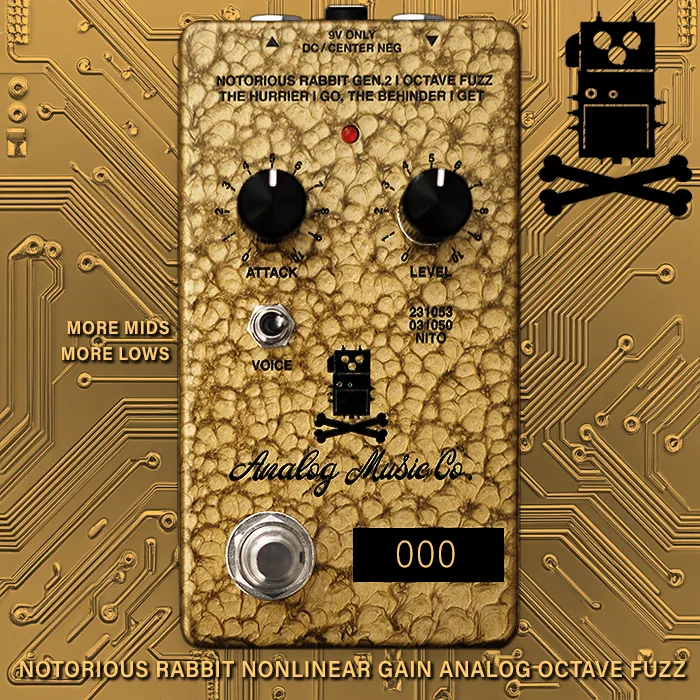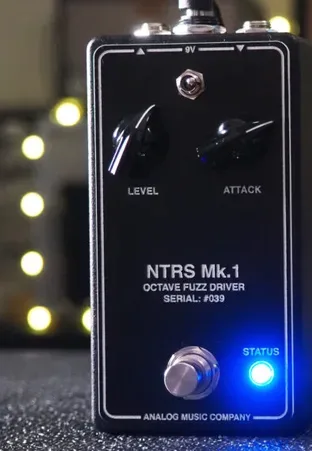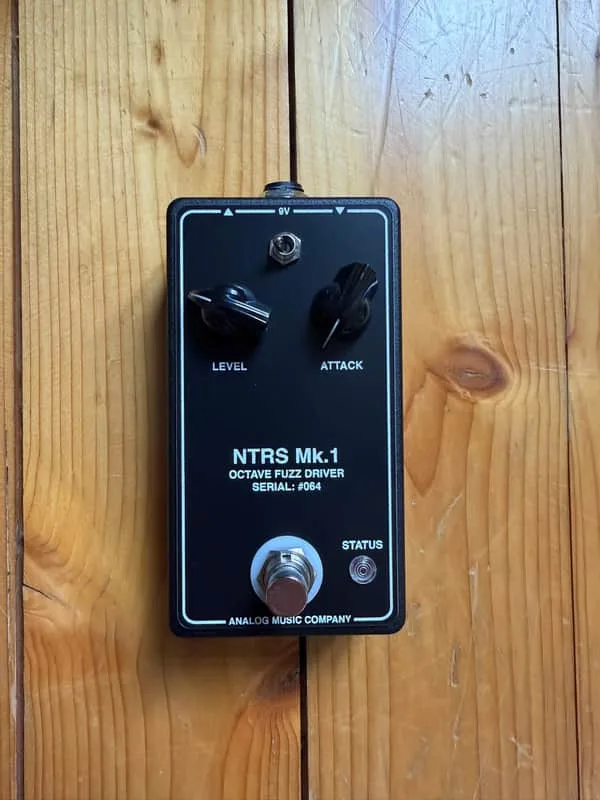


The Notorious Rabbit is a compact analog octave fuzz pedal from Analog Music Company, a builder based in Kyiv, Ukraine1. Released on 16 May 2025 and designed by the builder's Konstantin, it uses a nonlinear gain architecture and passive filtering to produce what Delicious Audio calls "uniquely synthetic and dynamic tones"23. The result is a wide range of textures, from soft fuzz to collapsing, gated waveforms2.
Guitar Pedal X described the output as raw and ragged, extreme and visceral, bordering on nasty at times, and called it one of the raspiest, gnarliest octave fuzz outputs around, with an extreme high gain profile3.
An octave fuzz that runs from soft fuzz to gated collapse
The pedal earns its reputation from how unstable it is. Under higher input levels, the interaction between the clamping diode, the transistor behavior, and the amplifier gain can result in complex, unstable, collapsing or gated waveforms, which is what gives the Notorious Rabbit its distinctly synthetic waveform quality1. In practice, that means the same pedal can sit at a fairly ordinary fuzz setting and then fall apart into sputtering, gated textures when you push it.
The circuit is unusual for a fuzz. Its gain stage is a Darlington configuration using both silicon and germanium transistors1, with a 1N5817 clamping diode that also adds asymmetrical clipping3. A final stage provides additional gain and low output impedance1. The build mixes surface-mount and through-hole parts in an evolved configuration3.
One thing a player needs to know before putting it on a board:
The Notorious Rabbit is designed to interact directly with passive pickups or unbuffered signal sources1, and it is highly sensitive to input signal and impedance2. A buffer or boost in front of it will change its behavior, sometimes dramatically.
The controls
The control set is small, but each control does a lot.
| Control | What it does |
|---|---|
| Attack | Adjustes gain and saturation, impacting harmonic content and gating behavior2 |
| Level | Controls the output volume without affecting the fuzz characteristics2 |
| Voice switch | Selects between two input filters, one emphasizing mids, the other allowing more lows, for tonal shaping2 |
The Voice switch is the tonal fork in the road. Guitar Pedal X lists it as a voicing and input filter choice between More Mids and More Lows3. Because it filters the signal before the gain stages, it changes not just the EQ but what the Darlington stage and clamping diode react to, so the two positions produce noticeably different fuzz characters, not just brighter versus darker versions of the same sound.
Versions and colorways
There are three versions: the MKI, the MKI.5 and the MKII3. The MKI.5 and MKII are the same circuit in very slightly different enclosures, and those later versions are a tiny bit more unleashed than the MKI, which has a slightly different arrangement3. The version covered by Pedal of the Day's review, the Notorious Rabbit Octave Fuzz Driver (NTRS Mk.1), ships in a black enclosure1.
The pedal also comes in 13 different colorways, and because it is made in small batches, there are rarely two exactly the same3.
What reviewers said
Guitar Pedal X called it a unique signature pedal and statement piece from Konstantin, praising its very unique analog octave fuzz circuit construction3. Pedal of the Day summed up the pedal's character as simple but monstrous, squeezing every ounce of crazy fuzz out of it1.
"The result is a wide range of textures, from soft fuzz to collapsing, gated waveforms."
For a player comparing it against other fuzz pedals, the honest summary from the press is that it is not a polite, set-and-forget fuzz. It is a high gain octave fuzz that is highly sensitive to input signal and impedance, and it is designed to interact directly with passive pickups or unbuffered signal sources321.
Videos
Analog Music Company
ambienttrash
R.J. Ronquillo
Questions
Is the Analog Music Company Notorious Rabbit analog?
Yes. All three press sources describe it as an analog octave fuzz pedal. Its circuit uses a mix of surface-mount and through-hole parts, NOS vintage germanium and silicon transistors in a Darlington configuration, an op-amp, and a 1N5817 clamping diode for asymmetrical clipping.
What does the Voice switch do on the Notorious Rabbit?
The Voice switch selects between two input filters for tonal shaping. One position emphasizes mids, the other allows more lows. Because it shapes the signal at the input, it also changes what the gain stages and clamping diode see, so the overall fuzz character shifts along with the tone.
Does the Notorious Rabbit use germanium or silicon transistors?
Both. Its gain stage is a Darlington configuration using both silicon and germanium transistors, described as NOS or vintage parts, plus an op-amp. The mix is part of what gives the pedal its unstable, collapsing behavior at higher input levels.
Why does the Notorious Rabbit react so much to my guitar and the pedals before it?
The pedal is designed to interact directly with passive pickups or unbuffered signal sources, and it is highly sensitive to input signal and impedance. Anything that changes what hits its input, such as a buffer, a boost, or your guitar's volume knob, changes the fuzz character, the gating, and the octave content.
Sources (3)
- Analog Music Company Notorious Rabbit Octave Fuzz Driver (NTRS Mk.1), Pedal of the Day, 2025-05-16
- New Pedal: Analog Music Company Notorious Rabbit Octave Fuzz, Delicious Audio, 2025-05-19
- Guitar Pedal X, Guitar Pedal X, 2025-05-16