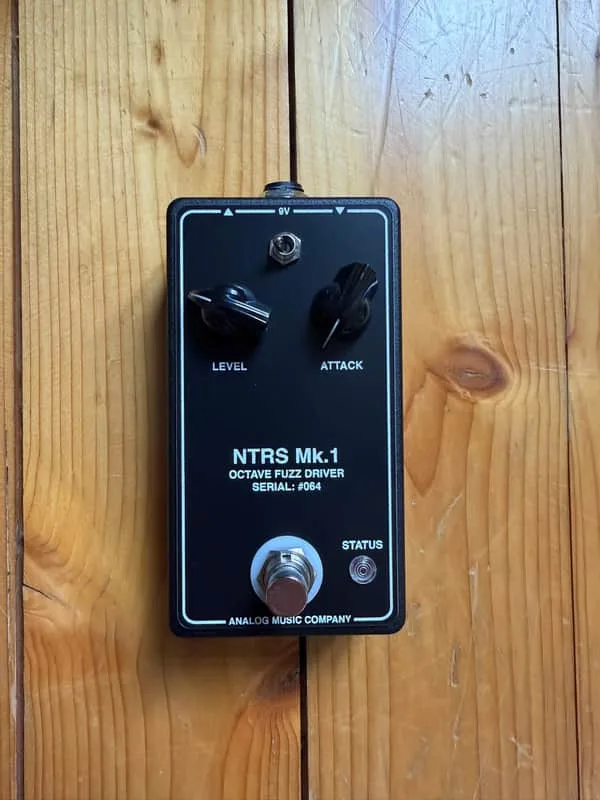


The Notorious Rabbit is a compact analog octave fuzz pedal from Analog Music Company, released on 16 May 2025 by the builder Konstantin1. It is a high-gain fuzz built around an unusual hybrid transistor circuit, and it is designed to interact directly with passive pickups or unbuffered signal sources2. Where most fuzz pedals aim for a stable, repeatable sound, this one leans the other way: Delicious Audio describes it as delivering "aggressive, unpredictable behavior for players seeking bold, reactive fuzz tones"3.
Guitar Pedal X's Stefan Karlsson called it "a very unique Analog Octave Fuzz circuit construction - with a raw and ragged, extreme, visceral" output, and placed it among the raspiest, gnarliest octave fuzz outputs he had heard, with an extreme high-gain profile1. Pedal of the Day summed up the pedal as "simple but monstrous"2.
What it does to your sound
The Notorious Rabbit is a crushing high-gain octave fuzz. Guitar Pedal X describes the output as raw and ragged, extreme and visceral, bordering on nasty at times, and extraordinarily textured1. Part of that character comes from how the circuit behaves under load: Pedal of the Day explains that the interaction between the clamping, transistor behavior and amplifier gain can result in "complex, unstable, collapsing, or gated waveforms, giving the Notorious Rabbit its distinctly synthetic waveform quality and characteristic sonic and dynamic behavior" under higher input levels2.
That synthetic quality is the point. Delicious Audio says the pedal "uses a nonlinear gain architecture and passive filtering to produce uniquely synthetic and dynamic tones"3. The pedal is also highly sensitive to input signal and impedance, so where it sits in your chain, and what feeds it, changes what you get out of it3.
The controls
The control set is minimal: two knobs and a switch1.
| Control | What it does |
|---|---|
| Attack (Gain) | Adjusts gain and saturation, impacting harmonic content and gating behavior3 |
| Level | Sets the output volume1 |
| Voicing / Input Filters | Selects between two input filters: More Mids or More Lows1 |
The Voicing switch is the tonal pivot. Delicious Audio describes it as selecting "between two input filters, one emphasizing mids, the other allowing more lows, for tonal shaping"3. Because the filters sit at the input, ahead of the gain stage, they change how the fuzz itself reacts rather than just cutting or boosting frequencies after the fact.
Circuit and versions: MKI, MKI.5 and MKII
The signal path, as laid out by Guitar Pedal X, runs: Voice input filters, then a pair of NOS or vintage transistors, one germanium and one silicon, in a Darlington configuration, then a 1N5817 clamping diode, then an op-amp boost1. The clamping diode also adds asymmetrical clipping into the proceedings1. The final stage provides additional gain and low output impedance2. The build uses a mix of surface-mount (SMT) and through-hole (THT) parts in an evolved configuration1.
The hybrid transistor pair is what sets the circuit apart from a straight germanium or straight silicon fuzz. Pedal of the Day notes the gain stage "is based on a Darlington configuration using both silicon and germanium transistors"2, and Delicious Audio likewise describes a silicon/germanium Darlington gain stage shaping sound through a complex interaction of diode clamping3.
Konstantin honed and evolved the fuzz through three different iterations, which is where the versions come from1:
- MKI: the first arrangement, with a slightly different circuit layout1
- MKI.5 and MKII: the same circuit as each other, in very slightly different enclosures, a tiny bit more unleashed than the MKI1
All three versions were priced the same at release1. The pedal comes in 13 different colourways, and because it is made in small batches, there are rarely two exactly the same1.
The Notorious Rabbit is designed to interact directly with passive pickups or unbuffered signal sources2. If you feed it from a buffered or active source, the impedance mismatch can change how the fuzz behaves, since the pedal is highly sensitive to input signal and impedance3.
What reviewers said
Guitar Pedal X's Stefan Karlsson said "all of the demos sound excellent," singling out Ambient Trash Matt's demo as delivering maximum flavor, while noting that Matt plays a MKI edition, which is not quite as ferocious as the MKI.5 and MKII demos1. Pedal of the Day's reviewer closed by promising to "squeeze every ounce of crazy fuzz out of this simple but monstrous pedal"2.
Videos
Analog Music Company
ambienttrash
R.J. Ronquillo
Questions
Who designed the Notorious Rabbit?
The Notorious Rabbit was designed by Konstantin of Analog Music Co., who honed and evolved the fuzz through three different iterations before releasing it on 16 May 2025. The versions correspond to those iterations: the MKI, MKI.5 and MKII.
Does the Notorious Rabbit use germanium or silicon transistors?
It uses both. The gain stage is a Darlington configuration pairing one NOS or vintage germanium transistor with one silicon transistor, followed by a 1N5817 clamping diode and an op-amp boost stage. The mix of the two transistor types is part of what gives the pedal its character.
What is the difference between the MKI and MKII Notorious Rabbit?
The MKI.5 and MKII share the same circuit in very slightly different enclosures, and both are a tiny bit more unleashed than the MKI, which has a slightly different arrangement. All three versions are priced the same.
Is the Notorious Rabbit analog?
Yes. The Notorious Rabbit is a fully analog octave fuzz pedal, built from a mix of surface-mount and through-hole parts in an evolved configuration. There is no digital processing in the signal path.
What does the Voicing switch do?
The Voicing switch selects between two input filters: one emphasizing mids, the other allowing more lows. Because the pedal is highly sensitive to input signal and impedance, the switch gives you a quick way to reshape the fuzz before the gain stage.
How much does the Notorious Rabbit cost?
All versions of the Notorious Rabbit were priced at $230 when released in May 2025, sold direct from Analog Music Co. and through their Reverb.com store. The pedal comes in 13 different colourways, made in small batches, so there are rarely two exactly the same.
Sources (3)
- Guitar Pedal X, Guitar Pedal X, 2025-05-16
- Analog Music Company Notorious Rabbit Octave Fuzz Driver (NTRS Mk.1), Pedal of the Day, 2025-05-16
- New Pedal: Analog Music Company Notorious Rabbit Octave Fuzz, Delicious Audio, 2025-05-19