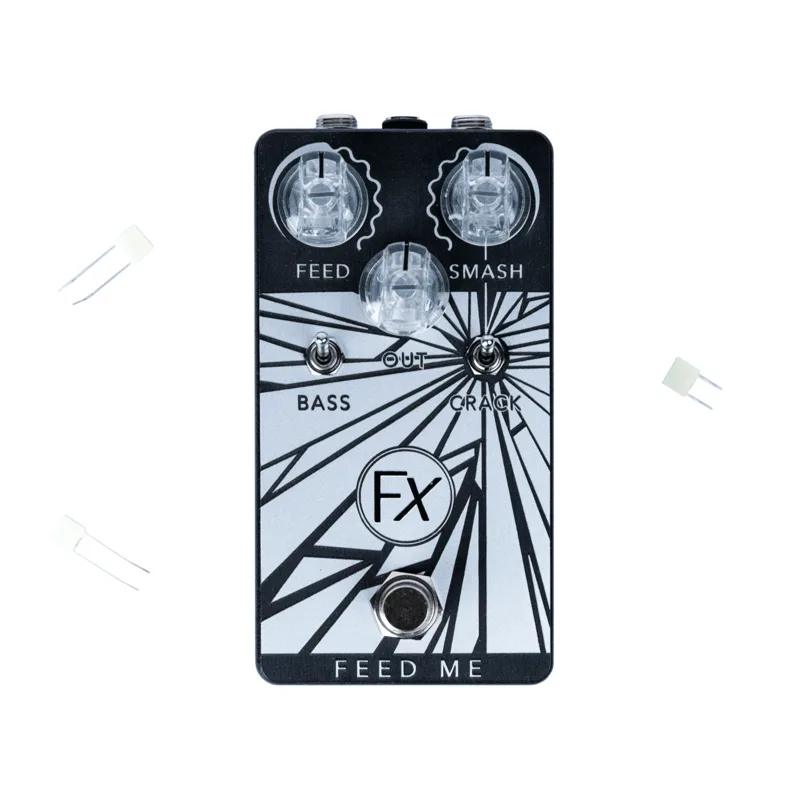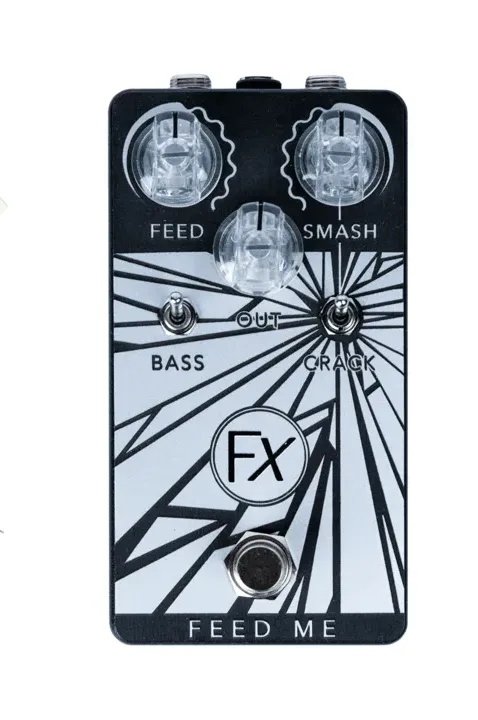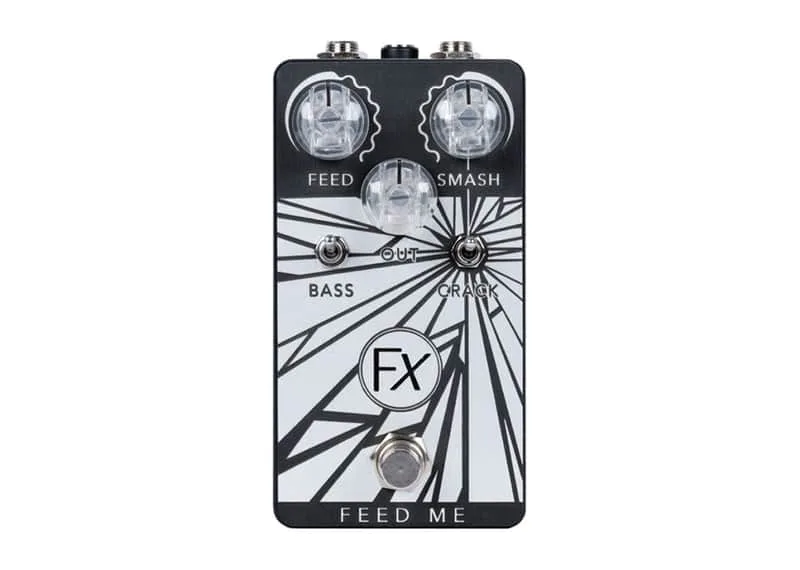


The Anasounds Feed Me is a fuzz pedal inspired by the Fuzz Face of the late 1960s, built around two BC108 silicon transistors. It was the first fuzz pedal released by Anasounds, a French company that handmakes its pedals in France12. Anasounds describes the sound as massive, thick and fat, with high frequencies that in some cases sit at the limit of an octave up, letting a player cut through a mix1.
The circuit is not a straight copy. Anasounds says it is a revised version of the model modded by Roger Mayer for the needs of a famous left-handed guitarist, updated with BC108 silicon transistors for more stability3. In its mk3 form the pedal moved into Anasounds' FX Teacher range, a line built around customization and DIY assembly24.
The original assembled Feed Me is discontinued. Anasounds lists it as "on sale while stocks last" and out of stock1. The mk3 continues in the FX Teacher range as kits and PCBs, with the full kit in stock and backorderable as of June 20264.
What the Feed Me does: a Fuzz Face-style fuzz
The Feed Me is a Fuzz Face-style fuzz, meaning it follows the topology of the famous circular 1960s pedal: two transistor gain stages with a feedback network, where the first stage saturates hard and the guitar's volume control cleans the whole thing up. Anasounds' manual explains that the first stage is a common emitter configuration, with the emitter of Q1 connected directly to ground without a resistor, giving huge gain that saturates the signal5. The FUZZ control varies the gain of the second stage, producing hard clipping5.
The FEED control is the input level of the circuit. Lowering it optimizes the clean-up with the guitar's volume control; raising it brings more saturation and sustain, and at maximum it lets the circuit go into self-oscillation for feedback effects you can then control from the guitar52. Anasounds says that used alone with a clean amp and the bass switch off, the Feed Me provides a massive, wide-spectrum fuzz for solo use that will cover all the frequencies usually covered by other musicians2.
The Mk3 controls
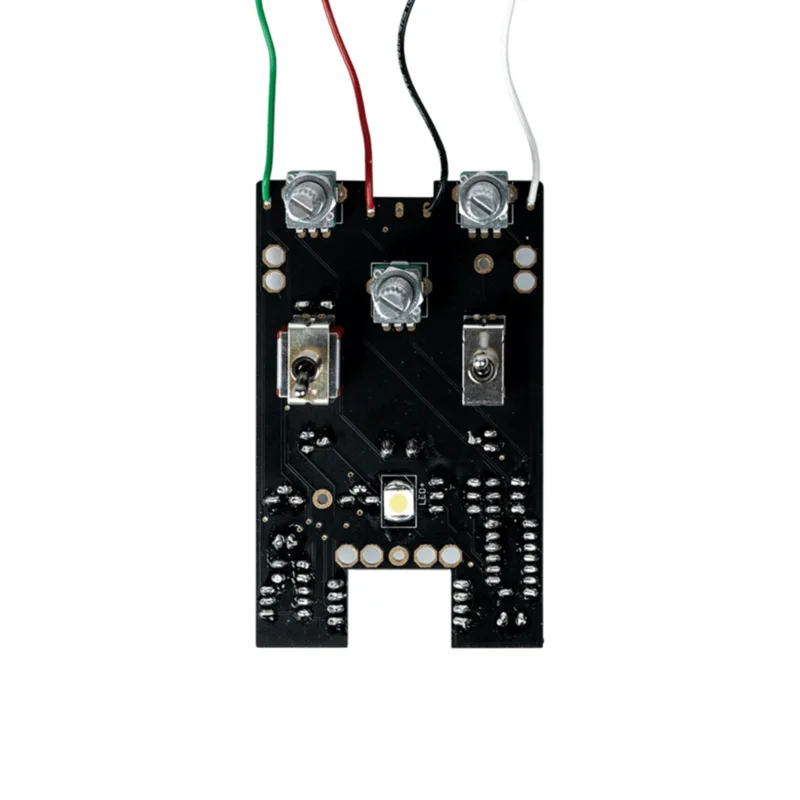
The Feed Me went through three versions. The mk1 had three pots on the side of the pedal: FEED for input level, FUZZ for gain and OUT for output volume23. The mk2 dropped external controls entirely for a plug-and-play approach, moving the feed, fuzz, out, bias and treble adjustments to internal trimpots3. The mk3, part of the FX Teacher range, adds customization features24.
| Control | Type | What it does |
|---|---|---|
| FEED | Knob | Input level; at maximum allows self-oscillation for feedback effects controllable with the guitar's volume2 |
| FUZZ | Trimpot | Gain of the fuzz, from creamy to raw tones; varies the second stage's gain, producing hard clipping53 |
| OUT | Knob | Output level, to hit the amplifier3 |
| SMASH | Knob | Alters the supply voltage from 0 to 3.8V when CRACK is activated, for a brutal gated fuzz3 |
| BIAS | Trimpot | Affects the transistor bias, originally set for an open and dynamic fuzz3 |
| CRACK | Toggle | Underpowers the circuit for gated, velcro fuzz53 |
| BASS | Toggle | Cuts or passes the low frequencies, from a rich and fat fuzz to a punchy and bright one53 |
| CAPS | Terminal block | Screws in capacitors; the capacitor chosen sets how much bass is cut, for a more aggressive fuzz3 |
The mk3 is delivered assembled and tuned, with a bag of components to mount on the terminal blocks using only a screwdriver, no soldering needed3. It runs on 100% analog processing in a Hammond 1590N1 enclosure with a Lumberg DC jack3.
Inside the circuit: Feed, Crack and the bass capacitor
The CRACK switch is the heart of the pedal's two personalities. With CRACK disabled, the circuit is supplied with 9V, producing a rich, wide-open fuzz, and resistor R4 attenuates the signal to balance the volume difference5. With CRACK activated, the circuit is underpowered: with a soft attack the signal does not have enough amplitude to pass through, causing a gate effect with limited sustain and a typical velcro fuzz sound from very asymmetric clipping5. Turning SMASH down reduces the supply voltage even more, accentuating the gated effect5. Anasounds cites a Jack White-like gated fuzz as one of the sounds the pedal can produce, using the Crack and Smash controls for a velcro texture3.
The BASS switch works through a capacitor. With the switch down, a 220nF capacitor soldered on the PCB lets all the bass pass through, for a massive and modern fuzz53. With the switch up, the terminal block takes over and the capacitor you screw in sets the cut-off frequency5. Anasounds gives three reference values:
- 220nF: all the bass passes, massive and modern fuzz3
- 6.8nF (original upper-position value): the typical bass cut of a vintage fuzz3
- 4.7nF: an aggressive and percussive fuzz3
Kits and versions
The Feed Me is available in several forms within the FX Teacher range426:
- Full kit: the complete DIY build, including one Feed Me PCB4
- Electronic kit: the electronics; you supply an enclosure kit or blank enclosure, a true bypass kit with 3PDT or relay, a tester and soldering tools6
- Enclosure kit: a ready-to-use enclosure with the Anasounds design and all holes drilled, for assembly with 3PDT or relay true bypass7
- PCB only: the bare circuit board, "for the most courageous"8
The original assembled pedal sold for 119,00 € (as listed, in euros), weighed 0,45 kg and measured 14 × 7 × 5 cm1. A B-stock version was offered at 99,00 €, down from an original 185,00 €, with the same audio guarantee but some aesthetic defects from manufacturing9; it is out of stock. An earlier "origins" version of the pedal also appears in Anasounds' catalog10.
Videos
Anasounds
Anasounds
Tone Factory
Questions
Is the Anasounds Feed Me a DIY kit?
It is both. Anasounds sells the Feed Me mk3 as a full kit, an electronic kit, an enclosure kit, or a bare PCB, and also as a fully assembled and tuned pedal. The assembled version ships with a bag of components you can mount on the terminal blocks with only a screwdriver, no soldering needed.
What transistors does the Feed Me use?
The Feed Me uses two BC108 silicon transistors, Q1 and Q2. Anasounds says the silicon transistors give the pedal more stability than the original germanium Fuzz Face circuit it is based on.
Can the Feed Me self-oscillate?
Yes. The FEED control sets the input level of the circuit, and at maximum it lets the circuit go into self-oscillation for feedback effects that you can then control with your guitar's volume knob.
How do you get a gated fuzz from the Feed Me?
Activate the CRACK switch. This underpowers the circuit, so soft attacks do not have enough amplitude to pass, producing a gate effect with limited sustain and a velcro fuzz character. The SMASH knob then varies the supply voltage from 0 to 3.8V for a more brutal gated sound.
Is the Anasounds Feed Me discontinued?
The original assembled Feed Me is listed by Anasounds as discontinued, on sale while stocks last, and out of stock. The mk3 lives on in the FX Teacher range as kits and PCBs, with the full kit still available and backorderable as of June 2026.
Sources (10)
- feed me | Anasounds, Anasounds, 2025-03-11
- Feed me mk3 fx teacher user manual, Anasounds, 2022-02-03
- Feed Me MK3, Anasounds, 2022-02-04
- Feed Me mk3, Anasounds, 2026-06-25
- Assemble your feed me mk3 fuzz, anasounds.com, 2022-02-03
- Feed Me mk3, Anasounds, 2025-07-06
- Feed Me mk3, Anasounds, 2023-10-13
- Feed Me mk3, Anasounds, 2024-06-12
- feed me - b stock | Anasounds, Anasounds, 2024-05-02
- feed me | Anasounds, Anasounds, 2019-04-26