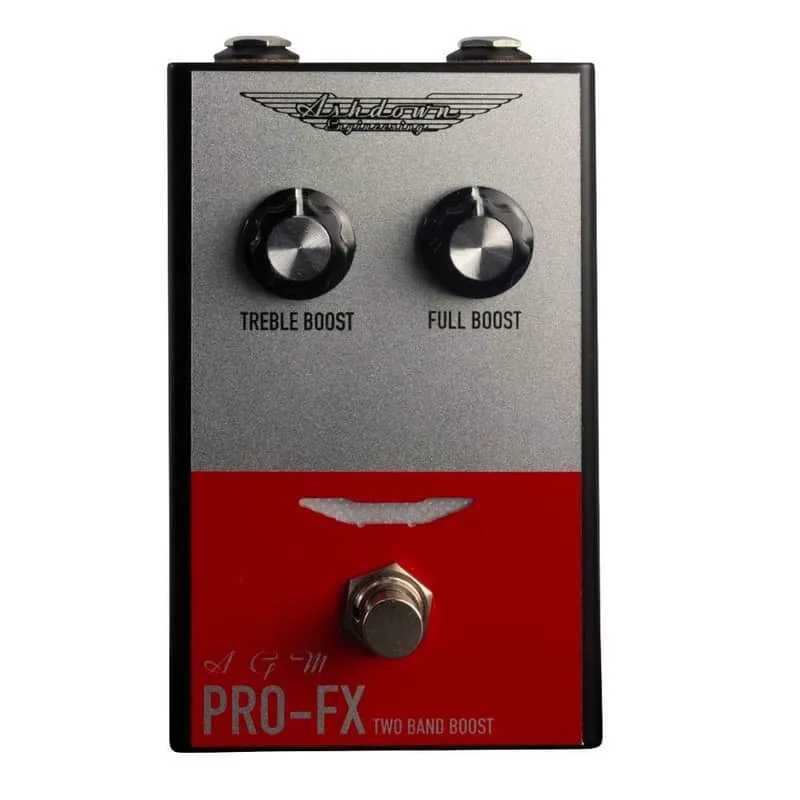


The Ashdown Pro-FX Two-Band Boost is a boost pedal that, as Guitar World's reviewer put it, "will take your sound up a level with integral tonal shading"1. Rather than a single clean volume lift, it carries two separate boost circuits, a Full boost and a Treble boost, each with its own knob, and the two can be used separately or in combination1.
Where it came from
Ashdown is perhaps better known for all things bass, but the company also caters for six-string players with both amps and the Pro-FX pedals1. The Two-Band Boost carries the range's build approach: as Ashdown puts it, "It sports a robust metal casing with four small rubber feet and feature a lit Ashdown logo when active"1.
The controls: Full boost and Treble boost
The pedal's two knobs shape very different kinds of lift, and part of the design is in how they combine1.
| Control | What it does on its own | What it adds to the other |
|---|---|---|
| Full boost | Apparent volume boost upwards of one o'clock on the knob, with plenty to drive an amp; adds a fat midrange with a perception of more subdued treble | Treble boost adds some top-end to the Full Boost sound |
| Treble boost | No volume boost at all and little in the way of treble; seems to offer a more scooped midrange | Adds top-end when used with Full boost |
"The idea here is that you can have one or the other separately or in combination."1 Trevor Curwen, Guitar World1
The Full boost on its own provides plenty of level to push an amp into its own overdrive, which puts it in the same territory players explore with overdrive pedals, though as a boost it works by lifting what the amp receives rather than clipping within the pedal itself1.
Power and pedalboard use
The Two-Band Boost runs from a nine-volt supply. Ashdown's Pro-FX pedals are known as the "Pro-FX 9 volt range" because all of them run from a nine-volt supply, and the review notes the pedal does not run from battery power1.
The Two-Band Boost does not run on a battery, so a nine-volt power supply is required1.
For pedalboard layout, the connections are front-facing, which the review notes facilitates close side-by-side placement on a pedalboard1. The pedal sports a robust metal casing with four small rubber feet and features a lit Ashdown logo when active1.
What reviewers said
Guitar World's review credits the pedal with plenty of boost to drive your amp at its boost level1. On the two circuits, the reviewer found the Full boost delivers its apparent volume lift from around one o'clock on the knob and brings a fat midrange, while the Treble boost on its own offers no volume boost and little treble, reading more as a midrange scoop that adds top-end when stacked with the Full boost1.
Videos
Specialty Traders
サウンドハウス
Jmorrero
Questions
Does the Ashdown Pro-FX Two-Band Boost run on a battery?
No. Guitar World's review notes that the pedal does not run from battery power. It takes a nine-volt supply, like the rest of Ashdown's Pro-FX pedals, which the company calls the Pro-FX 9 volt range. Plan a power supply on your pedalboard rather than relying on a battery.
What voltage does the Ashdown Two-Band Boost need?
Nine volts. Ashdown's Pro-FX pedals are known as the Pro-FX 9 volt range because all of them run from a nine-volt supply, and the Two-Band Boost is one of them.
Can you use the treble boost and full boost at the same time?
Yes. The pedal offers treble boost and full-band boost, each usable separately or in combination. Guitar World's reviewer found the Treble boost adds some top-end to the Full Boost sound when both are engaged.
Who designed the Ashdown Pro-FX Two-Band Boost?
Ashdown's Dave Green designed the Pro-FX Two-Band Boost. He was also responsible for the Dr Green effects range, which Ashdown launched in 2013 and from which this pedal takes its legacy.
Is the Ashdown Two-Band Boost based on another pedal?
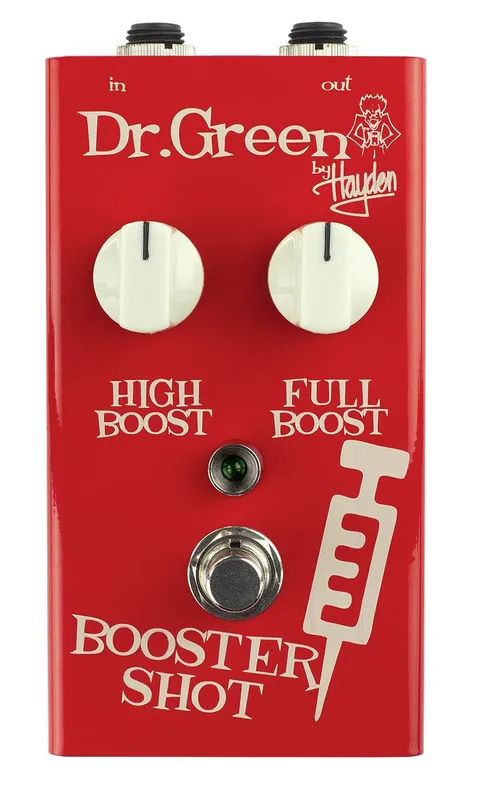
Guitar World's review observes that the Two-Band Boost looks very much like it has taken its legacy from Dr Green's Booster Shot pedal, another Ashdown design from the same designer, Dave Green.
Sources (1)
- Ashdown Pro-FX Two-Band Boost, Guitar World, 2021-11-30