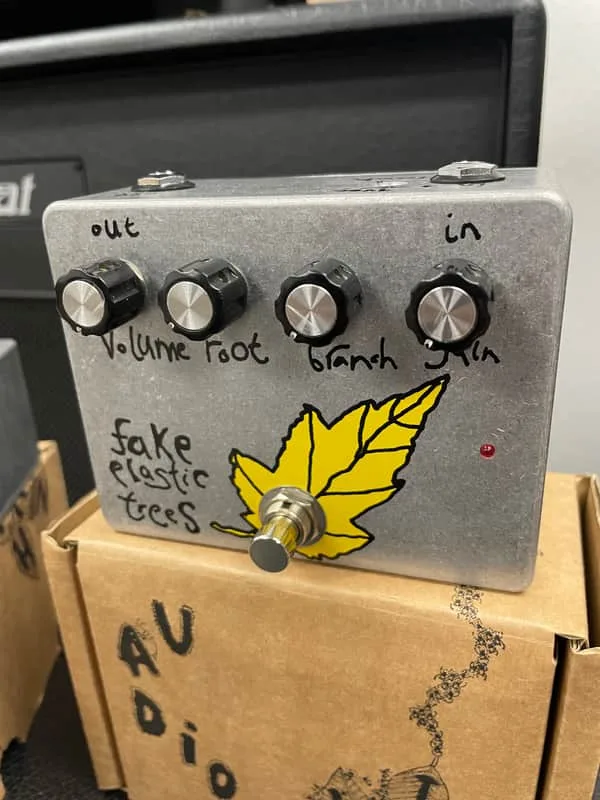


The Fake Plastic Trees is a Class A guitar and bass preamp pedal from Audio Kitchen, a boutique amp and pedal builder based in the UK1. It is a solid state design that uses hand-graded JFET transistors, and Delicious Audio notes that the circuit simulates the behavior of an EL84 tube with a JFET transistor1. Audio Kitchen describes it as a solid state homage to the sound available on the line out of its much loved The Big Trees (TBT) amplifier2.
Audio Kitchen notes that, as of its product page, there are very few of these out in the wild, describing the pedal as a new addition2. The price given is the UK price in pounds sterling2.
Controls
The pedal has four knobs. Audio Kitchen lists them as Gain, a Baxandall-based EQ with "Root" for the bottom and "Branch" for the top, and a "Volume" master volume2.
| Control | What it does |
|---|---|
| Gain | Sets the amount of drive1 |
| Root | Bass, the bottom end of the Baxandall-style EQ21 |
| Branch | Treble, the top end of the Baxandall-style EQ21 |
| Volume | Master volume21 |
Delicious Audio describes the range of sounds the pedal can produce: it can concoct a wide variety of amp-like tones, both for the amount of gain, from boost to fuzz, and for the tonal character, with an ultra-dynamic feel1. That span runs from a clean boost territory through to fuzz, which places it across ground normally shared by boost pedals, overdrive pedals and fuzz pedals, though it is at heart a preamp design, closer in role to other preamp pedals.
Power and practicalities
The pedal runs on a standard 9VDC supply at 100mA with a 2.1mm center-negative connector2. The 100mA current draw is worth noting when planning a daisy chain with other pedals. The enclosure is a durable die-cast aluminum box weighing 500g (1.1lbs) and measuring 116mm x 91mm x 55mm2.
What reviewers said
Delicious Audio's Paolo De Gregorio quoted producer Joe Barresi's first impression of the pedal1:
"Loving it. So musical and flexible. Gives an otherwise flat amp some dimension. And can punch out some fat clean"1
Barresi also said, of playing the pedal: "i was gonna stop several times but i kept playing to see what else i could get from it, so many sounds, modern and old"1.
Videos
AudioKitchenAmps
AudioKitchenAmps
AndyDemos
Questions
Does the Fake Plastic Trees work on bass?
Yes. Audio Kitchen lists it as a Class A Guitar/Bass Preamp Pedal, so it is designed for both instruments. Its Baxandall-style EQ, with Root for the bottom end and Branch for the top, gives bass players a way to shape low and high frequencies directly, and the output impedance of under 1 kOhm is suited to driving the next stage of a rig.
Is the Fake Plastic Trees analog?
Yes. Audio Kitchen describes it as a scrupulously engineered, solid state homage to the line out of its The Big Trees amplifier. The circuit uses hand-graded JFET transistors running Class A, and Delicious Audio notes that the circuit simulates the behavior of an EL84 tube with a JFET transistor. There is no digital processing in the signal path.
How is the Fake Plastic Trees different from The Big Trees amp?
The Big Trees is a valve amplifier from the same maker. The Fake Plastic Trees pedal is modeled on the sound available at the line out of The Big Trees, so it captures that stage of the amp in pedal form rather than replacing the amp itself. Audio Kitchen calls it a solid state homage to the line out of its much loved The Big Trees.
How much does the Audio Kitchen Fake Plastic Trees weigh?
Audio Kitchen lists the weight at 500g, or 1.1lbs. The pedal measures 116mm x 91mm x 55mm (4.6 x 3.6 x 2.2 inches, W x D x H) and sits in a durable die-cast aluminium enclosure, so it is a compact unit that still has the heft of a metal box.
Sources (2)
- Audio Kitchen Fake Plastic Trees, Delicious Audio, 2021-11-15
- Audio Kitchen, musically inspiring amp design, Audio Kitchen