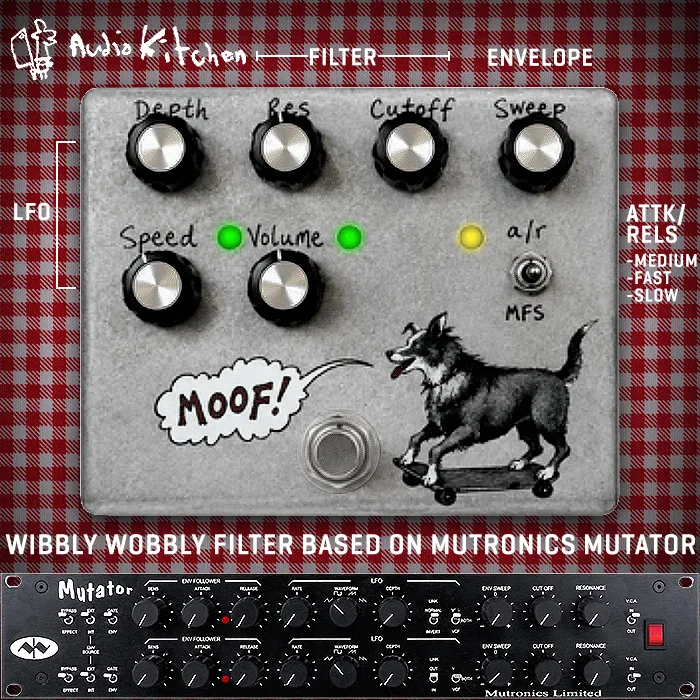

The Audio Kitchen Moof is an analog low-pass filter pedal that brings the character of the classic Mutronics Mutator into a compact, guitar-friendly pedal. It is built around an upgraded version of the SSM 2045 filter design by Dave Rossum, the same filter lineage as the Mutator, and Audio Kitchen says its sound is "remarkably close to the original, delivering the distinctive analogue filter sweeps associated with the Mutator"1.
The pedal is an envelope filter and auto-wah: its envelope follower converts your input signal into a control voltage, so the filter cutoff tracks your guitar's amplitude and playing intensity. Play harder and the filter opens up; back off and it closes down. A built-in LFO can sweep the filter automatically instead, and an expression pedal input lets you control the cutoff by foot1.
Where it came from
Guitar Pedal X reported the release in September 2026, describing it as a Mutronics Mutator-inspired envelope filter and auto wah pedal2. Audio Kitchen had the pedal up for preorder at that point, with shipping estimated for the end of September 20261.
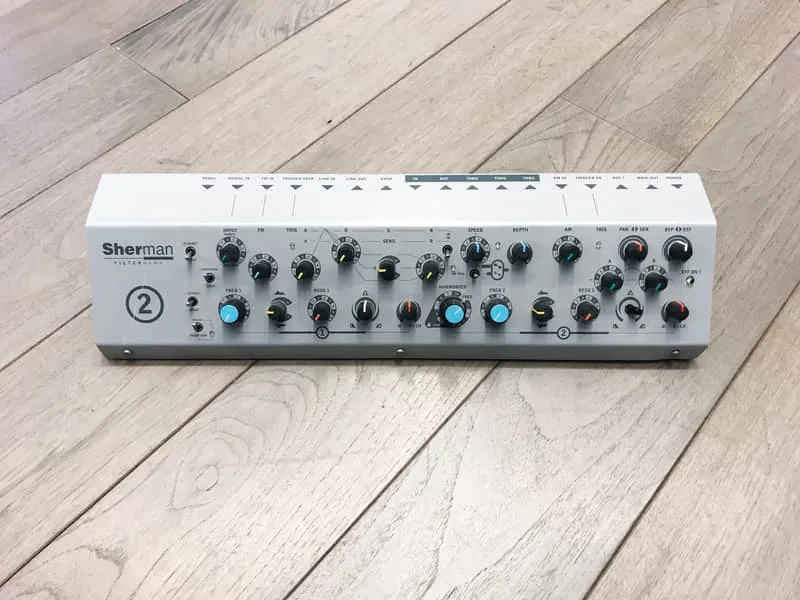
The Mutator itself was a rack unit: a pair of 24dB filters with envelope follower capabilities, well suited to stereo applications, and widely compared with the Sherman Filterbank as its nearest rival3. Where the Mutator had four filters, the Moof has one, enhanced and optimized for guitars and stringed instruments2.
Controls and how it works
The Moof's front panel divides into three sections plus an output trim1:
| Section | Control | What it does |
|---|---|---|
| Filter | Cutoff | Sets the filter cutoff frequency |
| Filter | Res | Sets resonance, the emphasis at the cutoff point |
| LFO | Depth | Sets how far the built-in LFO sweeps the filter |
| LFO | Speed | Sets how fast the LFO sweeps |
| Envelope Follower | Sweep | Sets the sweep direction, up or down |
| Envelope Follower | A/R | Attack/release switch: Fast, Medium or Slow |
| Output | Volume | Output trim, from unity gain up to approx. 3.6x gain |
The three attack and release settings, Fast, Medium and Slow, set how quickly the filter responds to your playing, so you can match the response to fast single-note lines or slower, sustained chords1. The envelope follower's sweep direction control lets the filter open upward from the cutoff point or sweep downward, which changes the character of the effect considerably, from a classic auto-wah chirp to a darker, reversed feel2.
Guitar Pedal X's Stefan Karlsson described the moving filter in the preview:
"This 'moving filter' sounds fantastic - and has a really pronounced wiggle / wobble to its output - kind of like a bubbletron"2
Power and connections
The Moof runs on a standard 9VDC supply at 300mA, with a 2.1mm center-negative plug1.
At 300mA the Moof draws more current than most analog filter pedals, so plan on a dedicated, isolated output from a pedalboard power supply rather than sharing a low-current daisy chain.
Nominal output impedance is under 1KOhm1. The pedal also carries an expression pedal input for cutoff control, so you can perform real-time filter sweeps with an expression pedal instead of relying on the envelope follower or LFO1.
Guitar and bass use
Audio Kitchen lists the Moof as an analog guitar and bass low-pass filter pedal, and the single filter was enhanced and optimized for guitars and stringed instruments rather than carried over unchanged from the Mutator's quad-filter design12. For bass players, that means the filter is voiced with the instrument's range in mind rather than being a synth-oriented rack filter adapted after the fact.
Videos
AudioKitchenAmps and yvette young
Questions
Who designed the Audio Kitchen Moof?
The Moof's filter circuit is built on the SSM 2045 filter design by Dave Rossum, the designer behind the chip used in the original Mutronics Mutator. Audio Kitchen describes the Moof as an upgraded version of that design, enhanced and optimized for guitars and other stringed instruments.
Is the Audio Kitchen Moof based on the Mutron Mutator?
It is modeled on the Mutronics Mutator, a rack filter with four 24dB filters and envelope follower capability. The Moof uses one filter rather than four, built on an upgraded SSM 2045 design, and Audio Kitchen says its sound is remarkably close to the original Mutator.
What power supply does the Audio Kitchen Moof need?
It runs on a standard 9VDC supply at 300mA with a 2.1mm center-negative plug. The 300mA draw is high for an analogue filter pedal, so a dedicated output from a pedalboard power supply is the practical choice rather than a low-current daisy chain.
Can I use an expression pedal with the Audio Kitchen Moof?
Yes. The Moof has an expression pedal input for cutoff control, so you can sweep the filter frequency in real time with your foot instead of relying on the envelope follower or the built-in LFO.
Does the Audio Kitchen Moof work with bass?
Yes. Audio Kitchen lists the Moof as an analogue guitar and bass low-pass filter pedal, and the pedal was enhanced and optimized for guitars and stringed instruments generally, with bass named in the product description.
What is the Audio Kitchen Moof Filter?
An analogue envelope filter and auto-wah pedal in a compact die-cast enclosure. It is a Mutronics Mutator-inspired low-pass filter with an envelope follower that tracks your playing, a built-in LFO, and controls for cutoff, resonance, sweep direction and attack/release response.
Sources (3)
- Audio Kitchen, musically inspiring amp design, Audio Kitchen
- Guitar Pedal X, Guitar Pedal X, 2026-09-02
- Reviews, Sherman (www.sherman.be)