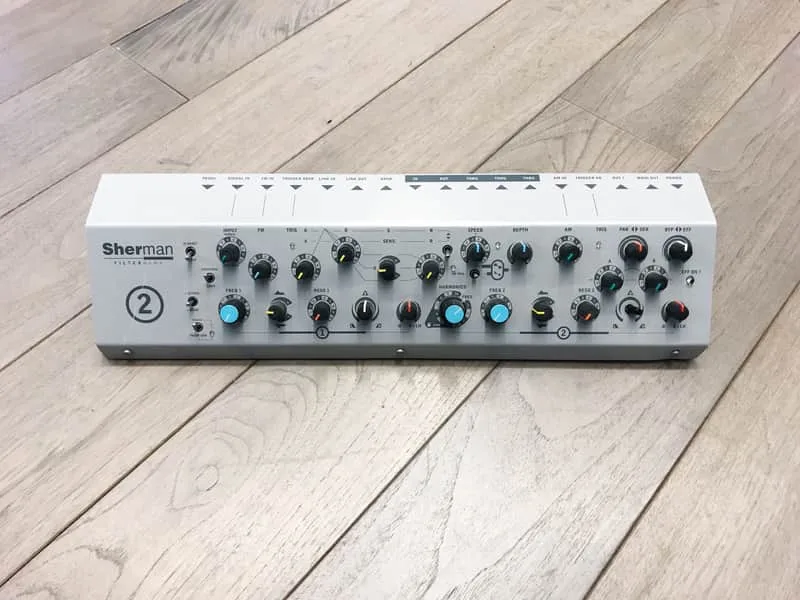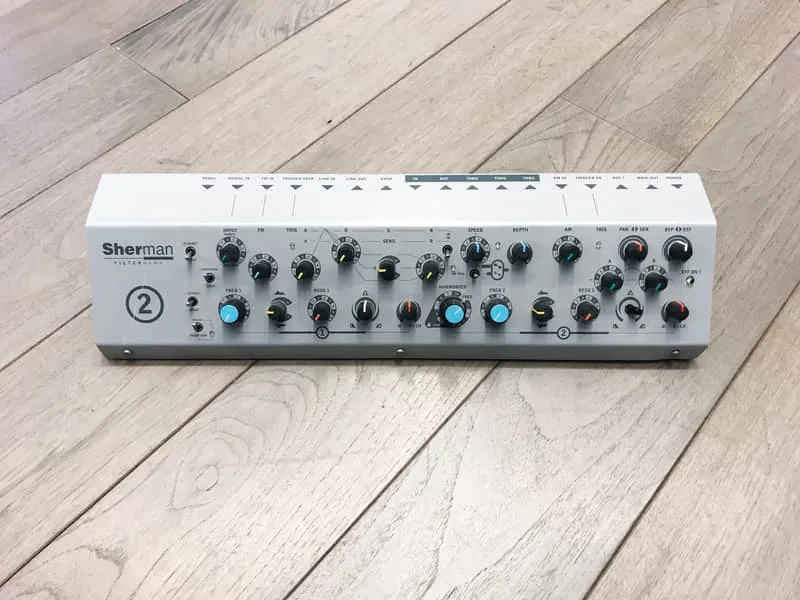


The Sherman Filterbank is an analog filtering and distortion unit in a rack enclosure, first marketed in 1996 by the small Belgian manufacturer Sherman Productions and designed by Herman Gillis12. Sherman describes it as "a powerful analog filtering and distortion unit with a huge frequency range and a killing TUBE overdrive behavior"3. Where a filter pedal shapes one frequency band of a guitar signal, the Filterbank is a dual-filter processor built to sweep, modulate and deliberately mangle whatever you feed into it, from synths and drum loops to guitars.
Vintage Synth Explorer calls it "an excellent musical processing device for creating filter sweeps and effects or damaging your sound"4. The original Version 1 is no longer made and Sherman is sold out, so it is now found secondhand; its successor is the Sherman Filterbank 21.
What the Filterbank does
The Filterbank is a 24dB/octave 4-pole dual filter module with one input and two outputs4. Sherman positions it as a filter first and a distortion box second: the circuit is genuine analog, with what Vintage Synth Explorer describes as "serious overdrive for the grungiest of sounds"4. The overdrive behavior is tube-style rather than the clipping of a distortion pedal or fuzz pedal, and it sits inside the filter stage rather than in front of it.
The filter itself covers hi-pass to low-pass filtering with LFO, ADSR and input signal modulation, meaning the cutoff can be moved by its own envelope, by a low-frequency oscillator, or by the dynamics of the signal passing through it4. Vintage Synth Explorer's reviewer found it "shines when it comes to producing the famous sound of filtered loops," the sweeping, resonant treatment heard throughout late-1990s electronic music4.
Sherman's own framing is that the box is more than a processor. The designer recommends seeing the Filterbank as a musical instrument, and the manual, titled the "Abusers Manual," runs 47 pages with 30 of them filled with educational illustrations5.
Filters, envelopes and routing
The Filterbank gives you independent low-pass, band-pass and high-pass filters, each with resonance, frequency and ADSR controls, and the ADSR can run positive or negative3. The two filters are switchable between parallel or serial routing3, and they can run dual mono or linked for stereo4.
Modulation sources include:
- An LFO that modulates the filter or the envelope4
- An ADSR envelope, with positive or negative response3
- Input signal modulation, where the incoming audio drives the filter4
- 1 FM input for the filters, accepting internal or external audio, LFO or CV6
The Filterbank 2 also accepts CV/GATE signals to control the filters, the ADSR envelope, the FM and AM5. There is no keyboard and no preset memory: settings live on the knobs, and Vintage Synth Explorer notes it "does not feature memory storage for favorite settings"4.
Inputs, MIDI and the rack enclosure
The original Filterbank has no MIDI of its own. The 1996 prototypes had none, and Herman Gillis's later update added MIDI and further features, which became the Filterbank 22. For the Version 1 unit, Sherman states it is "MIDI controllable via kenton control freaks," with the Kenton hardware preprogrammed using profiles for the Filterbank3. Vintage Synth Explorer adds that most important functions can be controlled via MIDI this way4.
The box itself is a white (light gray) 19" rack unit about 10 centimetres thick, with an angled sloping front panel5. Reviewers note it will just about fit into a 2U rack space but looks at home on a tabletop with its industrial look5. Sherman gives the tabletop dimensions for V1 and V2 as 430 mm (19") wide, 110 mm deep and 80 mm high, with a packed weight of 4.3 Kg3.
For the Filterbank 2, Sherman also publishes software support: a MIDI mixer map for Steinberg's Cubase sequencer, and an Instrument Definition and Studioware Panel for Cakewalk7.
History and versions
| Version | Year | Notes |
|---|---|---|
| Filterbank (prototype) | 1996 | Hand-built, 40 pieces, no MIDI2 |
| Filterbank (Version 1) | 1997 onward | About 500 sold in 1997; discontinued and sold out21 |
| Filterbank 2 | 2001 | Reworked panel, gray metal finish, MIDI81 |
The first Filterbanks marketed in 1996 were hand-built, and only 40 pieces were made2. In 1997 about 500 units were sold, in the United Kingdom (London), Belgium, Japan and the Netherlands2. Herman Gillis then updated the prototype with MIDI and added more features at the same time2, and the Filterbank 2 followed, produced from 20018.
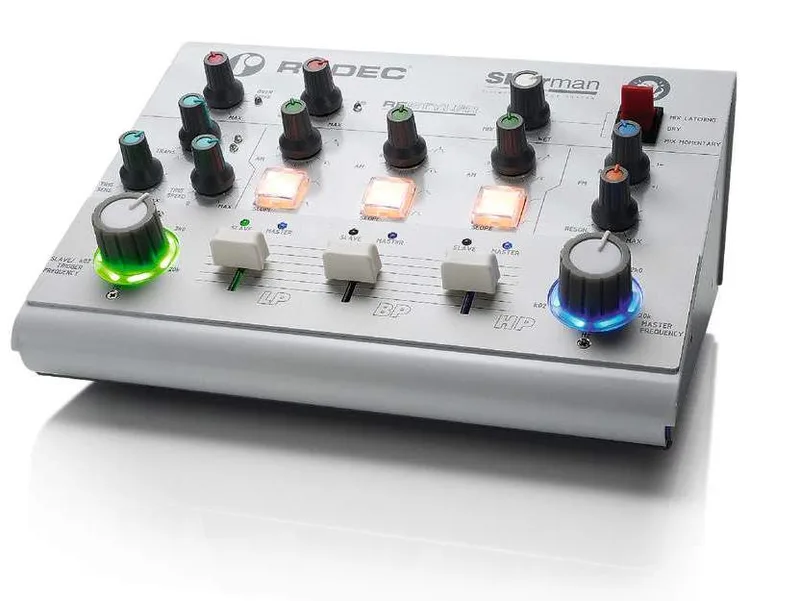
The Filterbank 2 represents what Sherman calls "the next evolutionary step" of the original5, with a reworked front-panel layout and a gray metal color1. From serial number 8280 and higher, all Filterbank 2 models include a range extension function; before that serial number, the Freq2 knob and ADSR amount knob were not used in Harmonic mode6. The update also brought new silver packing boxes with a photo on the upper side, new silver stickers, and new adaptors with the Sherman logo, versus V16. Sherman also later released the Sherman Rodec Restyler.
The original Sherman Filterbank (Version 1) is no longer being made and Sherman is sold out; it has been completely replaced by the Filterbank 21. Anyone buying a Filterbank today is buying the second version or a secondhand original.
Who uses it
Vintage Synth Explorer lists the original Filterbank as being used by William Ørbit, Fluke, Fatboy Slim, BT, Stereolab, The Crystal Method, Groove Armada and The Chemical Brothers4. The Filterbank 2's user list adds The Grid, Leftfield, U2 and Apollo 4408. A February 1997 review noted that Depeche Mode was using it5.
What reviewers said
Published reviews took a positive view of the FilterBank's sound-shaping abilities. One reviewer found that the unit particularly excels at a well-known studio effect, the sound of filtered loops4. The 24dB/oct 4-pole filter, with its low-pass, band-pass, high-pass and notch modes plus resonance and an ADR envelope, gives players a wide range of motion to work with4. One reviewer summarized the unit's standing:
"The Sherman has to be one of the most complex, flexible and great sounding stand-alone filters on the market5."
Sonic State, quoted in Sherman's review pages5
Videos
clubbingtvofficial
TrondC
Gearjunkies
Questions
Does the Sherman Filterbank have MIDI?
The original Filterbank does not have built-in MIDI. The 1996 prototypes had none, and the unit is instead MIDI controllable via Kenton Control Freaks, which were preprogrammed with profiles for the Filterbank. The Sherman Filterbank 2, its successor, adds MIDI IN, OUT and THRU.
Can you use a Sherman Filterbank with guitar?
Yes. It is a stand-alone analog filter with one signal input, so any line-level or instrument source can be fed through it, including guitar. Sherman's own manual, called the Abusers Manual, runs to 47 pages and the designer recommends treating the Filterbank as a musical instrument in its own right.
How many Sherman Filterbanks were made?
The first Filterbanks marketed in 1996 were hand-built in a run of only 40 pieces. In 1997 about 500 units were sold, in the United Kingdom (London), Belgium, Japan and the Netherlands. The original Version 1 is no longer made and is sold out, replaced by the Filterbank 2.
Who designed the Sherman Filterbank?
Herman Gillis, of the small Belgian manufacturer Sherman Productions. The product is described as a pure Belgian product. Gillis later updated the prototype with MIDI and additional features, which became the Filterbank 2.
Can the Sherman Filterbank save presets?
No. The Filterbank has no memory storage for favorite settings, so every sound is set by hand on the knobs and switches. Players who want recallable setups generally pair it with a MIDI controller such as the Kenton Control Freaks.
Sources (8)
- Products, Sherman
- History, Sherman (www.sherman.be), 1996
- Filterbank, Sherman
- Sherman Electronics FilterBank, Vintage Synth Explorer, 2026
- Reviews, Sherman (www.sherman.be), 1997
- Features, Sherman
- Technical Corner, Sherman
- Sherman Electronics FilterBank 2, Vintage Synth Explorer, 2026