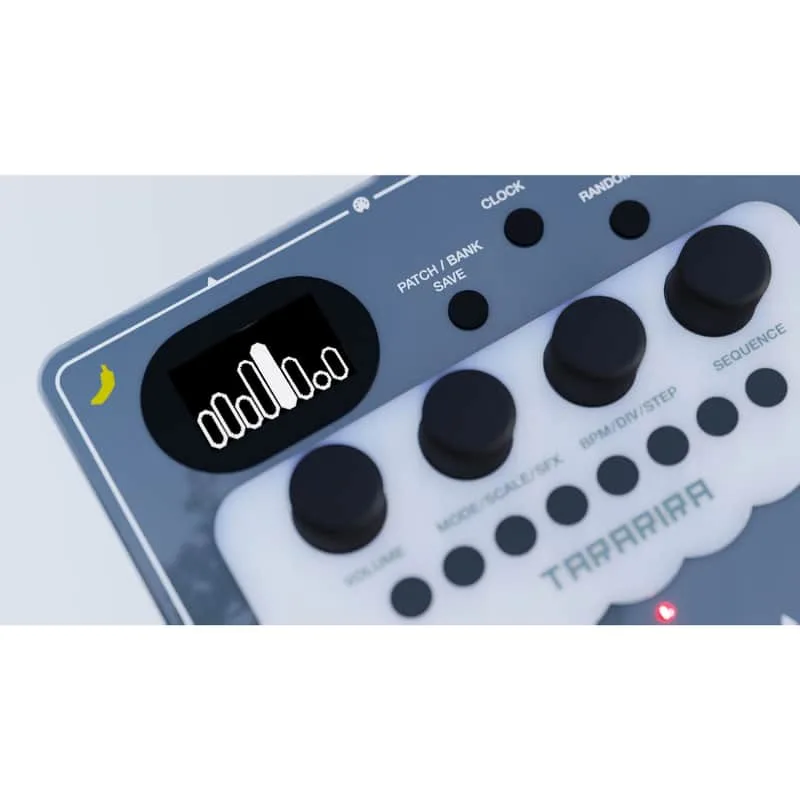


The Bananana Effects TARARIRA is an 8-step pitch-shift sequencer and arpeggiator pedal from Bananana Effects, a Japanese builder the press describes as one that "focuses on designing original effects that spark inspiration"1. Instead of shifting your pitch by a fixed interval like a typical octave or pitch pedal, it sequences pitch shifts across eight steps, so a single note you hold can be transposed to up to three notes per step, with each step assignable to a different scale or chord1. Because it is pitch-shift based, it works with any instrument, including microphone input2.
The pedal was released in February 2021, with Guitar Pedal X reporting the first batch largely sold out at launch1, and Delicious Audio reported it was upgraded to V2 in March 20211. Pedal of the Day revisited it in March 20263.
What it does: an 8-step pitch-shift sequencer
The core idea is an arpeggiator built around an 8-step sequencer "with simple operations that you can easily edit the sequence"5. You program which pitches play at each of the eight steps, and the pedal cycles through them as you play. A single sustained note can be transposed to up to three notes per step, and each step can be assigned to a different scale or chord, which is what turns a held note into a moving arpeggio1.
On top of the sequence itself, the pedal offers 9 sequence effects, which RockBoard's PedalPedia describes as useful for tricky performances5. A random function toggles between sequential and random playback, and when random is on, the same step will not play twice in a row6.
The modes and scales
The MODE knob selects from 8 modes, which the maker says range "from practical to experimental sounds"26.
| Mode | What it does |
|---|---|
| Normal | Pitch-shifter based arpeggiator mode; a tone filter can be applied6 |
| Sine | Requires a monophonic (single note) input6 |
| Sine Hold | Requires a monophonic (single note) input6 |
| Organ | Mixes the pitch shift with 5th harmony for a resonant, organ-like tone1 |
| Hold | Temporarily holds the sound playing when turned on and shifts its pitch6 |
| Glitch | Samples the input in a short time and sequences the output at different playback speeds and directions6 |
| Square | Converts the input to a square wave and shifts its pitch; the maker says it recalls retro game sounds and fuzz tones1 |
| Toy Box | Switches between 8 mini-effects using a sequencer6 |
The scale system is where the musical control lives. The SCALE knob offers 27 different scales plus 3 user-editable scales6. The built-in options include the church modes (Ionian, Mixolydian, Dorian, Aeolian, Phrygian, Locrian, Lydian), Major Penta, Minor Penta, and a set of stacked-interval scales such as Major & 5th, Minor & 5th, Oct/4th & 5th, Oct/5th & 6th, Oct/5th & 7th, Oct & 5th, and 4th/5th & 9th6. The 3 user scales let you edit the scale as you like, from two octaves down to the 5th of an upper octave6. Scales are not used in Glitch or Toy Box mode6.
An OPTION VOLUME knob adjusts a different control depending on the mode: Filter in Normal, 5th Mix in Organ, Root Mix in Hold and Square, and Oct Mix in Sine6.
The controls: three footswitches, knob and touch key
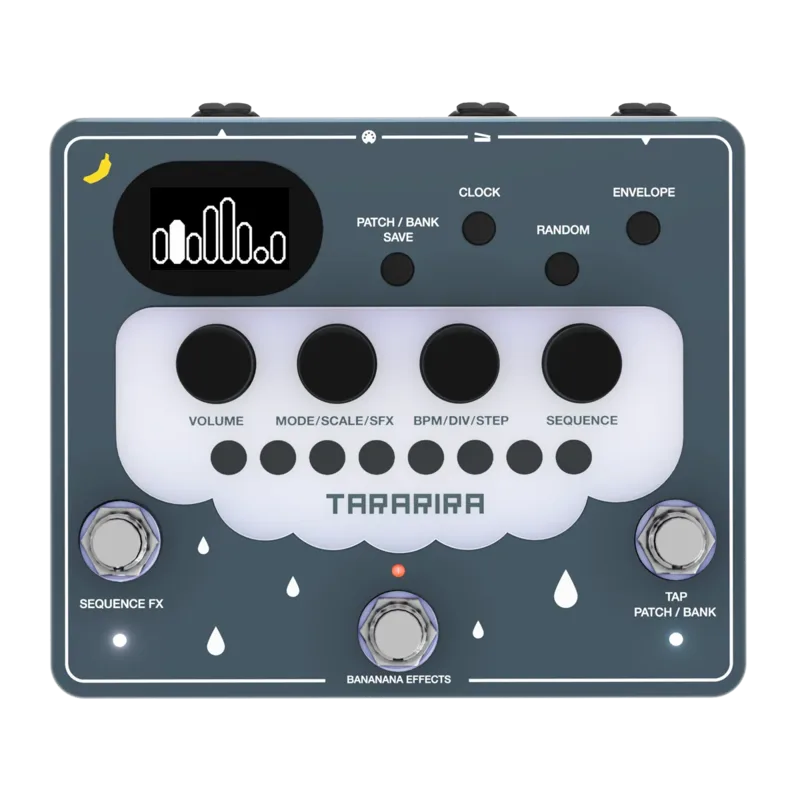
The pedal has 3 footswitches: the middle one is On/Bypass, the left activates Sequence FX, and the right is Tap-Tempo and Patch/Bank4. A mini OLED display is, in Guitar Pedal X's words, "where all the magic is controlled"4.
Editing happens through a push-rotate knob (PUSH switches pages, ROTATE changes parameters) and a touch key, along with two small tact switches6:
- ENVELOPE tact switch: changes the envelope, chosen from four types6
- RANDOM tact switch: turns random progression on and off6
- CLOCK button: selects the clock source6
The pedal saves up to 9 presets in 3 banks and 3 patches6, and a quick-change function lets you switch between presets with just a footswitch while playing, by holding the TAP switch6.
MIDI sync and expression control
The CLOCK button selects from five clock sources6:
- INTERNAL CLOCK
- MIDI CLOCK SYNC
- MIDI NOTE CONTROL
- EXP.PEDAL CONTROL
- TOUCH KEY CONTROL
MIDI CLOCK SYNC synchronizes the pedal with the clock signal from an external MIDI device such as a DAW; the manual notes the master side should output only the clock signal for accurate synchronization6. MIDI NOTE CONTROL goes further: note signals from an external MIDI device control the sequence directly, with MIDI notes C0 to C1 corresponding to pitches 1 to 86.
An expression pedal can be connected to sweep step-by-step through the sequence's pitches, which the maker describes as a sequence-driven pitch shifter under pedal control26. Players using an expression pedal this way get manual access to the same pitches the sequencer cycles through automatically.
Firmware updates
Updates are done over USB from a web browser using WebUSB, which communicates with the hardware directly from the browser6. The maker's procedure7:
- Disconnect all cables, unscrew the back of the unit, and remove the back cover.
- Connect the unit to the computer via Micro-USB.
- While holding down the RANDOM and ENVELOPE buttons, insert the power cable.
- Run the update from the browser.
The firmware updater only supports Chromium and Google Chrome browsers7, and the update requires opening the pedal's back cover first7.
Power
The TARARIRA runs on DC 9V, center negative only, and the manual says to use an adapter with 200mA or more of current capacity6. A Micro-USB jack in the center of the base is used for the power cable connection during firmware updates7.
What reviewers said
Guitar Pedal X's Stefan Karlsson, reporting on the 2021 release, wrote:
"Generally I'm very impressed by this innovative device, while I'm not yet 100% sure that it's entirely for me"4
He called it a wishlist item of undetermined priority, "kind of 50:50 for him right now"4.
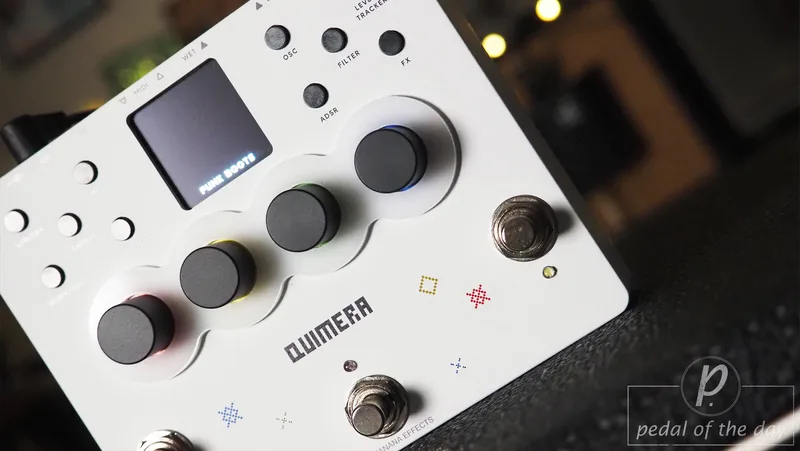
Pedal of the Day's reviewer, writing in March 2026 after also checking out the maker's QUIMERA Polyphonic Synthesizer Sampler, found that "while these two are completely different, they share a love of experimentation and sonic wonder," and was convinced by the pedal after playing it overall3.
Videos
BanananaEffects
Jake Cloudchair
Emily Hopkins
Questions
How is the Bananana TARARIRA powered?
It runs on DC 9V with a center negative plug only. Bananana Effects says to use an adapter with at least 200mA of current capacity, and the manual warns against anything less. A Micro-USB jack on the base is used for firmware updates over USB.
Can the TARARIRA sync to a DAW?
Yes. MIDI CLOCK SYNC synchronizes the pedal with the clock signal from an external MIDI device such as a DAW, and the manual notes the master device should output only the clock signal for accurate synchronization. An external MIDI keyboard can also control the sequence by note, with MIDI notes C0 to C1 corresponding to pitches 1 to 8.
How many presets does the TARARIRA hold?
It saves up to 9 presets, organized as 3 banks of 3 patches. A quick-change function lets you switch between presets with just a footswitch while playing, by holding the TAP switch.
How do you update the TARARIRA firmware?
Disconnect all cables, unscrew and remove the back cover, connect the unit to a computer by Micro-USB, then hold the RANDOM and ENVELOPE buttons while inserting the power cable to enter update mode. The update itself runs through a web browser using WebUSB, and only Chromium and Google Chrome browsers are supported.
Is the TARARIRA buffered bypass?
Yes. Bananana Effects lists the TARARIRA as buffered bypass, so your signal passes through the pedal's circuitry even when the effect is off.
Sources (7)
- Bananana Effects TARARIRA Pitch Shift Sequencer V2, Delicious Audio, 2021-03-18
- TARARIRA, Bananana Effects
- Bananana Effects TARARIRA Arpeggiator Pitch Shifter Sequencer, Pedal of the Day, 2026-03-29
- Guitar Pedal X, Guitar Pedal X, 2021-02-11
- Tararira by Bananana Effects, RockBoard PedalPedia, 2026
- MANUAL_TARARIRA, Bananana Effects
- TARARIRA Firmware Updater, Bananana Effects