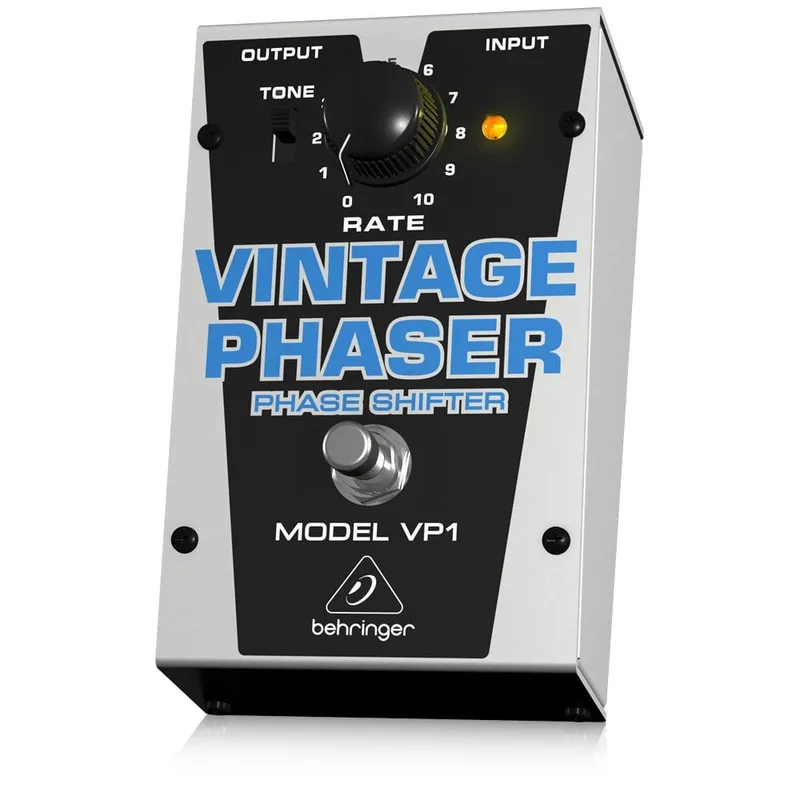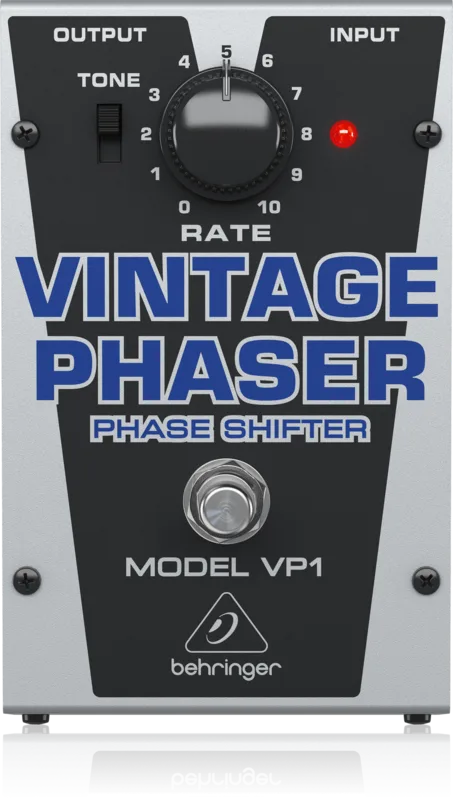



The Behringer VP1 is a compact phaser pedal, which the maker bills as an "Authentic Vintage-Style Phase Shifter"1. Behringer describes it as delivering "Authentic and classic 3-dimensional phase shifting", covering "everything from whirling speakers to impressive jet plane effects"1. It keeps things simple: one knob, one switch and one footswitch, which makes it a straightforward first phaser or a set-and-forget modulation on a larger board.
Controls
The VP1's control layout is minimal, and each control does one job:
| Control | What it does |
|---|---|
| Rate | Dedicated control for fine-tuning the speed of the phase shift1 |
| Tone switch | Separate switch for fine-tuning the tone1 |
| Footswitch | Activates the effect, confirmed by a blue LED1 |
The VP1's front panel is kept simple, in keeping with its vintage-style phaser design1. A blue LED tells you when the effect is activated, so you can see at a glance whether the phaser is in the signal path1.
Power and bypass
The VP1 runs on a 9 V battery, or on Behringer's PSU-SB DC power supply, which is not included with the pedal1. The PedalPedia listing for the Vintage Phaser VP1 gives the DC input as 9V DC, center negative2, so it will work with a standard center-negative pedalboard supply.
The PSU-SB power supply is not included in the box, so budget for one if you plan to run the VP1 from a power supply rather than a battery1.
When the effect is off, Behringer says the "physically hardwired true bypass maintains crystal-clear signal integrity"1, meaning your guitar's signal passes through untouched.
On bass and keyboards
Behringer positions the VP1 beyond guitar: "The VP1 sounds great on guitars, basses, and keyboards"1. For players running synths or bass through modulation effects, that makes it one of the phasers the maker explicitly covers for those instruments.
Where it sits in Behringer's phaser range
The VP1 is the simple, vintage-flavored option in Behringer's phaser range, marketed by the company as the "Authentic Vintage-Style Phase Shifter"1. It sits alongside Behringer's other phaser designs as the compact, single-effect take on the sound, with the blue activation LED as its only indicator1.
Videos
World Music Supply
Ryan Lutton
Guitar Strategies
Questions
Is the Behringer VP1 true bypass?
Yes. Behringer describes the VP1 as having physically hardwired true bypass, which the company says maintains crystal-clear signal integrity when the pedal is off. Independent press has also noted true bypass switching on the related Rockready VP-1 Vintage Phase design, which features true bypass switching and sturdy metal enclosures.
Does the Behringer VP1 run on a 9V battery?
Yes. Behringer says you can power the VP1 with a 9 V battery or its PSU-SB DC power supply. The PedalPedia listing gives the DC input as 9V DC, center negative, so a standard center-negative supply works if you prefer not to use a battery.
Does the Behringer VP1 come with a power supply?
No. Behringer states that the PSU-SB DC power supply is not included with the VP1. The pedal runs on a 9 V battery out of the box, and the PSU-SB is sold separately if you want to run it from a power supply.
Can the Behringer VP1 be used with bass or keyboards?
Yes. Behringer's product page says the VP1 sounds great on guitars, basses and keyboards, so it is not limited to six-string use. Players running synths or bass through modulation pedals will find it presented as a suitable option by the maker.
What does the Tone switch do on the Behringer VP1?
The Tone switch sits alongside the Rate control and is used for fine-tuning the tone. According to gearnews.com's Adam Douglas, flicking the Tone switch up engages a resonant peak, which sharpens the phaser's character, while the Rate knob sets the modulation speed.
Sources (2)
- VP1 | Behringer, Behringer
- Vintage Phaser VP1 by Behringer, RockBoard PedalPedia, 2026