

The Binson Echorec is a vintage Italian echo machine that creates its repeats with a rotating magnetic drum rather than a tape loop. Made in Milan by the Binson Amplifier Hi-Fi company from the 1950s onward, it records the guitar signal onto the spinning drum with a record head and plays it back through several playback heads spaced around the drum, giving single or multi-tap delays with a distinctive rhythmic character12. It is one of the classic delay designs, and its sound has been chased by pedal makers ever since.
The Echorec is most closely associated with Pink Floyd, thanks to Syd Barrett's and David Gilmour's use of the units, and T-Rex also names Hank Marvin among its famous users34. Its most famous single appearance is probably the drum sound on Led Zeppelin's "When The Levee Breaks", which was the Echorec and not the sound of the room at Headley Grange5.
A drum echo built on a rotating magnetic drum
Where a tape echo like the Echoplex records onto a loop of tape, the Echorec writes the signal onto a metal drum coated with magnetic material, which spins at a fixed speed. A record head writes, and playback heads positioned around the drum read the signal back at different times depending on their distance from the record head6. Because the drum speed is fixed, the delay time is fixed too: the original Echorec tops out at 300ms on the fourth playback head10.
The spacing of the heads is what gives the Echorec its musical character. Strymon's history of the drum echo explains that head one gives a 16th note delay, head two an 8th note, the third head a dotted 8th note, and the fourth head a quarter note, so selecting combinations of heads produces rhythmic multi-tap patterns rather than a single plain repeat3.
The sound is shaped by the electronics around the drum. Magnetic drum echoes are famous for their warmth and harmonically rich, saturated sounds, and on the most sought-after Echorec units there were tubes in the input buffer, the signal mixer, the record and playback amplifiers, the tone shaping circuit, and the output mixing circuit3. The version 2 Echorec ran on six 12AX7 tubes1.
Because the machine has moving mechanical parts, no two vintage units sound quite alike. T-Rex, which studied the originals for its own reproduction, notes that each unit had its own voice, its own flutter, warmth, and feedback behavior4.
The controls and playback heads
The heart of the Echorec's control surface is a twelve-position switch on the front panel that selects different combinations of active and inactive playback heads3. The original had a 12-position rotational switch used to select different playback heads and combinations for single and multi-tap delay12.
The version 2 machines also carried a "Selector" knob that delivered three different effects1:
- Echo: slapback delay
- Repeat: regular delay mode
- Swell: delays with overlaps, which behaves like feedback, and its length is adjustable13
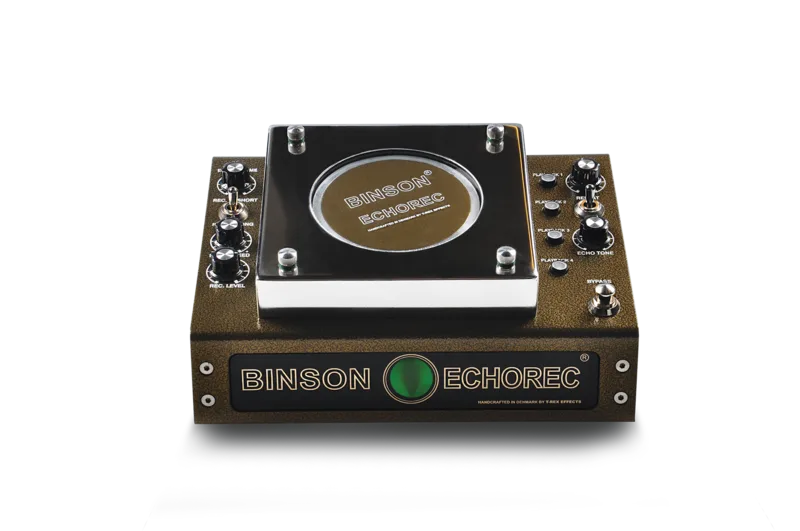
On the T-Rex reproduction, which follows the original's layout, the full control set runs to Echo Volume, a switch for Record Head 1 or Record Head 2, Drum Speed, Record Level, Playback Heads 1 to 4, Repeat, a switch for Repeats and Swell, Echo Tone, and a Bypass switch with indicator4. MusicRadar's news coverage of that pedal describes the same idea from a player's angle: four selectable playback heads, a tone dial for EQing the repeats, and an input stage where you choose between two recording heads, one short like the original and one long14.
Versions from the 1950s onward
Version one of the Echorec was released in 1953, and Binson followed it almost immediately after 1958 with the Echorec 2, which was also sold under other names including the Sound City Echo2. The most popular version was probably the second one, released in 19601. Binson produced several iterations over the years, including the Echorec 2, the Echorec Baby, and eventually six-head solid state models3. There were a number of very different models from the 1950s, '60s and '70s15.
| Version | Notes |
|---|---|
| Echorec (version one) | Released 19532 |
| Echorec 2 | Released shortly after 1958; also sold as the Sound City Echo; David Gilmour of Pink Floyd used one2 |
| Echorec 2 T7E | Released 1960; the most popular version; four-tap tube magnetic echo with a 12-position rotational switch for playback head selection112 |
| Echorec Baby | Mid-1960s multi-head magnetic drum echo unit13 |
| Solid state models | Six-head versions, later in the production run3 |
The Echorec today
Original Echorecs are expensive and demanding. Guitar World reported prices ranging from $3,000 to $7,000 for the originals in 2023, depending on condition and model11, and Tone Island's 2026 guide notes that original units can set you back over $2,000 and require significant maintenance9.
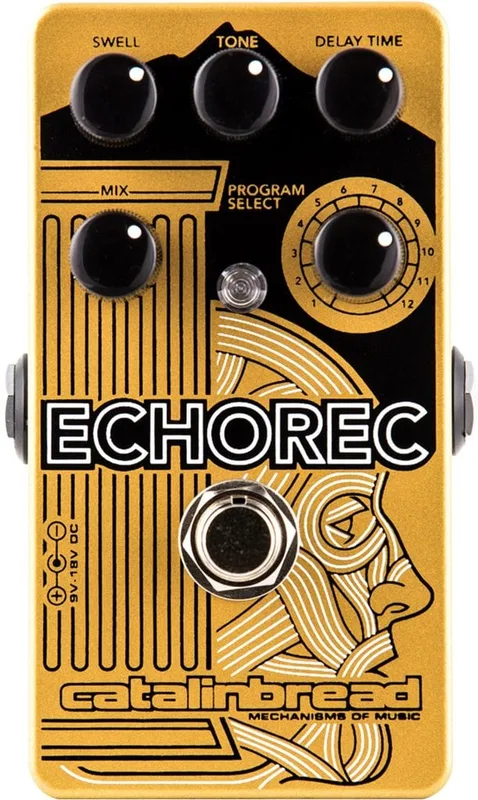
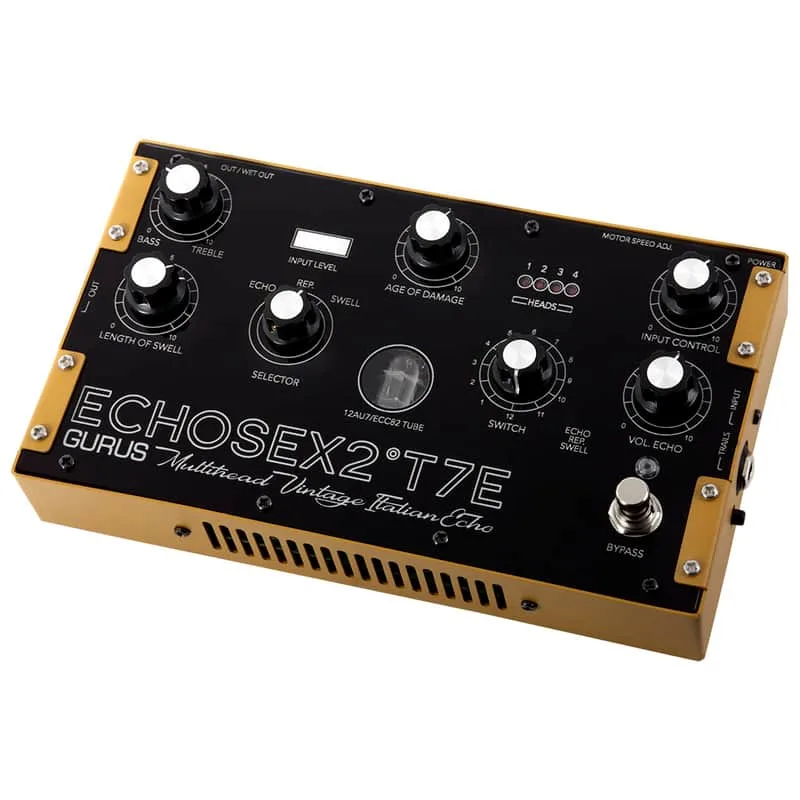
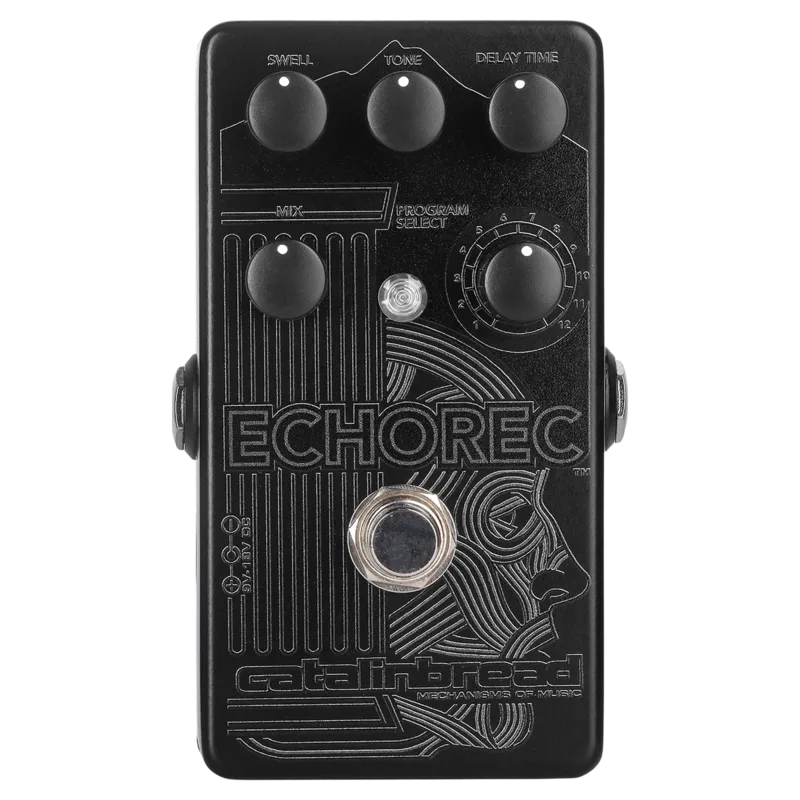
That has made the Echorec a favorite for modern makers to revisit. Modern options include the T-Rex Binson Echorec, a reproduction of the original circuit complete with spinning drum11; the Catalinbread Echorec, a digital pedal take on the drum echo sound111617; the Gurus Echosex 2° T7E, which carries all the features and controls of the old Echorec 2° T7E model; and the Dawner Prince Boonar, another pedal built around the Echorec's magnetic drum echo design111617.
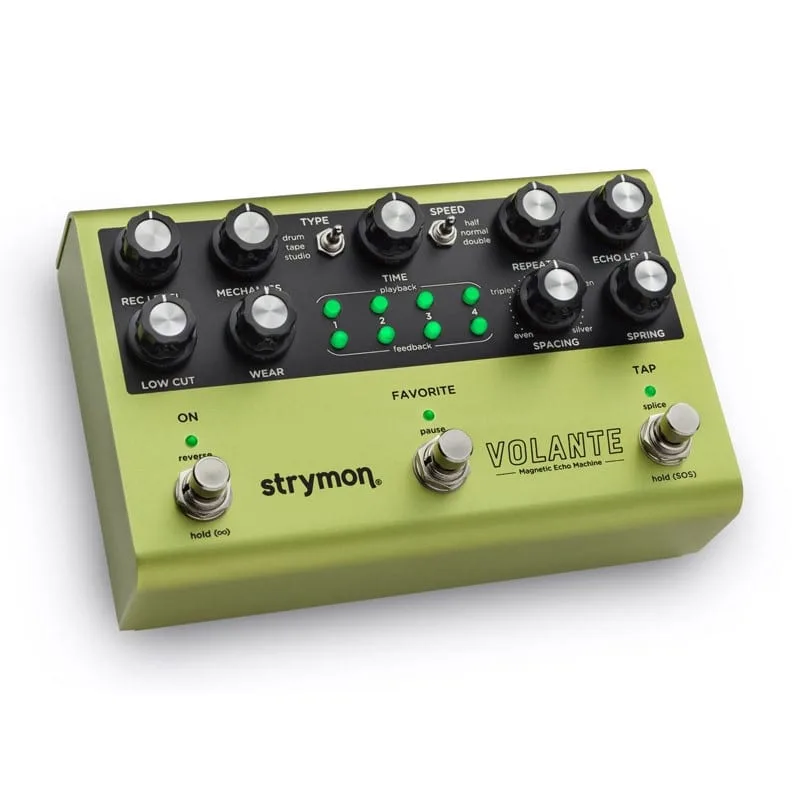
On That Pedal Show, a 2023 episode demoed the new T-Rex unit, which the presenters described as "a genuine multi-head magnetic drum echo made by the laudable people at T-Rex in Denmark", alongside a vintage mid-60s Echorec Baby13. A later episode compared the Echorec-style pedals against each other, including both Boonar versions, the T-Rex, the Catalinbread and the Strymon Volante18.
Rhett Shull's video on the Echorec covers the machine's history and its famous uses, including the "When The Levee Breaks" drum sound5.
Videos
Bob's Tone Review
Sean Callanan
That Pedal Show
News
Questions
How does the Binson Echorec work?
A record head writes the guitar signal onto a steel drum that spins at a fixed speed, and up to four playback heads spaced around the drum read it back at different times. Selecting combinations of those heads gives single or multi-tap delays. A tube circuit with six 12AX7 tubes handles the input, record and playback amplifiers, tone shaping and output mixing.
How long is the maximum delay on a Binson Echorec?
About 300ms, reached on the fourth playback head. The drum spins at a fixed speed, so unlike a tape echo there is no delay-time control; the different delay times come from which playback heads are active, with the first head giving a 16th note delay and the fourth a quarter note.
Does the Echorec use tape?
No. The Echorec records onto a rotating magnetic drum rather than a tape loop, which means no tape to wear out or replace, and a fixed drum speed. That is the main technical difference from tape echoes like the Echoplex, and it is why the delay time tops out around 300ms.
How much does an original Binson Echorec cost?
Original units are expensive. Guitar World reported used prices ranging from $3,000 to $7,000 in 2023 depending on condition and model, and Tone Island notes originals can set you back over $2,000 and require significant maintenance. The T-Rex reproduction, released in 2023, retailed at $2,100.
Which famous recording used an Echorec?
The most famous use is the drum sound on Led Zeppelin's When The Levee Breaks, which came from an Echorec rather than the sound of the room at Headley Grange. The unit is also closely associated with Pink Floyd, through Syd Barrett and David Gilmour, and with Hank Marvin of The Shadows.
Sources (18)
- The Best Binson Echorec Pedal Clones In 2024, Delicious Audio, 2024-06-24
- ULTIMATE HISTORY OF TAPE ECHO, JHS Pedals
- What is a Drum Echo?, www.strymon.net, 2019-03-13
- → T-REX EFFECTS ← Pedals for guitar and bass players!, T-Rex Effects
- Should You Buy A Strymon Volante?, youtube.com (Rhett Shull channel), 2019-03-01
- Tel-Ray Ad-N-Echo, Catalinbread Effects, 2021-08-06
- All About… Echo, Guitar.com, 2015-09-22
- Strymon Volante Magnetic Echo Machine review, MusicRadar, 2019-05-29
- The Best Binson Echorec Pedal Clones For 2026, Tone Island (toneisland.com), 2026
- ECHOREC (Blackout Series), Catalinbread Effects
- NAMM 2023: T-Rex unveils stunning $2,100 Binson Echorec reproduction, Guitar World, 2023-04-14
- BOONAR Multi-Head Drum Echo, Dawner Prince Electronics
- T-Rex Binson Echorec Vs Vintage Baby Rec, Volante, Boonar, Catalinbread Echorec & Boss DD-200, That Pedal Show (YouTube), 2023-11-10
- NAMM 2023: T-Rex Effects brings the Binson Echorec back to life with a spectacular $2,100 reproduction, MusicRadar, 2023-04-14
- Real Binson Echorec vs Catalinbread, Boonar & Echosex, That Pedal Show, 2017-03-03
- Echoplex, Stompbox Book (stompboxbook.com), 2019-03-03
- Gurus Amps Presents the Echosex 2° T7E, Premier Guitar, 2017-07-24
- The Best Echorec-Style Delay Pedal? Both Boonars, T-Rex, Catalinbread & Strymon, That Pedal Show, 2025-09-05
 David Gilmour