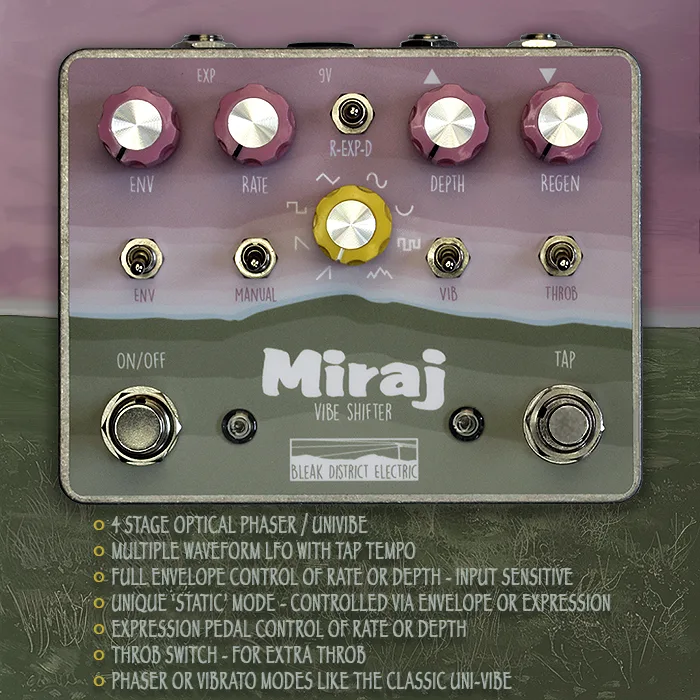


The Bleak District Electric Miraj is a dual-mode, tap-tempo analog modulation pedal handmade in the UK that can recreate the sound of two classic vintage effects: the Uni-Vibe and the Phase 901. At its heart it is an all-analog, four-stage optical phase shifter, using a similar LED/LDR mechanism to the original Uni-Vibe, where a light-dependent resistor changes value as an LED pulses, sweeping the phase notches across your tone2.
A toggle switch lets you enter the pedal's "Uni" and "90" modes, shifting between those well known tones, while a second switch selects phaser or vibrato operation. Delicious Audio's Paolo De Gregorio noted one naming quirk: the Phaser/Vibrato toggle "confusingly named 'Phaser/Vibrato,' simply removes the clean signal in the Vibrato setting"1. In vibrato mode there is no dry signal blended in, so you hear the full shifted waveform rather than the notched, phased blend.
Uni and 90 modes: the circuits behind them
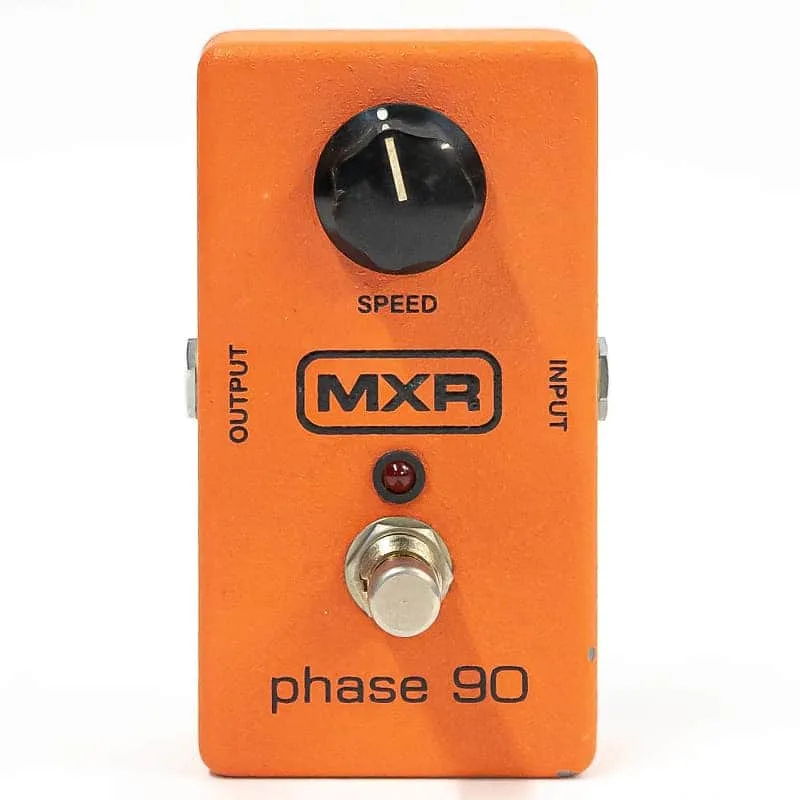
The Miraj's original design brief was to deliver the best of the Phase 90 and Uni-Vibe in the same circuit and enclosure2. The Uni mode is based on the Univibe and the 90 mode on the Phase 90, so a single toggle moves you between the thick, vocal swirl of the four-stage optical vibe circuit and the tighter, more aggressive sweep of the classic script-phase sound1.
Both circuits are phase shifters, but they feel different to play. The Uni-Vibe lineage gives the Miraj its optical LED/LDR core, the mechanism that makes a vibe pulse and breathe rather than sweep mechanically2. The Phase 90 side brings the familiar focused notch movement players know from countless rock records. Regen acts as a modulation intensity control that can lead to self-oscillation at higher settings, pushing the pedal from gentle movement into a frantic to-ing and fro-ing of phase shift1.
Controls and waveshapes
The original Miraj gives you eight different waveshapes for the LFO, which is far beyond what either vintage circuit offered1. The V2 edition, released in April 2024, expands the control count from 7 to 102.
| Control | What it does |
|---|---|
| Rate | Sets the speed of the sweep2 |
| Depth | Sets how deep the modulation goes2 |
| Regen | Modulation intensity, self-oscillates at high settings1 |
| Volume | Output level2 |
| Univibe / Phase 90 switch | Selects the Uni or 90 mode1 |
| Phaser / Vibrato switch | Selects the core effect2 |
| Waveshape | Chooses among 8 LFO shapes1 |
| Tap footswitch | Sets the rate to match a song's tempo1 |
The V2's control set adds Envelope, an EXP switch (Rate / Off / Depth), an Envelope switch (Depth / Off / Rate), a Regen/Feedback control, a Manual On switch, and a Waveshape selector offering Ramp Up, Ramp Down, Square, Triangle, Sine, Lumps, Random, and Stepped shapes2. Full details are on the Miraj 4-Stage Vibe V2 page.
The V2's manual mode gives you a range of static phase tones, or lets you control the phase shifting directly with an expression pedal or your playing dynamics2. Its envelope feature drew particular praise from Guitar Pedal X's Stefan Karlsson:
"The Envelope itself is superb - how you can vary the Rate or Depth via your playing style and pick-attack - I have a couple of tremolos that do similar things to great effect."2
Expression, tap tempo, and power
Use the EXP TRS input to adjust the rate on the fly with an expression pedal, which is useful for swelling into a solo or pulling the sweep back for a verse1. The Tap footswitch sets the rate to match the tempo of a song, so you are not stuck hunting for the right knob position mid-set1.
Power is 9V DC center-negative, and the supply is not included, so plan on a spot on your pedalboard power supply1.
Who it suits
Delicious Audio found the Miraj offers a wide range of sounds suiting many genres, from heavy blues to classic rock, shoegaze to metal1. Whether you want a subtle swirl, a deep throb, or full self-oscillating chaos, the pedal covers that range2. For players weighing it against other modulation options, it sits in the phaser family while borrowing heavily from the vibrato side of the fence.
Videos
Bleak District Electric
Pedal Experiments
Gigs & Guitars
Questions
Is the Bleak District Electric Miraj a Uni-Vibe clone?
Not exactly. The Miraj is a four-stage optical phase shifter that borrows design elements from both the Uni-Vibe and the MXR Phase 90, and its Uni and 90 modes let you shift between those two well known tones. It uses a similar LED/LDR mechanism to the Uni-Vibe, but it adds tap tempo, eight waveshapes, and expression control that the originals never had.
Does the Miraj have tap tempo?
Yes. A dedicated Tap footswitch sets the rate so you can quickly and easily match the tempo of a song, and the pedal's LFO offers multiple waveforms with tap tempo. That is a significant step beyond the fixed-speed originals it draws from.
Can I use an expression pedal with the Bleak District Miraj?
Yes. The original Miraj has an EXP TRS input for adjusting the rate on the fly with an expression pedal. The V2 edition adds an EXP switch that selects whether the expression pedal controls Rate, Depth, or is switched off entirely.
Does the Bleak District Electric Miraj come with a power supply?
No. The Miraj runs on 9V DC center-negative power, and the power supply is not included, so you need to supply your own. It is a standard pedalboard power arrangement.
Is the Bleak District Electric Miraj true bypass?
Yes, the Miraj is true bypass, so with the effect switched off your dry signal passes through without active buffering.
Sources (2)
- Bleak District Electric Miraj, Delicious Audio, 2022-08-21
- Guitar Pedal X, Guitar Pedal X, 2024-04-26